
By Paul A. Djupe and Brooklyn Walker
[Image credit: Mother Jones]
If there’s one thing we thought we could count on in the social scientific study of religion, it was the gender gap in religious identity and involvement. True across the world for a long time, it has been a staple of American religion too. Except where there are religious prohibitions against women’s religiosity in public, women tend to be more religious than men and have historically done the day-to-day work to maintain congregations.
That’s why the new Pew Religious Landscape report was so surprising. Set in the context of a leveling off of Christian decline, they also show that the gender gap has been erased in the youngest adult generation – Gen Z. They don’t really say anything else about it, though, and there are so many questions. It’s not as though Pew is the only survey organization to notice this change. The Survey Center on American Life also found that men are being drawn to church, though their analysis focused on the push factors driving women from the pews, staying silent on the pull factors drawing men in.
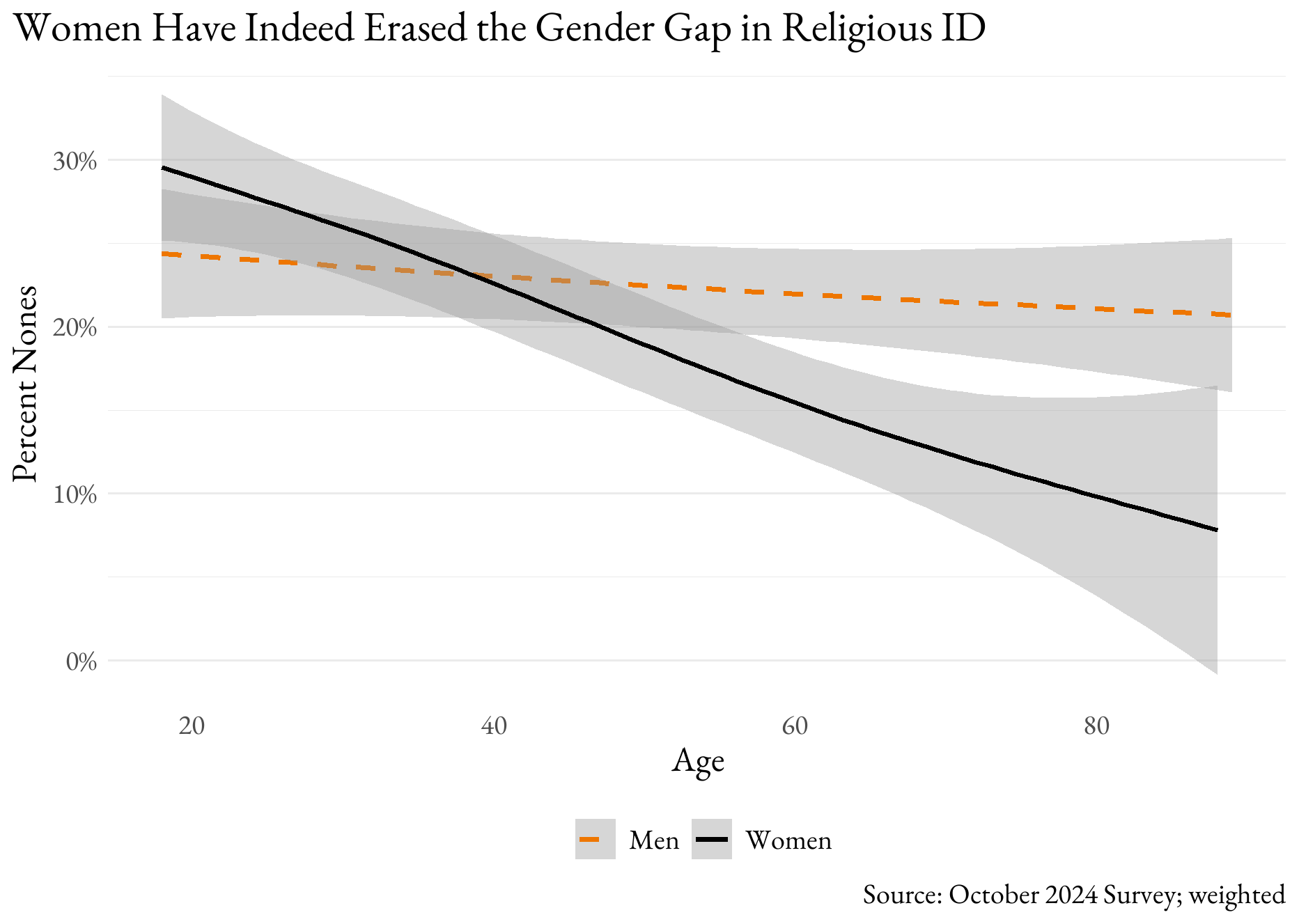
Using our own data collected in October 2024, we can confirm that men and women’s relationship to religion appears to be shifting. Below, for instance, is a look at how identification as a religious none shifts across age in the sample differently for men and women. There is little variation across age for men, but younger women are clearly more likely to be nones than older women. And women under 40 identify as a religious none at higher rates than men. These estimates are smoothed, but we did not impose linearity – the results look linear because they are linear naturally in the data. Also, because the sample is on the small side (n~2500), we do not wish to suggest taking these results literally – instead we are just confirming that the gender gap looks to be erased and perhaps even flipped among younger Americans across multiple samples.
To date, researchers are not showing the distinctiveness of the young religious men who are bucking expectations. For this we turned to a survey of Christians that we conducted in January 2024 (n~1500) that is weighted to resemble the national distribution of Christians.
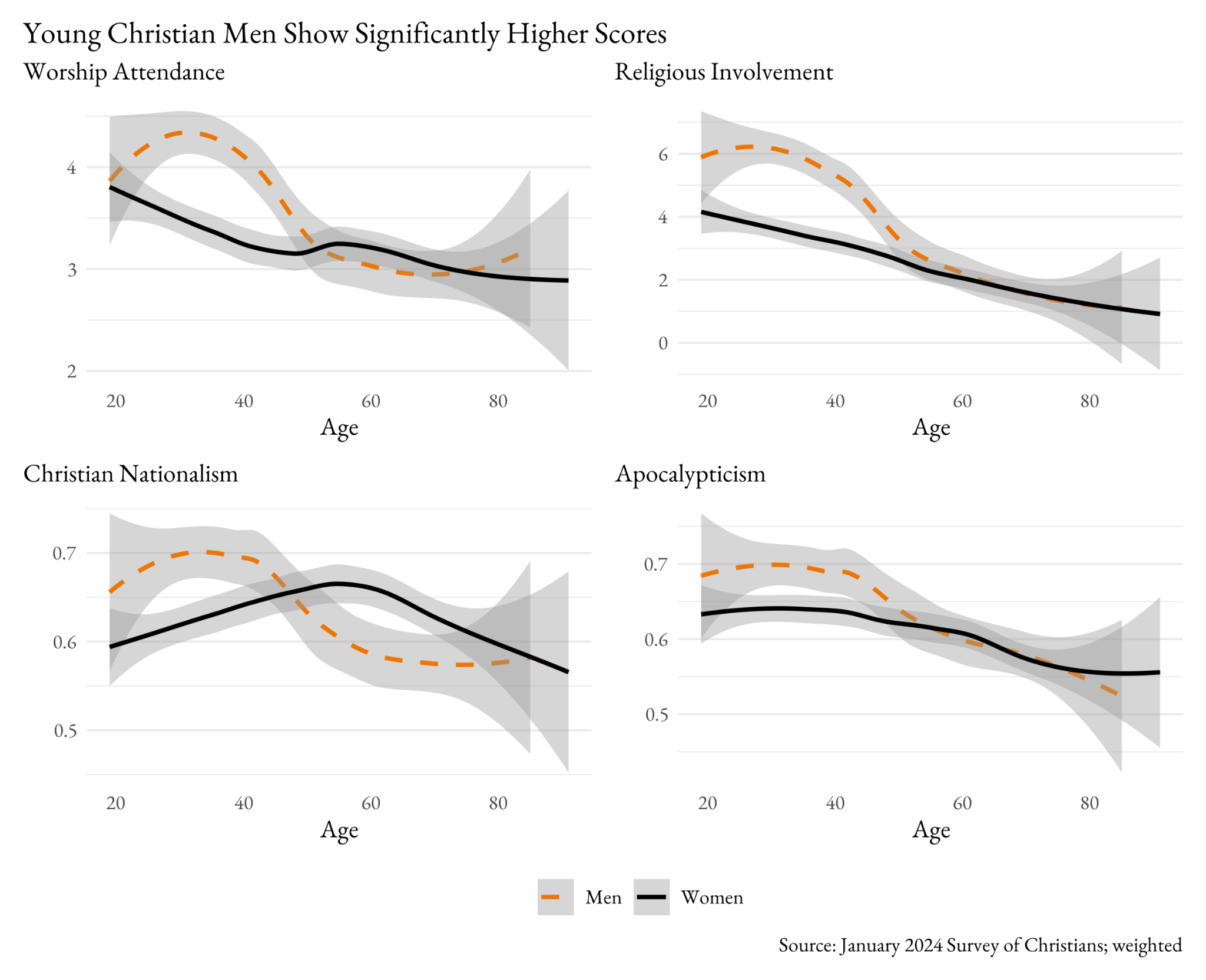
Not only are young men equally or more likely to be involved with religion, but the nature of their involvement and commitments are distinctive. As shown below, young Christian men attend religious services more often than young Christian women and more often than older Christian men. But it’s not just showing up to church. This pattern repeats when it comes to religious involvement beyond worship, for which young men are involved in 2-3 more groups and activities than women – that’s 50 percent more. The differences do not end there as we also find that young Christian men have stronger Christian nationalist worldviews (measured using the Whitehead and Perry scale), and higher concentrations of apocalypticism (as measured by Djupe, Neiheisel, and Lewis). These gender differences are in the range of 10 percent among young adults and generally fade with age. Together they show younger Christians are more engaged with a very particular form of Christianity that seeks to exert control over the nation in part because they believe they are under siege by evil, demonic forces.
Why are young men being pulled to religion in its various manifestations? We suspect it has something to do with the conflation of several important cultural trends that are especially attractive to young men. First, Republican figureheads have explicitly stoked conservative Christian grievances while evoking an aggressive version of masculinity. Donald Trump has embodied machismo with ‘locker room talk’ and attacks on ‘gender ideology’. But J.D. Vance draws the clearest connections between masculinity and Christianity. At this year’s CPAC, Vance valorized ‘masculine urges’, saying, “[w]e actually think God made male and female for a purpose, and we want you guys to thrive as young men and as young women, and we are going to help with our public policy to make it possible to do that.” Vance also described mainstream culture as oppressive of masculinity.
J.D. Vance isn’t just a central Republican party elite – he’s also attracted the adoration of the “TheoBros,” a group of young evangelical leaders active in virtual spaces. TheoBro pastors are more conservative than Religious Right evangelicals of yore and do not shy away from airing their far right views on gender and masculinity. For example, to support the repeal of the 19th Amendment, Joel Webbon has asserted that politics “is war, and I believe that the sword has been given to men. The sword is – without being crude, I think this is a fact – it is a phallus. It is assigned by God to men. War is something that is belonging to men and it’s not something that we employ in our ranks – whether it be political war or whether it be literal war. [… A] woman is like a child in the way that God has appointed men to protect them. Women are not supposed to be leading the way, they’re supposed to be protected.” Mark Driscoll built (and rebuilt) a church empire in part by advertising the church as a refuge for men from an emasculating culture. And, of course, this is just a part of the broader right-leaning media ecosystem that caters to disenchanted young men.
All of these cultural trends have in common a claim of grievance –men are created to be masculine, and masculinity is currently under threat in a feminized culture. And while there are well-documented and increasingly-recognized challenges for American men and boys, it’s young Christian men in particular who are being rallied to misogyny as a solution. We asked people (in the October 2024 survey) if they had heard someone make the argument to repeal the 19th Amendment, and young Christian men were the most likely to answer, ‘Yes’.
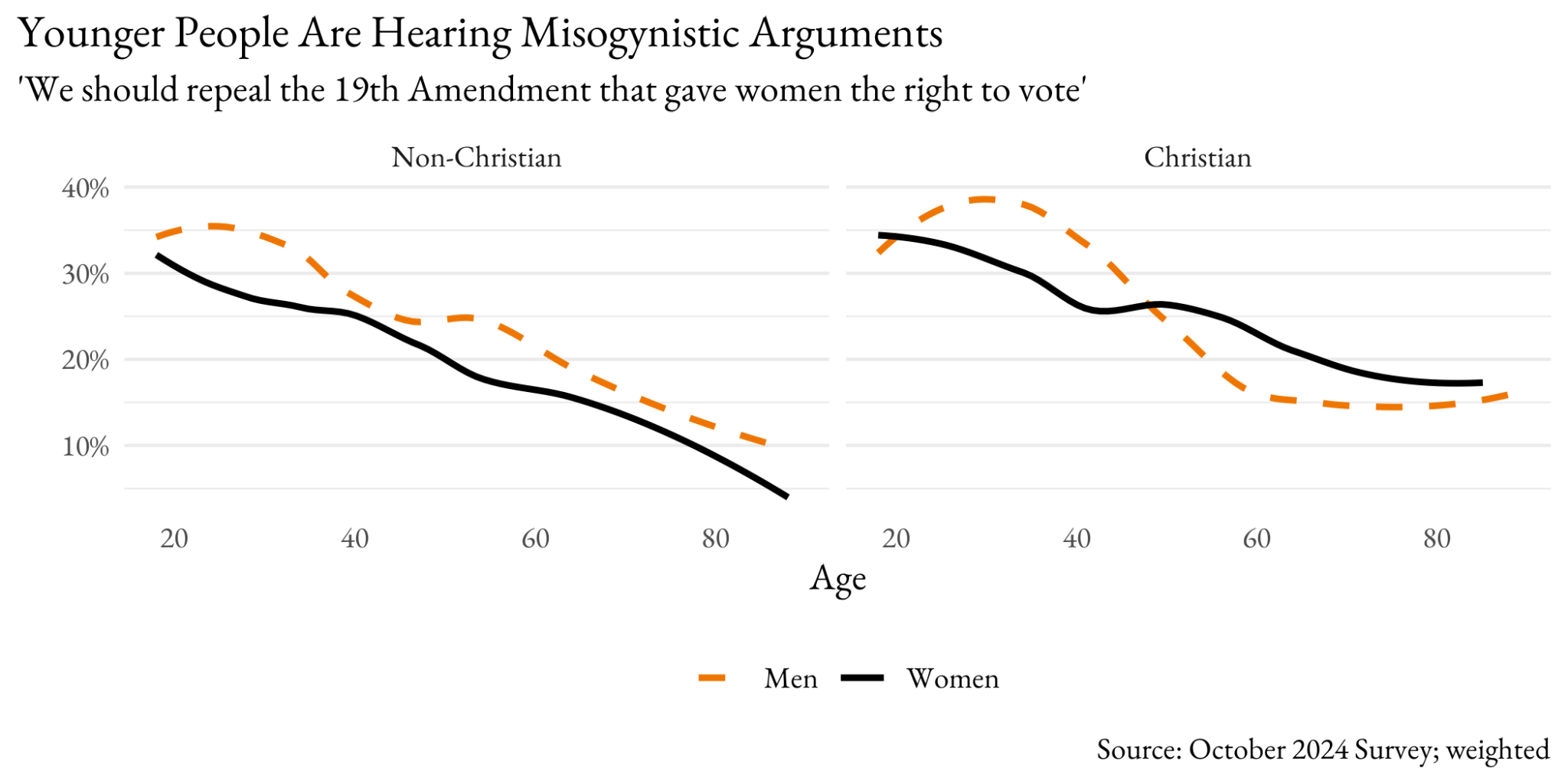
Perhaps what is most notable, though, is that young people in general were more likely to be exposed to this argument by a factor of 3. And while non-Christians were hearing this argument in substantial numbers, Christians were more likely to report being exposed to it (by roughly 5-10 percentage points). Misogyny is clearly a fixture of modern right-leaning media and is particularly concentrated within Christianity.
So does this sense of victimhood, whipped up by elites connected to a right-wing Christian ecosystem, draw men to Christianity? We asked our respondents a series of questions about their sense of victimhood (following Armaly and Ender). For example, items in the scale ask, “The system works against people like me” and “I rarely get what I deserve in life.” The relationship between this sense of victimhood and identification as born again varied dramatically with the respondent’s age and sex. For middle-aged respondents (median is 46), men and women who endorsed a victimhood mentality were more likely to be evangelical. But across ages, ‘victimized’ young men (see the aged 19 figure) are the most likely to turn to evangelical identification and the link fades as men age. Among the oldest, there is not a link between evangelicalism and victimhood, but it’s a lock among the youngest men.

These data document a significant shift in the social scientific study of religion. Men are increasingly drawn to a religion that affirms their gender identity and seeks to lock in traditional gender hierarchies. And because this is concentrated among young men (who, developmentally, are solidifying their religious commitments), we anticipate that this marks a generational and therefore long-term evolution in the American religious landscape.
Paul A. Djupe directs the Data for Political Research program at Denison University, is an affiliated scholar with PRRI, the series editor of Religious Engagement in Democratic Politics (Temple), and co-creator of religioninpublic.blog. Further information about his work can be found at his website or on Bluesky.
Brooklyn Walker is currently an Instructor of Political Science at Hutchinson Community College but in the fall will join the University of Tennessee-Knoxville as Assistant Professor of Political Science. Learn more about her work on Twitter, Bluesky, or at her website.
 Religion in Public
[…] ma non solo, le donne sono sempre più indipendenti e credono sempre meno in un dio. Per reazione, diversi uomini (specie se giovani) sono attratti «da una religione che afferma la loro identità di genere e […]
LikeLike