
By Alena Smith and Julianna J. Thomson
[Image Credit: Wikimedia Commons]
After Mike Johnson (R-LA) became Speaker of the House in October 2023, Republican legislators started using significantly more religious language in the newsletters they sent to constituents. That’s the key finding in our paper, “Sacred Speech: analyzing the influence of congressional leadership on religious rhetoric,” which was recently published open access in the journal Politics and Religion. By analyzing nearly 10,000 House floor speeches and over 9,000 e-newsletters from 2022 to 2023, we find that Speaker Johnson’s rise coincided with a notable shift: while official floor speeches remained largely unchanged, Republican outreach to constituents became markedly more religious.
Why does this matter? Mike Johnson’s (R-LA) election as the 56th Speaker of the United States House of Representatives in October 2023 marked the ascent of a figure whose deep religious convictions were already a prominent feature of his public life and political career. Johnson was known for making statements about how his Christian faith “informs everything [he does]” and for openly challenging the separation of church and state on the House floor. It was no surprise, then, that his inaugural speech as Speaker directly reflected these convictions. He told the chamber, “I believe that scripture, the Bible, is very clear that God is the one that raises up those in authority, he raised up each of you, all of us. And I believe that God has ordained and allowed us to be brought here to this specific moment and time.”
While references to faith by Speakers are not unprecedented – Nancy Pelosi and Paul Ryan made religious references in their inaugural speeches – the reaction to Johnson’s religiosity was distinct. In the weeks following his election, 31 Republican representatives praised his faith in their constituent newsletters. Many Democrats also noted Johnson’s deep faith, but in a less complimentary way: they viewed it as a signal of growing Christian nationalism in the government. This polarized response raised a compelling question: What role does Congressional leadership play in impacting legislators’ use of religious language?
How We Did It: Data & Analyses
We aimed to answer this question by analyzing a substantial amount of congressional communication: nearly 10,000 official speeches delivered on the House floor and around 9,000 e-newsletters sent by representatives directly to their constituents. Our analysis focuses on two months before Speaker Johnson’s election in October 2023 and two months afterwards, allowing us to compare the “before” and “after”. We anticipated that Republican representatives would increase their use of religious language after Johnson became Speaker, more so than their Democratic counterparts.
Measuring changes in religious rhetoric isn’t always straightforward, especially when the study period includes major holidays like Thanksgiving and Christmas, which naturally prompt more religious language. To measure the exact Johnson effect on religious language, we focus on two primary statistical methods: “difference-in-differences” (DiD) and “triple difference” (DDD) estimators. While the full explanation is in our paper (and we highly suggest checking it out!), essentially we compare the religious language used by:
- Republican vs. Democratic legislators,
- Two months before Johnson became Speaker vs. two months after, and
- The year Johnson became Speaker vs. the year before.
In summary, this allows us to compare the Republican-Democratic difference in religious rhetoric around Johnson’s speakership to the same partisan difference during a similar timeframe in a previous year, when there wasn’t a change in speakership but the same holiday season occurred. This technique helps to filter out those predictable seasonal variations, giving us a much clearer view of any changes specifically linked to the new Speaker.
What We Found: Audience Matters
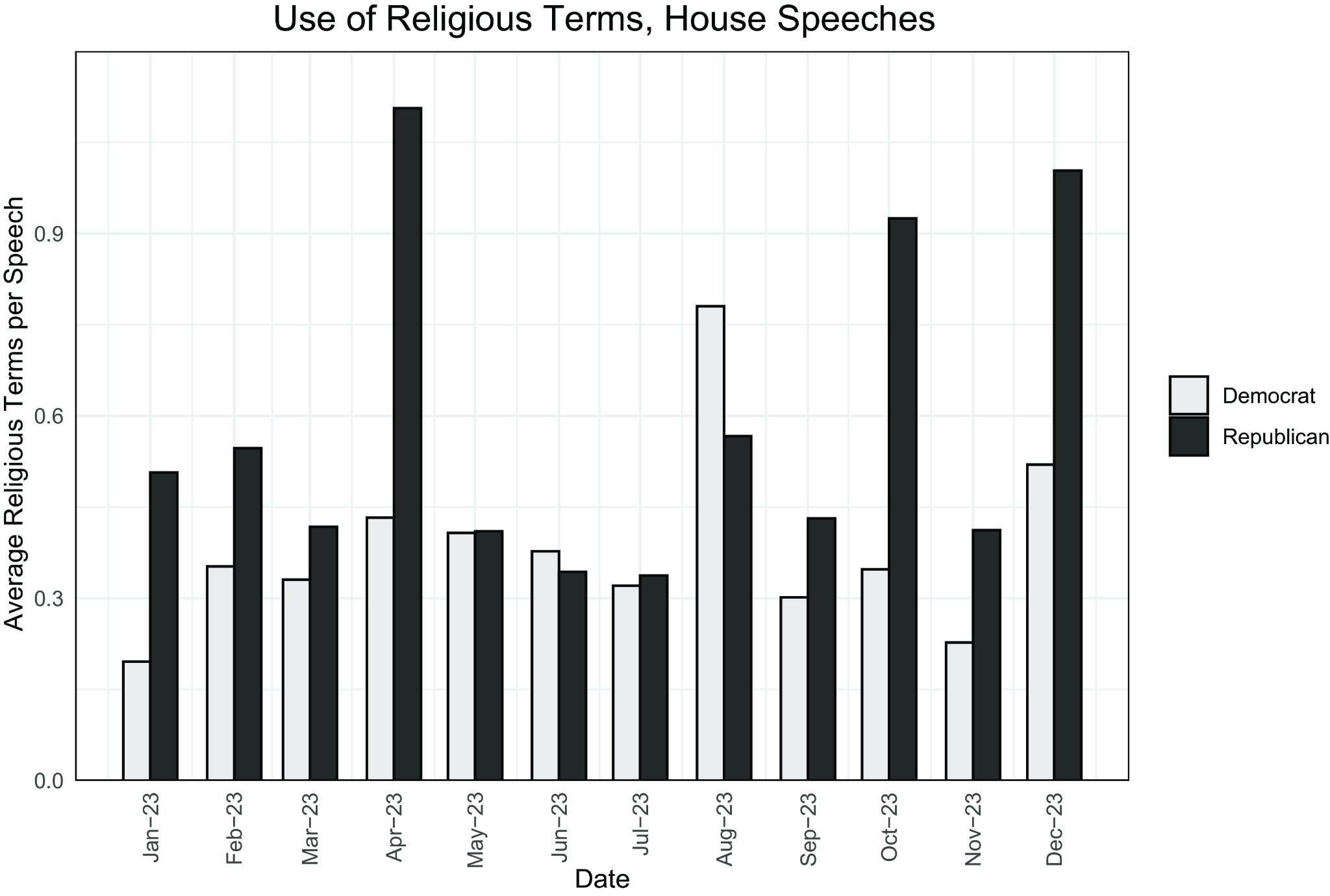
Our results were surprising, to say the least. We did not find a notable increase in religious language used in official House floor speeches by Republicans or Democrats after Speaker Johnson’s election. In fact, the use of such language on the House floor by Republican representatives either remained consistent or decreased following his inauguration. In contrast, we observed a significant increase in the use of religious rhetoric in newsletters sent to constituents by Republican representatives. This trend persisted even when controlling for the past holiday season. This divergence we found is particularly telling. It suggests that while Speaker Johnson’s overt religiosity might not have immediately reshaped formal debates among legislators, it seemingly encouraged fellow Republicans to amplify their religious appeals when speaking directly to their voters.
In the figures below, you can see the impact of partisanship and audience on representatives’ language. Both figures show the average number of religious terms per speech or newsletter each month in 2023 for both Democrat and Republican representatives. Both partisans use religious terms at somewhat similar rates on the House floor, but Republicans consistently outnumber Democratic religious usage in newsletters. These figures highlight our main finding: audience matters when using religious language.

What Caused The Johnson Effect?
How does this happen? We argue that leaders like Johnson can act as powerful symbolic permission structures. Instead of issuing direct orders, his own prominent displays of belief and rhetoric send cues to partisan colleagues about what’s now considered politically advantageous or acceptable. Johnson’s overt religiosity and ties to Christian nationalist themes may have signaled to like-minded Republicans that it was safe, and perhaps strategic, to amplify religious language, especially in outreach to their base. Meanwhile, we observed that Democratic legislators actually decreased their use of religious language in newsletters compared to the previous year, suggesting a partisan counter-reaction. In this way, Johnson’s leadership appears to have not only emboldened religious expression on the right but also sharpened the divide over how, or even whether, religion should be invoked in political communication.
Ultimately, this rhetorical shift reflects a broader transformation in American politics: the deepening fusion of Republican identity with specific religious narratives. As Christian nationalism gains traction within GOP circles, we argue that the way politicians talk about faith becomes less about personal conviction and more about strategic signaling – one that both mobilizes supporters and marks partisan boundaries.
Alena Smith is a Ph.D. candidate in political science at Stanford University studying religion in American politics. She can be reached at asvinod@stanford.edu or on BlueSky at @alenasmith13.bsky.social.
Julianna J. Thomson is a Ph.D. candidate in political science at George Mason University studying religious rhetoric and American politics. She can be reached at jthomso4@gmu.edu or on BlueSky at @julthomson.bsky.social.
 Religion in Public
