By Paul A. Djupe and Brooklyn Walker
It’s rare for scholars, public pundits, and religious leaders to catch onto the same trend-setting lingo, but we are observing one of those cases when it comes to Christian nationalism. Essays like this usually start out with a definition of Christian nationalism, but we won’t this time around because all those actors have been framing Christian nationalism in different ways.
For some, Christian nationalism is about imposing a legislative agenda. In an essay advocating for his view of Christian nationalism, Stephen Wolfe writes:
The magistrate enacts or maintains a Christian body of law, which (like all bodies of law) will be filled with commands that concern human things, such as prohibitions of theft. These are not distinctively Christian, and their immediate objects are human concerns. But a Christian body of law also contains what is distinctive to Christianity, which serves in part to normalize Christianity in civil society. These might include Sabbath laws (i.e., blue laws), punishments for blasphemy, and laws ensuring Christian norms within public institutions such as schools. When such laws are present, the body of law is Christian, for it directs man to both his temporal and eternal goods.
In other words, a Christian nation is one where Christian values (both those that are held in conjunction with people of other faiths and worldviews and those that are distinct to Christianity) are enshrined in legislation. Others take a different approach, seeing Christian nationalism as primarily concerned with political power. William Wolfe, author of The Case for Christian Nationalism and no relation to Stephen quoted above, recently pontificated, “We should not blink, we should not hesitate to tell people—not because we are so wise, not because we made the rules of the world; we didn’t—we humbly submit to how God made the rules of the world, and we say, ‘This is how we should order our lives together,’” Wolfe said. “And frankly, yes, we are going to impose it upon you. If you don’t like it, I’m sorry, but this is good and right and just if it lines up with God’s standards and I am going to enforce my morality on you inasmuch as our morality is God’s morality.” That is perhaps not too different from Doug Wilson’s vision that “We should respect all 10 commandments in our civic law. Yes, we should do that” in response to Russ Douthat’s question in the New York Times.
And finally, some talk about Christian nationalism as an identity matter, that the only true Americans deserving of the full rights of citizenship are Christians. An NPR Up First segment includes this exchange between Heath Druzin, an NPR journalist, and Gabriel Rench, a leading Christian nationalist activist.
DRUZIN: You said it would probably take a long time but that you would like to see only Christians be able to run for office. So if you’re Jewish, if you’re Muslim, if you’re atheist, certainly. If I had you right, you said that yes, you would support eventually that – them not being allowed to run for office.
RENCH: That’s correct. I did say that. […] I think that the Christian faith is the ideal moral doctrine in principles for a thriving society. And the farther you get away from that, the more in chaos we descend. And so I’d – the only way to maintain that or one of the ways to maintain that is you have to have people who are running for office who believe that, or you’re going to get back into that chaotic decline.
DRUZIN: So I’ll tell you straight up. As a Jewish American, I hear that, that I can’t run for office, other non-Christians can’t, and I have to admit it’s a little terrifying to me because, to me, that means a fundamental freedom of mine in this theoretical world is gone.
RENCH: Well, I mean, you’re saying that in a country where you experience all these immense freedoms that was built on the Christian faith. So…
DRUZIN: But I – where I can run for office right now.
RENCH: Yeah, because your worldview is not good for society.
So here we have three main framings of Christian nationalism. Christian nationalism is about imposing Christianity through legislation. Christian nationalism is about imposing Christianity through force like the January 6 Insurrection. And Christian nationalism is about imposing Christianity through identity. Does it matter how elites are framing Christian nationalism, or are all of these understandings bound up in the term?
To answer this question, we fielded an experiment in January 2024 (administered to a sample of almost 1500 Christians) that explicitly varied the definition attached to the label before asking respondents their beliefs about the worldview.
Each condition began with the same sentence, “Switching subjects, do you agree or disagree with these statements about Christian nationalism?” That was the control. The substantive treatments added one of the following three definitions (the emphasis was in the original question text):
- Experts agree that Christian nationalism is best understood as the belief that government should create legislation that’s consistent with Christian values.
- Experts agree that Christian nationalism is best understood as the worldview behind the Insurrection at the US Capitol on January 6, 2021.
- Experts agree that Christian nationalism is best understood as the belief that only Christians can be true Americans.
The definitional treatment was followed by a series of questions tapping beliefs about Christian nationalism – namely, whether it is a threat, whether it is the “only idea that will save this fallen nation,” whether it is a threat to the reputation of Christianity, and whether it is a term made up to make Christians look bad. We chose these items to see if the more extreme definitions caused people to distance themselves from the term. If Christian nationalism is unstable and subject to framing attempts, then respondent impressions of the term may shift considerably, or at least detectably. (Methods note: We used OLS models that included partisanship, a Christian nationalism scale, worship attendance, and demographics. Randomization was successful, and the model composition does not substantively change the results.)
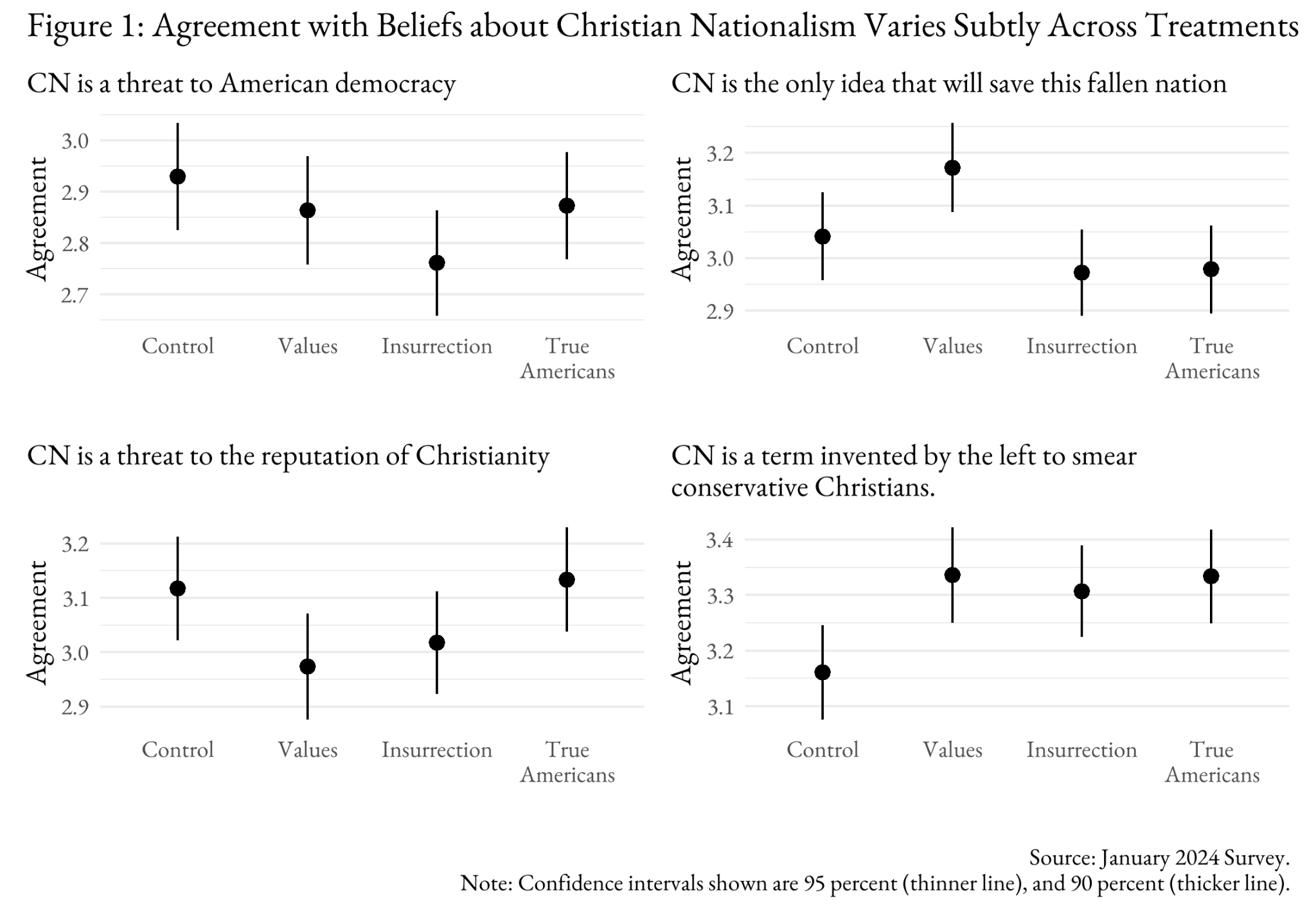
We report two types of tests. Figure 1 shows how much of a difference the definitions make among Christians as a whole. If the respondents to an experimental treatment have about the same response to a question about Christian nationalism, we should see the same level of agreement (a higher score is greater agreement to the question listed). There are very few differences across all of these groups, but the one that emerge are quite interesting. Those who read that Christian nationalism is the worldview behind the insurrection agree less that CN is a threat to democracy, a bit less that CN is a threat to the reputation of Christianity, and agree more that CN is an invented smear.
A second tack we took was to check whether the link between Christian nationalism and the four beliefs varied given the definition of Christian nationalism given to them. We used a slightly-modified version of Andrew Whitehead and Sam Perry’s index of Christian nationalism (promoted by Djupe, Lewis, and Sokhey), asking our respondents whether they agree with these statements:
- The federal government should declare the United States a Christian nation.
- The federal government should advocate Christian values for the benefit of Christians.
- The federal government should enforce strict separation of church and state.
- The success of the United States is part of God’s plan.
- The federal government should allow Christian prayer in public schools.
- The federal government should allow the display of Christian symbols in public spaces.
We had strong expectations about how holding a Christian nationalist worldview would link to these beliefs: strongly and defensively. That is, Christian nationalists should be more likely to think the term is a made-up smear, that Christian nationalism will save America, that Christian nationalism is not a threat to the reputation of Christianity, and that Christian nationalism is not a threat to democracy. Are those priors supported, and does a redefinition of the worldview in the treatments alter that trajectory?
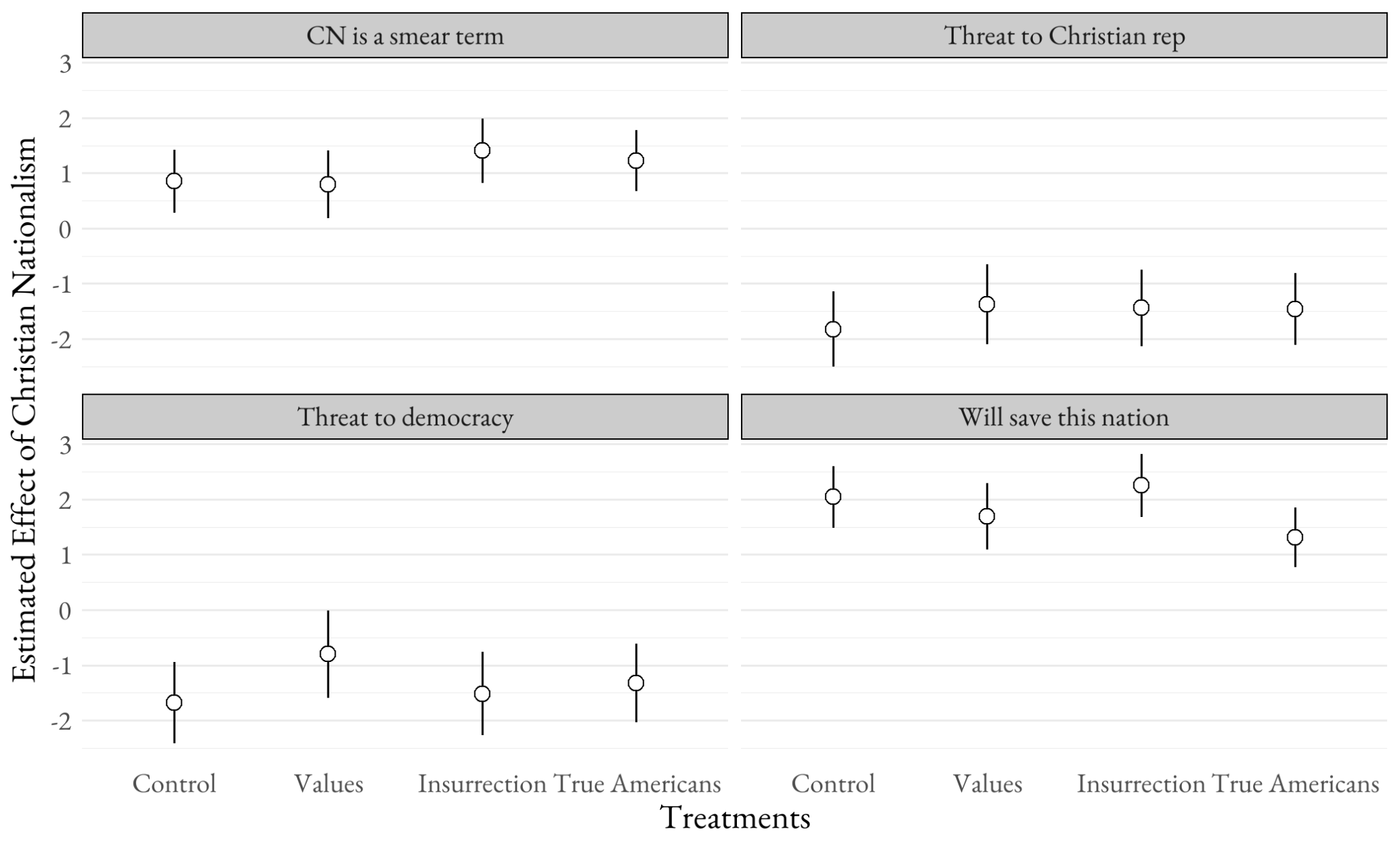
The short answer is “yes to the first and no to the second.” As Figure 2 shows, respondents high in Christian nationalism are more likely to believe that Christian nationalism is a smear word made up to denigrate Christians. They are less likely to see Christian nationalism as a threat to the reputation of Christianity or as a threat to democracy. And they are more likely to believe that Christian nationalism is necessary to save the nation.
But it is essential to note that the different definitions of Christian nationalism in the experiment (the treatments) did not affect almost at all how their Christian nationalist views are linked to the four beliefs – all of the estimates for the effect of Christian nationalism are almost identical.
Figure 2 – The Treatments Do Not Significantly Alter the Effects of Christian Nationalism on the Four Beliefs about Christian Nationalism
Source: January 2024 Survey. Christians only.
Based on this experiment, our conclusion is that Christian nationalism isn’t just about a legislative agenda, identity fusion, or political control – it’s about all of these. And that fact amplifies the threat Christian nationalism poses to the health of democracy given that this sizable American cohort is equally at home with administering Christian values as they are with disrupting the peaceful transfer of power.
Paul A. Djupe directs the Data for Political Research program at Denison University, is an affiliated scholar with PRRI, the book series editor of Religious Engagement in Democratic Politics (Temple), and co-creator of religioninpublic.blog. Further information about his work can be found at his website and on Bluesky.
Brooklyn Walker is an Assistant Professor of Political Science at the University of Tennessee-Knoxville. Learn more about her work on Twitter, Bluesky, or at her website.
 Religion in Public