By Niva Golan-Nadir and Daniel Smith
[Image credit: https://www.history.com/articles/blue-laws-sunday%5D
In “From religious to secular perspectives of religion and state – tracing the American Blue laws,” We explore how religiously rooted legislation evolves over time, but has a hard time leaving, democratic systems. In our new research out in Politics & Religion, the main question is: under what conditions does religious law, rooted in state establishment, decline in democratic systems? The answer, however, is complicated, grounded in history, and deeply related to debate surrounding religion, law, and public life.
We submit a three-part hypothesis in order to answer this question: religious law declines when (1) political elites avoid embedding religion into state institutions, (2) constitutional frameworks explicitly prohibit state-sanctioned religion, and (3) legal justifications shift from religious to secular reasoning. It should be noted, and this is an insight from the core of the article, decline does not mean disappear. Through mechanisms of path dependency and historical institutionalism these laws born from religious context can endure, but in secularly disguised justifications.
Religion and State
Unpacking this process, we turn to the United State’s history and legal system as a ‘deviant case.’ Despite its commitment to the separation of church and state, religion is highly evident in its laws and culture, albeit using secular terminology. This type of balancing-act between the two is captured in the term ‘light secularism,’ where a system neither fully removes religion nor formally establishes its place in the state. In such a system, religion is not just taken out of public life, rather it is reframed to better fit into it.
The Blue Laws
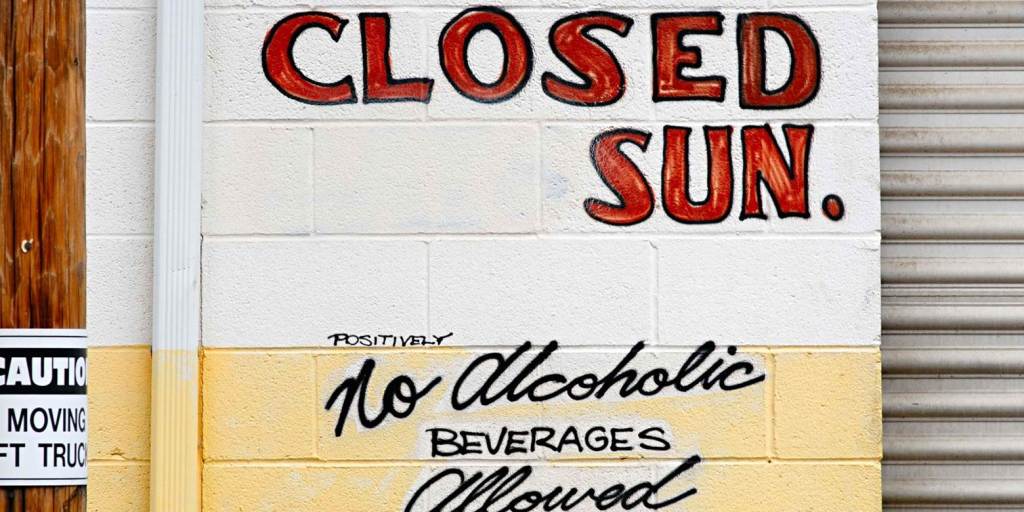
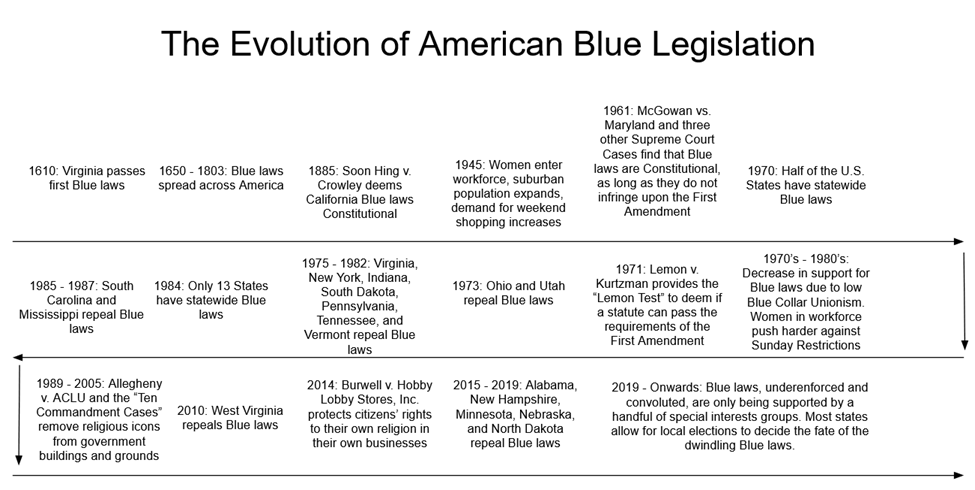
To explore this idea, the article’s central focus is on Blue laws, or Sunday legal regulations dating back to colonial America that enforced rest and religious observance. At the beginning, these laws were overtly theological in their wording, goals, and justification, mandating church attendance and restricting commercial activity on the ‘Sabbath.’ From colonies, through the Revolutionary War into statehood, and even with the adoption of the First Amendment, many states held onto these laws with minimal change.
A major turning point came in 1961 with four Supreme court cases, notably McGowan v. Maryland, which upheld the American Blue laws not on religious grounds but on secular ones. In practice this meant that states, if they wanted to keep their Blue laws, had to change the wording of the laws themselves from goals of ‘observing the Sabbath,’ to ‘promoting public welfare, rest, and social well-being.’ This was a critical juncture for the Blue laws: the laws were upheld, but their justifications shifted into constitutionally acceptable language.
Rationale for Blue laws—a shift towards secular justification
Why did this shift happen? Broader societal changes brought this about. For example, increasing post- World War II secularization, suburbanization, and the addition of significant amounts of women into the workforce (among other factors) all contributed to the erosion and reshaping of the Blue laws.
Since 1961 many states have repealed parts of, if not all of, their Blue legislation. However, Blue laws persist across the U.S. primarily in three domains: alcohol sales, car sales, and hunting restrictions. Though justified in secular terms, many modern Blue laws contain traces of their religious origins. For instance, references to ‘the Sabbath’ or ‘the Lord’s Day’ are found in certain state statutes, and many states’ laws still reference explicitly religious holidays, such as Christmas or Easter. This duality, secular language overlying and reframing religious structures, is the article’s main empirical finding.
Textual analysis comparing pre-1961 and post-1961 Blue legislation across several states from several time periods reinforces this point as well as reveals a clear change in word choice: moral and religious terms, such as ‘Sabbath breaking’ and ‘immoral practices’ before 1961 change into religiously neutral language stressing public order, economic regulation, and general social welfare after 1961. Despite the change in tone, the underlying legal restrictions remain mainly unchanged. Sunday is still singled out as a special day. Certain activities are still limited. The structure persists, even as its rationale evolves.
| Existing Blue laws and their rationale: | ||
| Law Type | Number of States holding it | Religious/Secular wording in the specific section where law is written |
| Alcohol Restrictions | 34/50 | 11/34 Mention specific religious holidays. |
| Motor Vehicle Sales Restrictions | 19/50 | 1/19, Wisconsin mentions “the Sabbath.” |
| Hunting Restrictions | 11/50 | 1/11, South Carolina mentions “Christmas,” though it is not connected to the Blue law other than in location of the words. |
The broader theoretical contribution of this article involves situating religion within the framework of historical institutionalism. Here our argument is that religion is able to function similarly to any entrenched ideology, capable of shaping policy long after its explicit authority declines. Blue laws are not religiously-rooted outliers from four centuries ago, but examples of a general pattern throughout history: institutions can outlive the ideas that created them. Returning to our hypothesis, this idea of historical institutionalism can be seen as a process of layered transformation.

This process entails a growing gap between legal-institutional arrangements and public preferences. As American society becomes more secular and diverse, support for Blue laws declines. However, the Blue laws’ institutional entrenchment, reinforced by organized interest groups and legal precedent at state and federal levels upholding them, makes repeal a difficult process.
The findings of this study offer more than a historical account of the American Blue laws and their journey from the 1600s to the 2000s. It provides a framework for understanding how democracies negotiate the legacy of religion, not by abandoning it outright, but by reshaping it to fit the language and norms of a modern, secular, government.
Dr. Niva Golan-Nadir is a Research Associate at the Center for Policy Research, University at Albany, SUNY, and at the Institute for Liberty and Responsibility, Lauder School of Government, Diplomacy & Strategy, Reichman University. Her research focuses on comparative politics and state-religion relations. In 2024, she was a visiting scholar at the Taub Center for Israel Studies, New York University.
Daniel Smith is a BA student at the Lauder School of Government, Diplomacy & Strategy at Reichman University.
 Religion in Public