By Abigail Vegter and Brooklyn Walker
[Image Credit: Premier Christianity]
Over the past several years, the catastrophic effects of conspiracy theories have become especially apparent. Vaccine hesitancy resulted in unnecessary infections and death, millions of Americans still deny the legitimacy of the 2020 presidential election, and some of those election denialists stormed the United States Capitol in what is now known as one of the greatest assaults on American democracy in our nation’s history. Evangelicals have been especially susceptible to this false information, such as with QAnon, leading us to ask what is the relationship between religion and generalized conspiracy thinking in America?
We investigate this question in new research published in the Journal for the Scientific Study of Religion. Specifically, we assess the role of Christian nationalism and biblical literalism in predicting conspiracy thinking.
The 2019 wave of the Chapman University Survey of American Fears introduced eight conspiracy theories, asking respondents to indicate how strongly they agree or disagree that the government is concealing what it knows about the following occurrences: alien encounters, the 9/11 attacks, global warming, the JKF assassination, the moon landing, the Illuminati/NewWorld Order, mass shootings, such as those at Sandy Hook, Las Vegas, and Parkland, and the “South Dakota crash.” This last occurrence is especially noteworthy given it is a fictional event placed on the survey to assess if participants were responding to particular popularized conspiracy theories or simply expressing a tendency to accept any sort of conspiracy at all.
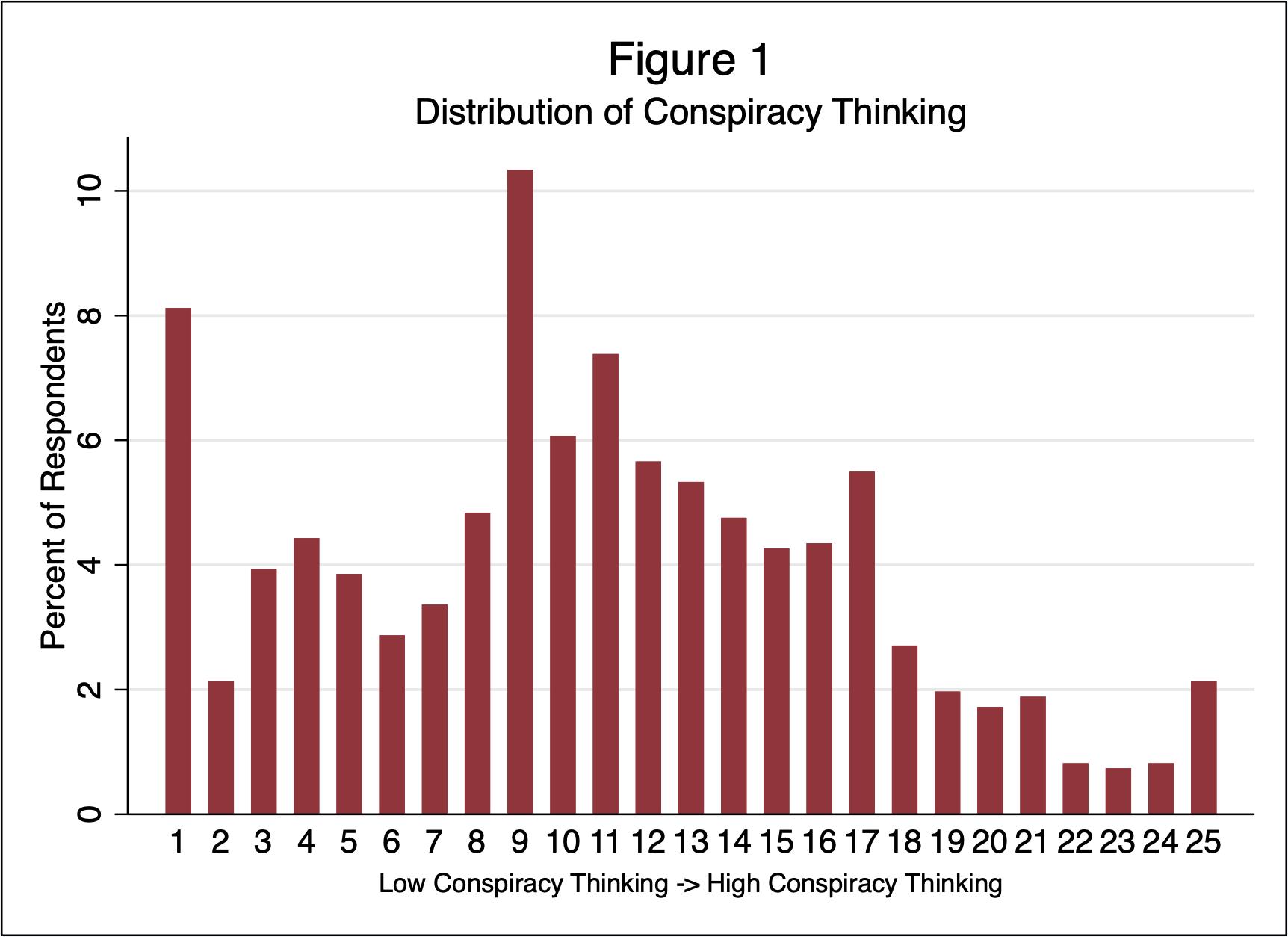
We generated a single index of conspiracy thinking by combining all of these beliefs together, the distribution of which is shown in Figure 1. Our measure is powerful, as it does not only capture adherence to specific conspiracy theories, but given the inclusion of the fictional “South Dakota crash,” it also reflects a commitment to a conspiracy mindset. Moreover, these conspiracy theories span political ideologies, which allows us to assess a general propensity for conspiracy thinking. We suggest that both Christian nationalism and biblical literalism play a role in predicting such thinking.
Christian Nationalism
Christian nationalism places Christianity at the center of the American story, using both identities to draw symbolic boundaries around who belongs and who doesn’t. Research suggests that minority groups are more likely to adopt conspiracy thinking; and while few would suggest that Christians are a minority in the United States (what with the vast majority of Americans identifying as Christian, the overrepresentation of Christians in the halls of Congress, and the recent political wins for Christians including the overturning of Roe v. Wade), a key Christian nationalist belief is that the Christian way of life – and by extension, the American way of life – is under attack.
Therefore, while they may not actually be the minority, the fear that they may be someday soon gives Christian nationalists a comparable mindset to actual minority groups in the US. Given this perceived sense of threat, we predict that individuals with greater support for Christian nationalism will be more likely to display conspiracy thinking.
Biblical Literalism
We contend that biblical literalism, the belief that the Bible means exactly what it says, may also play a role in the development of conspiracy thinking given its relationship to trust. Biblical literalists tend to display higher levels of distrust in science, in the media, and perhaps most importantly, in the government. Given that conspiracy theories are built on an assumption that the truth is being hidden, we suspect that individuals with a strong belief that the Bible ought to be taken literally will be more likely to hold conspiracy beliefs.
What We Found
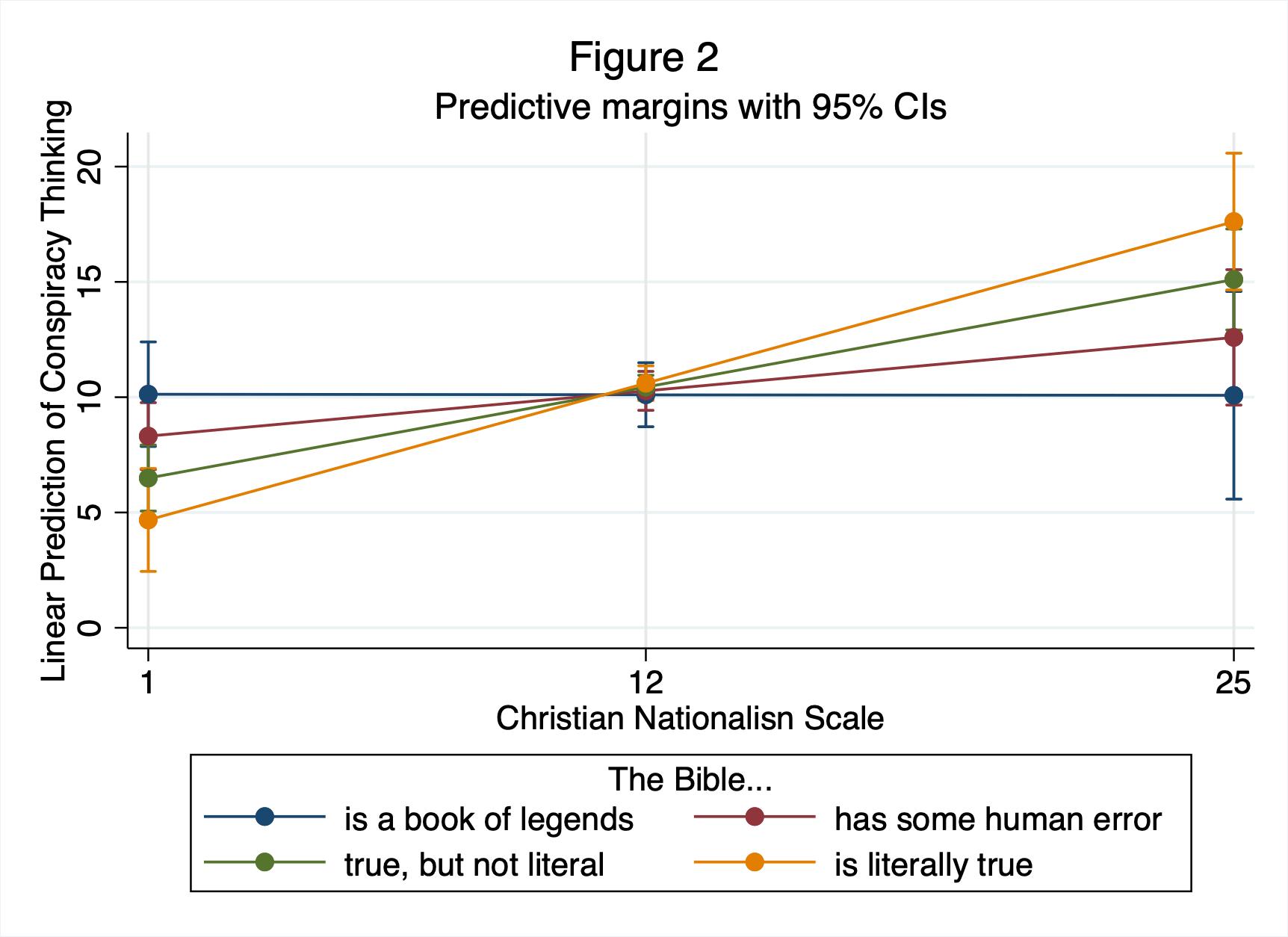
We find that both Christian nationalism and biblical literalism have an impact on an individual’s likelihood of adopting generalized conspiracy thinking. As people express both higher levels of Christian nationalism and higher levels of biblical literalism, they are more likely to express conspiracy thinking.
Additionally, the interaction of these two belief systems is especially powerful. As shown in Figure 2, Christian nationalist beliefs have the largest impact on biblical literalists. In other words, when individuals who believe that Bible is literally true also hold views that America is a distinctly Christian nation and ought to remain that way, they are far more likely to believe that government is hiding something – from information on 9/11 to global warming to events that never even happened, like the fictionalized South Dakota crash.
Why We Care
The tendency for some segments of a population to adopt conspiracy thinking can create ripple effects that affect the population as a whole. Conspiracy thinking is amplified when one holds the fear mindset inherent in Christian nationalism’s claims of a threatened way of life and the anti-elitism common among biblical literalists – and this way of interpreting the world is not limited to the popular conspiracy theories of the day.
By generating a generalized conspiracy thinking measure, we suggest that Christian nationalists and biblical literalists are likely to buy into future conspiracy theories too.
History tells us that Covid denialism and QAnon will fade at some point and new conspiracy theories – like election denialism – will arise, presenting their own challenges to the fabric of the country. Society has a vested interest in predicting who will be most susceptible to the conspiracy beliefs of tomorrow. We help tell this story by demonstrating how both Christian nationalism and biblical literalism are correlated with increased conspiracy thinking in the United States.
Abigail Vegter is an Assistant Professor of Political Science at Berry College in Rome, GA. She publishes broadly on religion and politics and gun politics in the United States. To see more of her work, visit abigailvegter.com or check out her twitter, @abigailvegter.
Brooklyn Walker is an Instructor of Political Science at Hutchinson Community College. Her work focuses on religion and politics, public opinion, and political psychology, with a special focus on Christian nationalism. To learn more, visit brooklynevannwalker.com or follow her on Twitter @brooklynevann.
 Religion in Public