
By Paul A. Djupe and Brooklyn Walker
[Image credit: Tennessee Lookout]
A recent story from NPR helps make the connections between extraordinarily restrictive anti-abortion policies and a broader movement to reshape the norms and laws that govern gender roles. That is, for some, eliminating the right to abortion is about instating a patriarchal form of Christianity where women are withdrawn from public life and the world of work outside the home and occupy circumscribed roles as mother and wife. And, for some, as the story reports, the male form of headship is explicitly violent, with calls for men to train with guns to defend against supposed foes. But within the covered portion of the anti-abortion movement, activists look to intimidate ideological enemies, including women in public life.
NPR isn’t alone – journalists at the New York Times, Vox, and CNN have noted similar convergences between Christianity, gender ideology, and the politics of the day. As social scientists, one of our roles is to assess whether individual examples, such as those covered in the NPR story, can be found systematically across society. And we attempt to find logical structures that would substantiate the links drawn from case studies. It’s not that we mistrust reporters, it’s that we want to understand the degree to which stories are unique or whether they are part of a broader movement or social structure that is worth pursuing further.
In this case, we are near perfectly equipped to start this investigation. In January 2024, and funded by a Jack Shand grant from the SSSR, we surveyed nearly 1,500 Christian identifiers on the Lucid/Cint online platform, using quotas so that respondents look like the population of adult Christians in the US. We are just beginning a larger project on a particular Christian gender ideology that resonates with some of the (scant) theological material covered in the story. Complementarianism is a set of ideas that suggests men and women were made for each other, playing complementary but separate roles. Men are designed (by God) for leadership, public life, fighting, and protecting. Women, on the other hand, are for caring, raising children, and private life. We composed six items that capture many of the major facets of complementarianism from the Council on Biblical Manhood and Womanhood, which developed perhaps the most full-throated articulation of complementarianism in the Danvers Statement in 1987:
- God created men to be masculine and women to be feminine.
- While God values men and women equally, God created different roles for men and women.
- While God values men and women equally, God institutes male headship for biblical marriages.
- While God values men and women equally, God designed men for leadership roles in the church.
- Biblical women joyfully submit to their husband’s leadership.
- When men and women don’t occupy their biblical roles, the culture disintegrates.
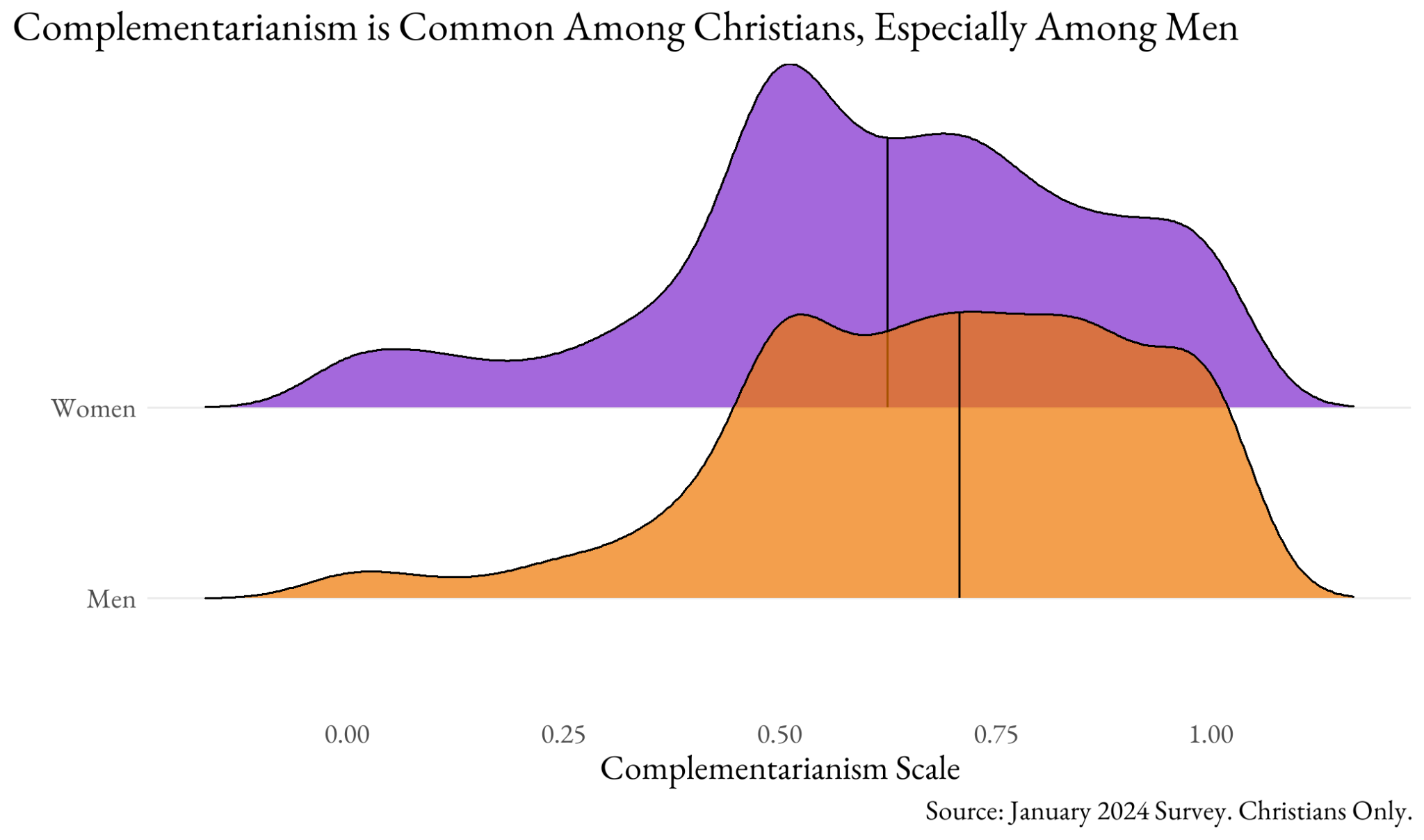
The distribution of the scale formed from these items is shown in the figure below indicating widespread support among sample Christians. The median scores hover at .63 for women and near .71 for men. Most everyone lies above .5. One note of caution – while we can look at the relationships between complementarianism and other variables, we need to remember that low scores on this gender ideology scale are rather sparse.
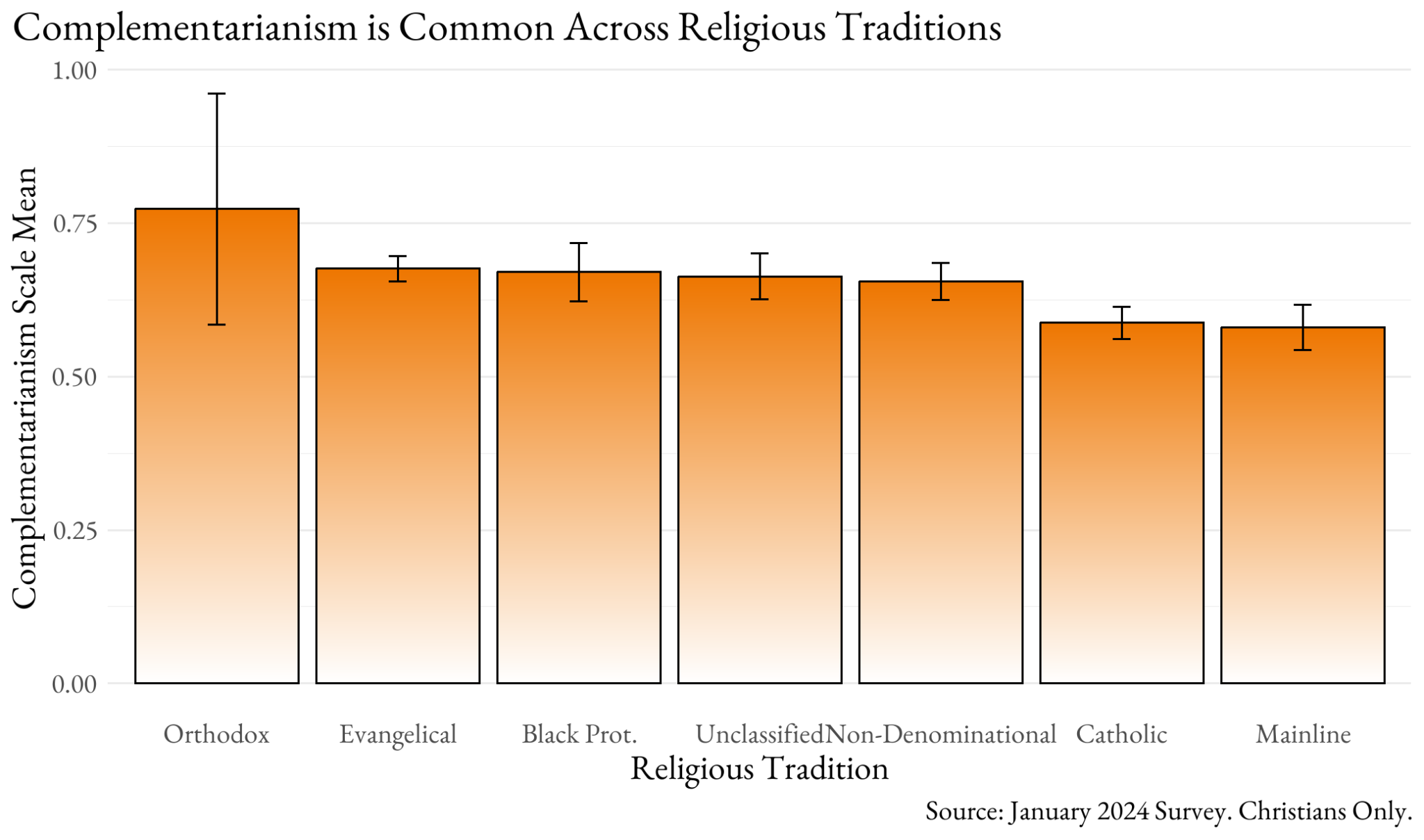
One question that readers might have is whether complementarianism is just another name for evangelical. The following figure shows, we think convincingly, that complementarianism is widespread across religious traditions in the US. Evangelicals, both Black and White, are near the top, but Catholics and Mainline Protestants are not far behind. Catholics and Mainliners are distinguishably lower, but not by much. All of the religious tradition average scores are above the middle point on this scale.
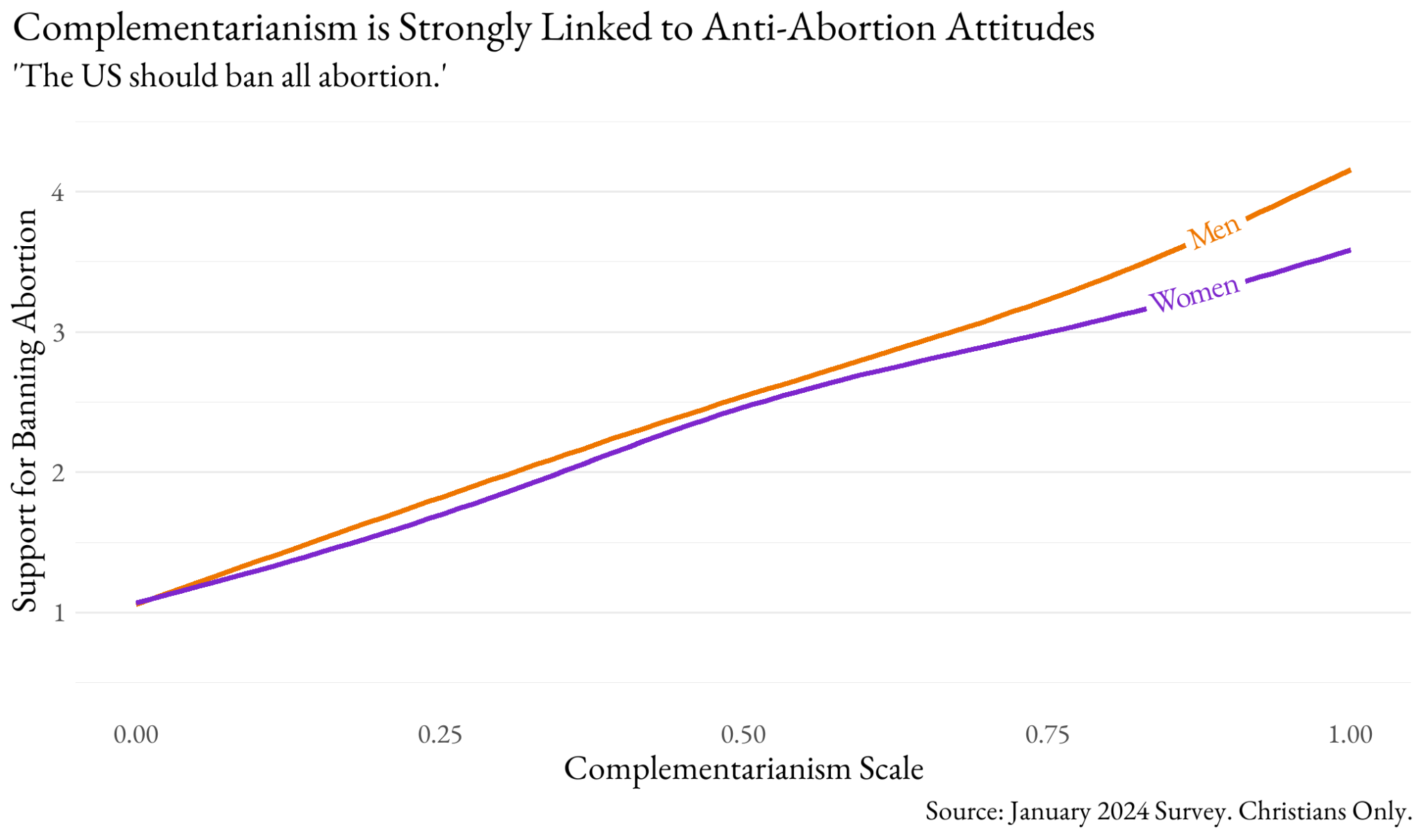
Now to the heart of the matter. Our measure of complementarianism is strongly linked to a belief that the US should ban all abortion (see the figure below). Those Christians who reject this gender ideology also strongly reject the idea of an abortion ban (score of 1 on the y axis). Greater acceptance of complementary roles for men and women also show greater support for an abortion ban. And that rate is monotonic – it increases steadily until full acceptance of complementarianism is linked to support for an abortion ban (a 4, which is not quite “strong support” which is a 5 on this scale). It is notable that a small gender gap opens up at the top of the complementarianism scale with men slightly more in favor of an abortion ban. That relationship between complementarianism and banning abortion is a simple, bivariate one, but this strong relationship holds in a more complex statistical model that we will explore in future work.
The link between complementarianism and extreme abortion attitudes suggests that this gender ideology matters for some of the most consequential issues of our time, but further tests would help to cement that association. It is abundantly clear from the reporting that anti-abortion activists are looking to impose their view on all of society, that it is part of a broader worldview of Christian male domination, and that subscribed males should train and equip themselves to take it by force if necessary. That call particularly plays on those who feel insecure about their masculinity. A measure of Christian nationalism has been demonstrated on this blog to be associated with desired Christian dominion over the US, and has been associated with conservative gender ideology in previous work by Whitehead and Perry.
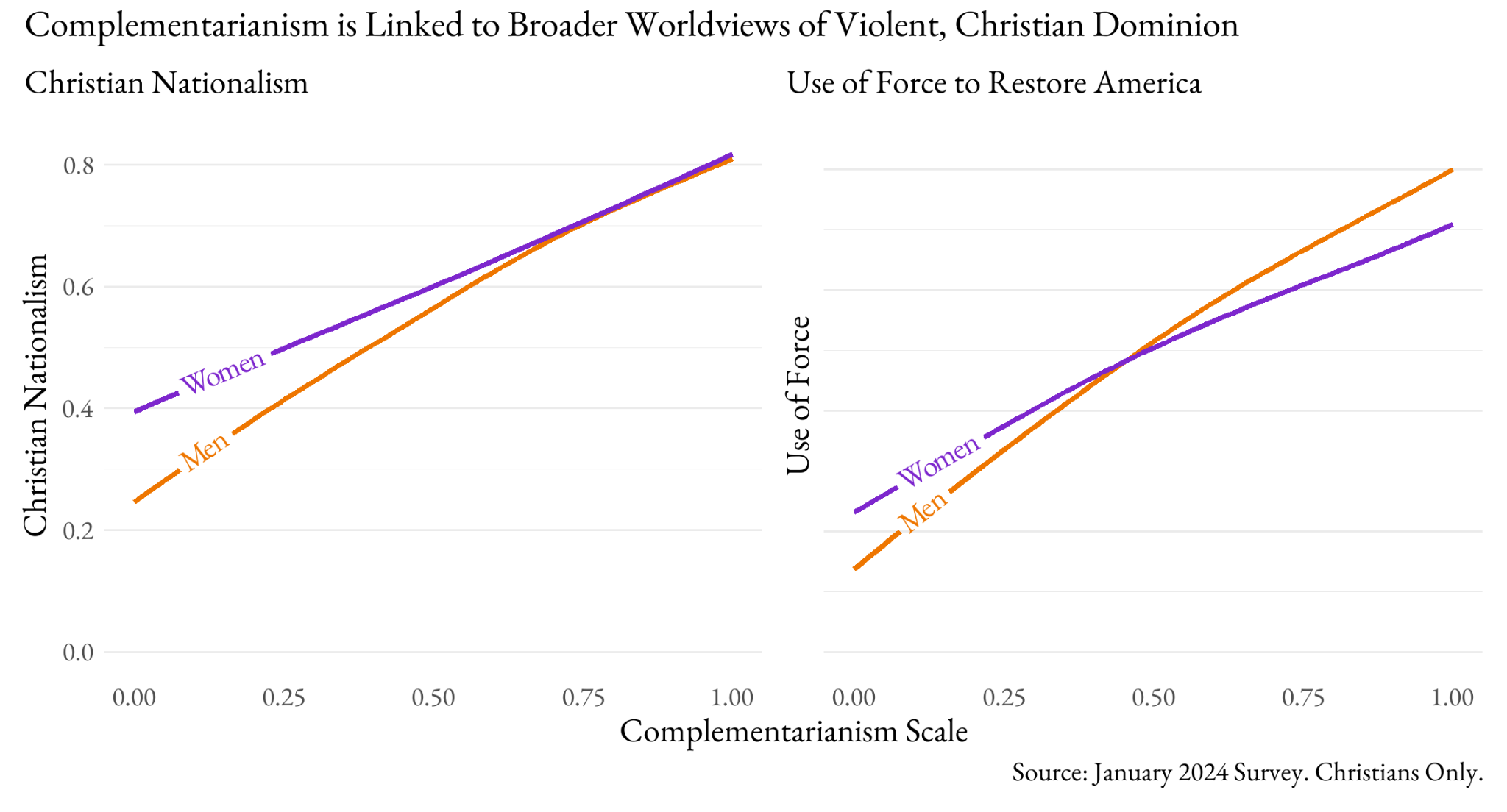
In our January 2024 data, complementarianism is strongly related to Christian nationalism as well as the need for the use of force to take America back, as the following figure shows. The relationships do not differ much between men and women – Christian women have more default Christian nationalism and have somewhat lower support for violence at the highest levels of complementarianism, which is predicted by the worldview, of course (it might have been a greater gap if the question had segmented what kind of person could use force rather than just the generic use of force).
Perhaps it’s necessary to state the obvious. Though we have more data coming soon, and we’ve had good luck in the past in replicating our population estimates from survey to survey, this is one sample. Our conclusions do not apply to all Christians, but there are few who outright reject this exclusive gender ideology, and there are quite many (~38 percent are in the top quartile scoring .75 or over) who embrace most elements of it. And most of the rest are right behind them (42 percent score between .5 and .75).
From our read of the data, there is both narrow and broad support for the reporting done by NPR about the nature of the modern pro-life movement. It is not just about the fetus, but loops in a comprehensive worldview of Christian dominion and male headship within it that has a built-in, validated resort to violence if necessary. And the trigger is loss, which is just another “season” for believers for which they might need assault weapons.
Paul A. Djupe directs the Data for Political Research program at Denison University, is an affiliated scholar with PRRI, the book series editor of Religious Engagement in Democratic Politics (Temple), and co-creator of religioninpublic.blog. Further information about his work can be found at his website and on Bluesky.
Brooklyn Walker is currently an Instructor of Political Science at Hutchinson Community College but in the fall will join the University of Tennessee-Knoxville as Assistant Professor of Political Science. Learn more about her work on Twitter, Bluesky, or at her website.
 Religion in Public