
By Brooklyn Walker and Paul A. Djupe
“Section 1. Purpose and Policy. It is the policy of the United States, and the purpose of this order, to protect the religious freedoms of Americans and end the anti-Christian weaponization of government. The Founders established a Nation in which people were free to practice their faith without fear of discrimination or retaliation by their government.” Executive Order on Eradicating Anti-Christian Bias
In our new research out at Journal for the Scientific Study of Religion (open access), we assess whether there is a common basis for different racial groups to mobilize against a common threat to their shared Christian identity.
Believing that your group is treated differently, even persecuted is hardly new. Those of you who attended Christian Sunday School likely saw the story of Shadrach, Meshach, and Abednego acted out on a flannel board – in the ancient kingdom of Babylon, these three men were punished for refusing to worship the king. Although the United States is not a country that punishes religious minorities by death in a fiery furnace, there has been a surge of concern among American Christians that they are or are soon to be targeted for religious persecution. For example, pastor Jack Hibbs in 2020 commented that,
I have no doubt whatsoever that the churches will be persecuted. It’s already started. Right now, we’re only dealing with what I call “white-collar persecution”—lawsuit intimidation. But I think very soon, it’s clear from the Book of Daniel, that spiritual powers will move among municipalities and governments … and our nation is in trouble.
Some scholars have recently proposed that these Christian persecution beliefs (CPBs) are a type of racial dog whistle. Because most of the dominant branches of American Christianity have a history of supporting White dominance, talking about Christian persecution could be a coded way to talk about White persecution. The problem is that, in most datasets, the number of Latino and Black respondents is too small to draw meaningful conclusions about their commitment to CPBs or how CPBs are linked to their social and political attitudes. Do racial minorities avoid CPBs as a proxy for White dominance? Or are they on the same page given their shared religious identity?
In 2022, our co-author Brian Calfano collected data from approximately 4,500 Christian respondents evenly divided by race (White, Black, and Latino), which is a large enough sample to let us generate more reliable estimates for these racial groups.
In general, we see few substantive differences in Christian persecution beliefs (“How much discrimination or unfair treatment do you think different groups face in the United States? 0=None, 1=A little, 2=Some, 3=A lot). On the 0-3 scale, White Christians report an average score of 1.61, Black Christians 1.80, and Latino Christians 1.48. CPBs are not concentrated among White Christians.
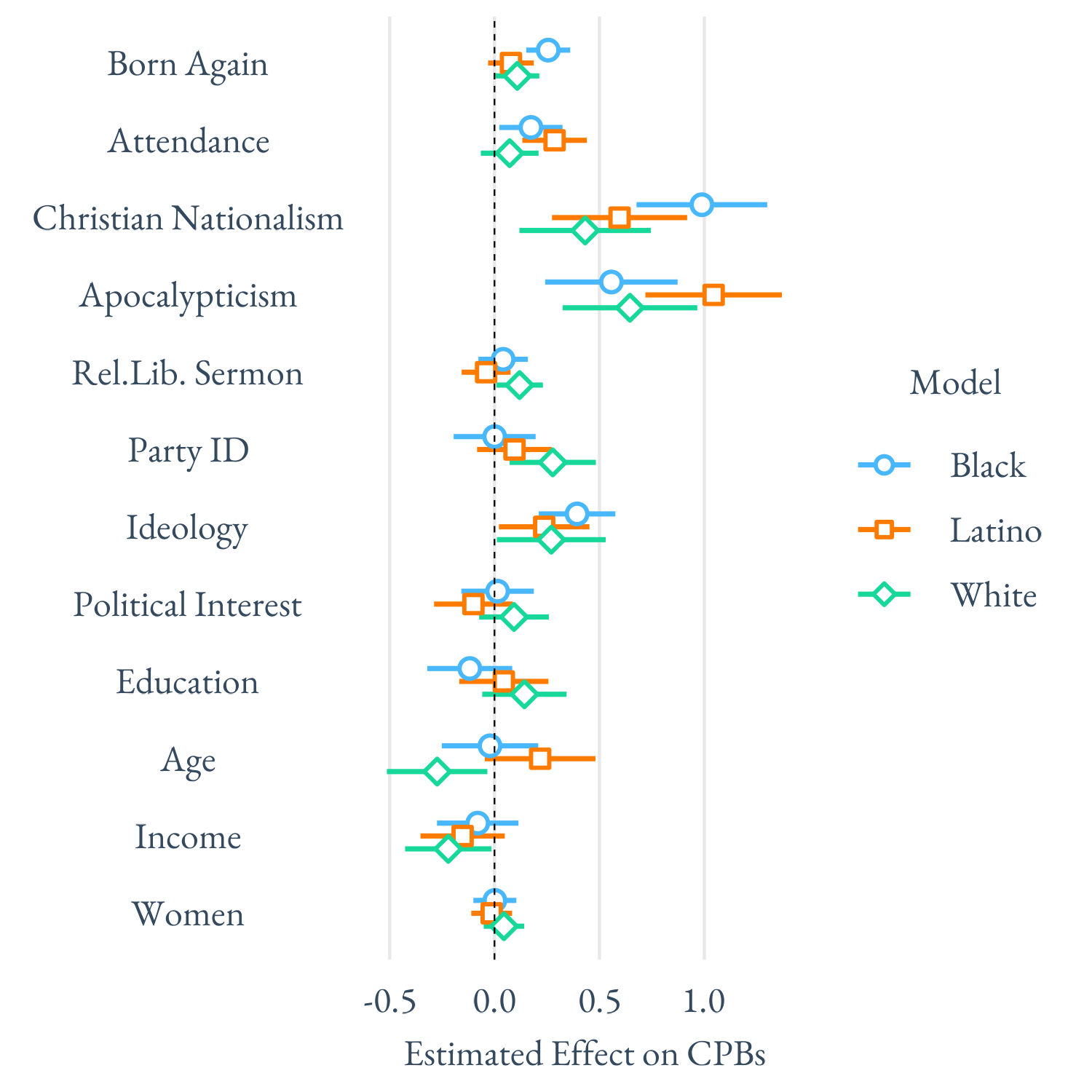
But maybe different types of people from each racial group are drawn to CPBs. We predicted CPBs for Whites, Blacks, and Latinos separately – Figure 1 below shows how the predictors of CPBs compare by racial group. There are relatively few differences between racial groups. For instance, older whites believe in more extensive CPBs, while age has no effect on Blacks or Latinos’ views. It is important to note that worldviews like Christian nationalism and apocalypticism are connected with CPBs for White, Black, and Latino respondents at roughly equivalent rates. And CPBs are connected to greater conservatism for all three racial groups.
Figure 1 – The Predictors of Christian Persecution Beliefs Largely Do Not Differ Across Racial Groups
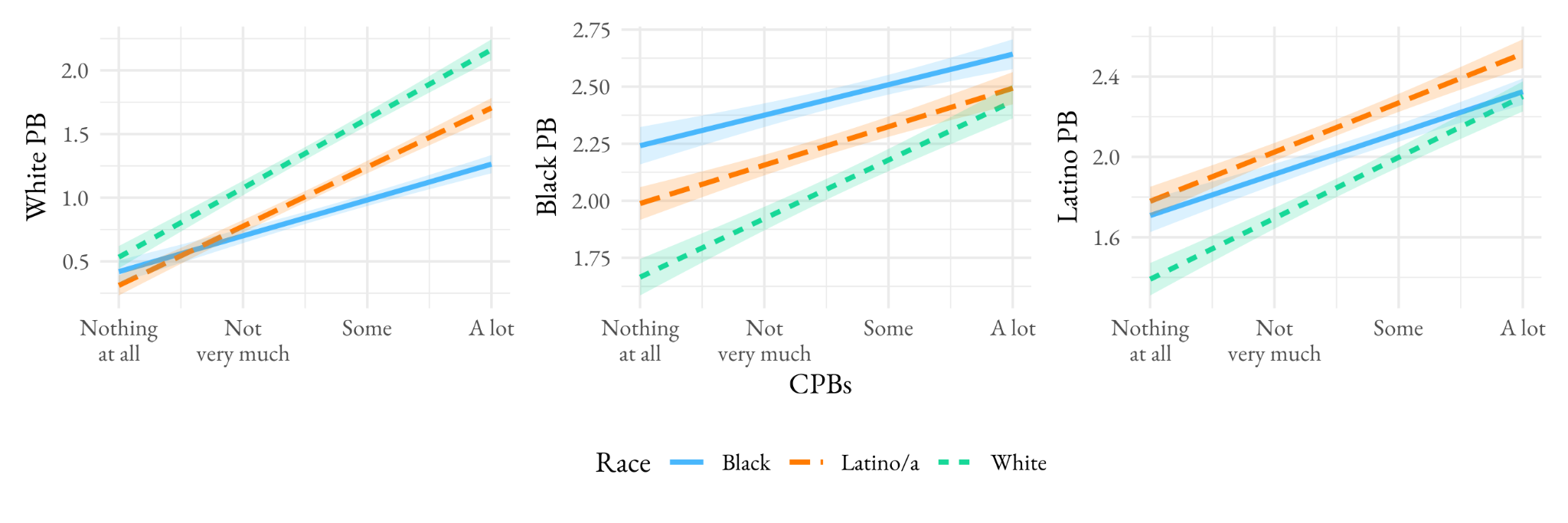
Perhaps CPBs are segmented from views of how racial groups are treated. Given these data, we are able to compare Christian persecution beliefs to discrimination perceptions of each of our three racial groups: White, Black, and Latino (the lines show beliefs of respondents from each racial group while the panels show beliefs about persecution of each racial group — for example, the green line in the first panel shows how more extensive CPBs among Whites are linked to perceptions of racial bias toward Whites). If CPBs are about White advocacy, we should see positive correlations between CPBs and perceptions of anti-White discrimination, but not of anti-Black or anti-Latino discrimination. But our data tells a different story (see Figure 2 below). CPBs are positively correlated with racial group discrimination perceptions, and this is true for all three racial groups.
Figure 2 – Christian Persecution Beliefs are Linked to Higher Racial Persecution Beliefs Across the Board
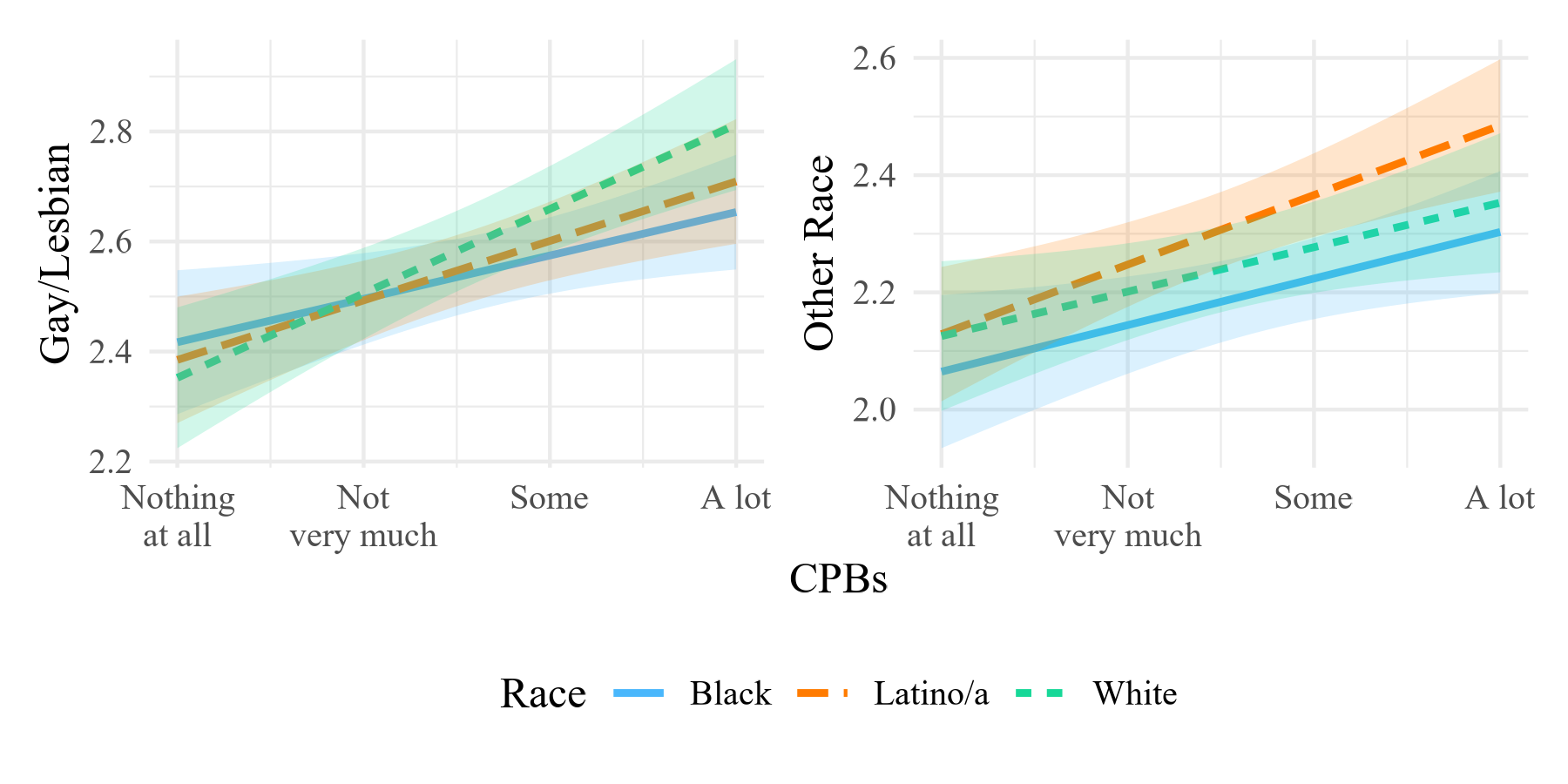
Here’s the wildest finding in the bunch. Those with stronger CPBs are more likely to support the right of a Christian business owner to refuse service to an LGBTQ customer if that violates their religious beliefs. But they also support refusing service to someone of another race if that violates their religious belief (that text was bolded in the question to make sure respondents saw it). And the level of support does not differ between Whites and Black Christians – see Figure 3 below. That is, there is some evidence that more extensive threats against the religious group may lead to prioritizing religious freedom, even if that entails discriminating against racial minorities.
Figure 3 – Link of CPBs to support for religious exemptions to serving someone based on their customer’s sexual orientation and race
In other work, we have argued that threat plays a significant role in shaping perceptions of the social world. In this article, we show that religious threat, or beliefs that your religious group is the target of persecution, can actually bring together people across America’s deep and persistent racial divide. As political scientists continue to wrestle with the meaning of racial difference in American politics, our work suggests that other types of identities, like religious identities, and the threat that makes those identities salient, should be an important part of the conversation.
Brooklyn Walker will join the University of Tennessee-Knoxville as Assistant Professor of Political Science in the fall. Learn more about her work on Twitter, Bluesky, or at her website.
Paul A. Djupe directs the Data for Political Research program at Denison University, is an affiliated scholar with PRRI, the book series editor of Religious Engagement in Democratic Politics (Temple), and co-creator of religioninpublic.blog. Further information about his work can be found at his website and on Bluesky.

