
By Paul A. Djupe and Brooklyn Walker
A Roy’s Report story a few days ago reported on the misogynistic views of Reformed Pastor Dale Patridge of Prescott, Arizona. He is not a newcomer to urging a rollback of women’s rights. Back in November he called for the repeal of the 19th Amendment, which gave women the right to vote, arguing “[W]e should repeal the 19th Amendment because I love America and American women and want to protect our nation from their suicidal empathy.” More recently, he argued on his social media account that women do not have the emotional stability to vote. Last time we checked, emotional maturity was not a condition for the exercise of citizenship rights.
Anyway, there’s good commentary in the article providing context for Partridge’s views. One comment in particular caught my eye, “White Christian nationalism envisions not only a racial and ethnic hierarchy, but a gender hierarchy as well — men at the apex of society and women subordinate in every meaningful way.”
But is this true? Are the misogynistic views of people like Dale Patridge, Joel Webbon, and Doug Wilson limited to White Christian nationalism? We’ve explored opposition to the 19th Amendment in a prior post, but did not look across racial groups.
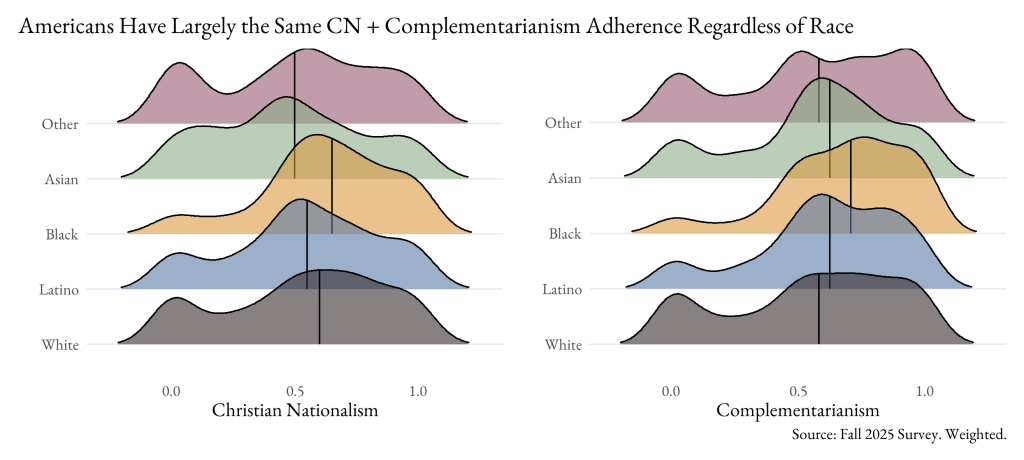
To answer this question, we’re going to draw on data from a survey we conducted in Fall 2025 with about 3,000 adult Americans (results are weighted to resemble the adult population). It is worth noting that Americans, regardless of race, hold roughly equivalent levels of Christian nationalism (measured in a conventional way – see the figure below). In fact, though, Black Americans have modestly higher levels which is mostly a function of the concentration of Christian identifiers among them. American racial groups also have equivalent levels of complementarianism (see this piece for an excellent explainer), with Black American scores, again, somewhat higher. Simply put, this worldview advocates that men and women have separate but complementary roles to play in society, where men are leaders and providers, while submissive women tend to the home. Are those two worldviews linked in the same ways across racial groups?
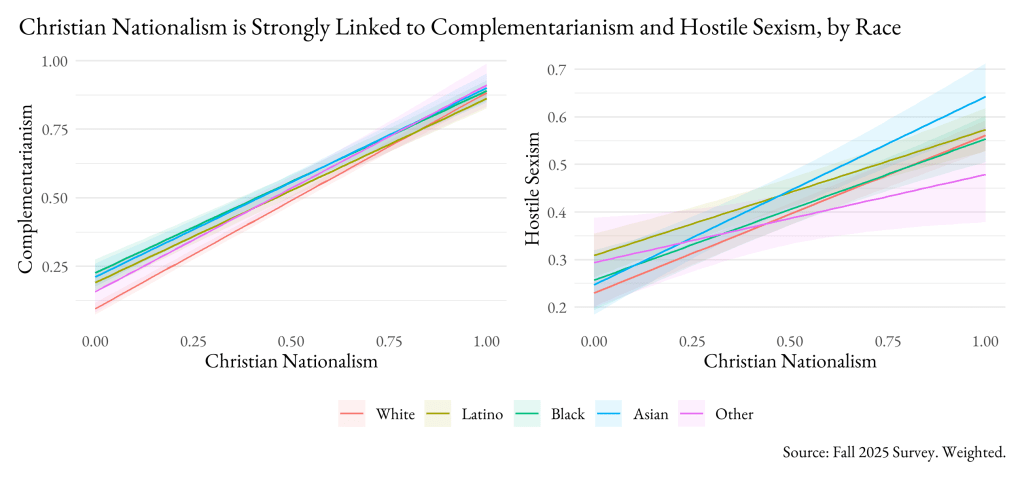
The answer is an emphatic yes. In the following figure, increases in Christian nationalism are very strongly related to escalating complementarianism at almost the same rate by racial group. There is only a bit of differentiation on the low end of Christian nationalism, where Whites have even lower levels of complementarianism. The right panel of the figure below shows the link between Christian nationalism and hostile sexism (a scale of 6 items, including “Women seek to gain power by getting control over men.”). The relationship is still quite strong, but is weaker than the one with complementarianism. It also varies a bit by race – Asians show a stronger relationship, racial “others” show a weaker relationship (both very small groups in the survey), while Whites, Blacks, and Latinos are indistinguishable in how they link their Christian nationalism to hostile sexism.
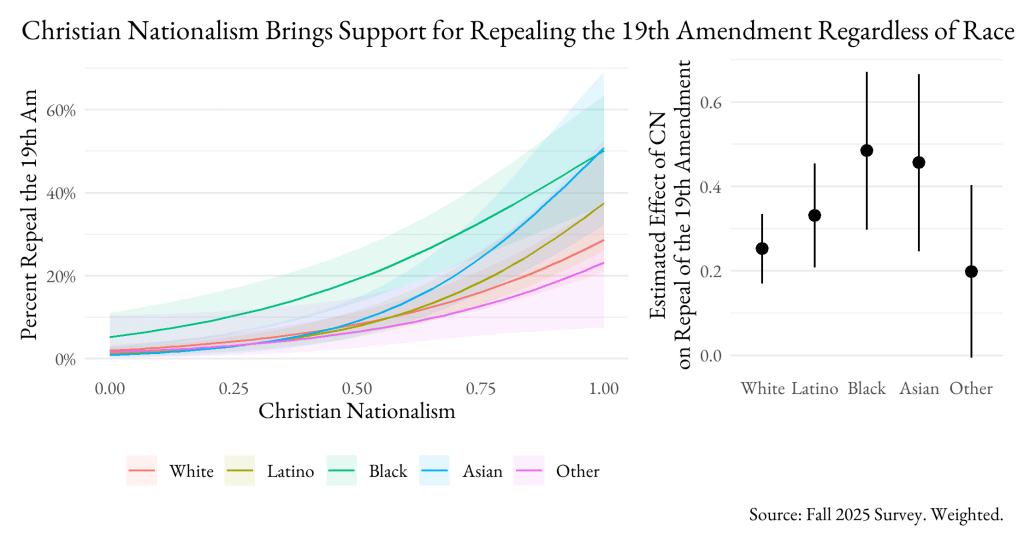
If we had any doubts about the link between Christian nationalism and desire to strip women of their rights, we think this resolves them. In the last year or so, we started hearing what felt like stray mentions of repealing the 19th Amendment – the 1920 Amendment giving women the right to vote. While this seemed absolutely bonkers to us, we’ve learned that there is often a substantial portion of Americans who take such extreme positions. And that’s true here – 20.7 percent of the sample agrees that the amendment should be repealed.
The figure below shows a strong, positive relationship between Christian nationalism and the desire to strip women of their voting rights. The variation by race is technically statistically insignificant (we can’t confidently distinguish those relationships – see the right panel of the figure). But the relationship is modestly stronger among Blacks and Asians and a bit weaker among Whites. Non-Christian nationalists (score of zero on the x axis) have less than 10 percent who favor repeal and this support grows to between 20 and 50 percent in favor at the top of the Christian nationalism scale. It feels hard to call an idea fringe when it is actively talked about and a fifth of the adult population agrees with it.
This is not a new observation for us. In multiple published peer–reviewed articles, we and colleagues have found only highly selective differences in how American racial groups connect their religious worldviews, including their Christian nationalism, to their policy attitudes. In essence, only policies that threaten the fundamental rights of the racial groups sustain different relationships with Christian nationalism by race. This is not at all to say that White Christian nationalism is not dangerous to the American project. It is deeply threatening. But we should not make the assumption that just because we often see White conservative Christians like Partridge making these arguments that the troubling connections are limited to Whites. It is most often the case that Christian nationalist Blacks, Latinos, Asians, and others are thinking much the same.
Paul A. Djupe directs the Data for Political Research program at Denison University, is an affiliated scholar with PRRI, the series editor of Religious Engagement in Democratic Politics (Temple), and co-creator of religioninpublic.blog. Further information about his work can be found at his website or on Bluesky.
Brooklyn Walker is an Assistant Professor of Political Science at the University of Tennessee-Knoxville. Learn more about her work on Twitter, Bluesky, or at her website.

