
By Brooklyn Walker and Paul A. Djupe
[Image source: Schwaninger, Adrian, Christian Wallraven, Douglas W. Cunningham, Sarah D. Chiller-Glaus. 2006. “Processing of facial identity and expression: a psychophysical, physiological, and computational perspective.” Progress in Brain Research 156: 321-343.]
Despite perennial complaints about “Reviewer 2”, the peer review process can take you down profitable rabbit trails. We had such an experience during an early round of peer review at Public Opinion Quarterly for our article, “Christian Nationalism as an Identity.” In that paper, we explore the relationship between Christian nationalist identities and worldviews. To refine our understanding, a reviewer asked us to evaluate the so-called “off-diagonals” (i.e., the respondents whose identities and worldviews didn’t match up). We found that highly educated respondents were more likely to express a stronger Christian nationalist identity than their Christian nationalist worldview would predict, a result that distinguishes Christian nationalism from other, more established, identities.
The social identity literature famously emerged on the foundation of the Minimal Group Paradigm, in which participants were randomly assigned to artificial groups to see if group-based dynamics could emerge out of nothing (yes, they could).
Although Christian nationalist ideas have been around for a long time and although Christian nationalism is linked to other deep identities (like race and religion), Christian nationalism is similar to the Minimal Group Paradigm in that there was no sense of a defined group holding these views until sociologists Sam Perry and Andrew Whitehead named the phenomenon.
We took a Google Scholar dive to see if other scholars had described the types of people most likely to adopt a new identity in the Minimal Group Paradigm – there were surprisingly few results. The closest analogue was published by Reynolds et al. (2007). In a series of minimal group experiments, they find that individual personality variables (personal need for structure, social dominance orientation, authoritarianism, ethnocentrism) don’t predict whether a respondent adopts a stronger in-group identity. Instead, their results suggest that it’s those individuals who are paying more attention during the experiment that adopt stronger identities. That might help explain why the highly educated were more likely to adopt a Christian nationalist identity – they pay better attention.
Does our data yield similar findings in the real-world example of an emerging Christian nationalist identity? There are several ways to capture identity. The first is to ask people whether they would put themselves into a group. This is a binary choice – someone either says they are a member of a group or not. We call this self-categorization. But there are other ways to think about identity that contain more nuance. We also asked our respondents how important being a Christian nationalist is to their identity, how they would feel if a close relative married a Christian nationalist, whether what happens to Christian nationalists in this country will have something to do with what happens to them, how much discrimination Christian nationalists face, and whether it’s important for Christian nationalists to work together to change laws that are unfair to Christian nationalists. These are standard measures in the racial identity literature, and we simply applied these concepts to Christian nationalism (CN).
The figure below shows that a CN worldview is strongly linked to the strength of a CN identity. The relationship levels out at the high end of a CN worldview, meaning some people who researchers would describe as CN are wary of adopting that term and associating with that group. On the flipside, there are almost no people who score below the worldview scale midpoint (0.5) and have strong CN identities – the upper left quadrant is essentially blank.
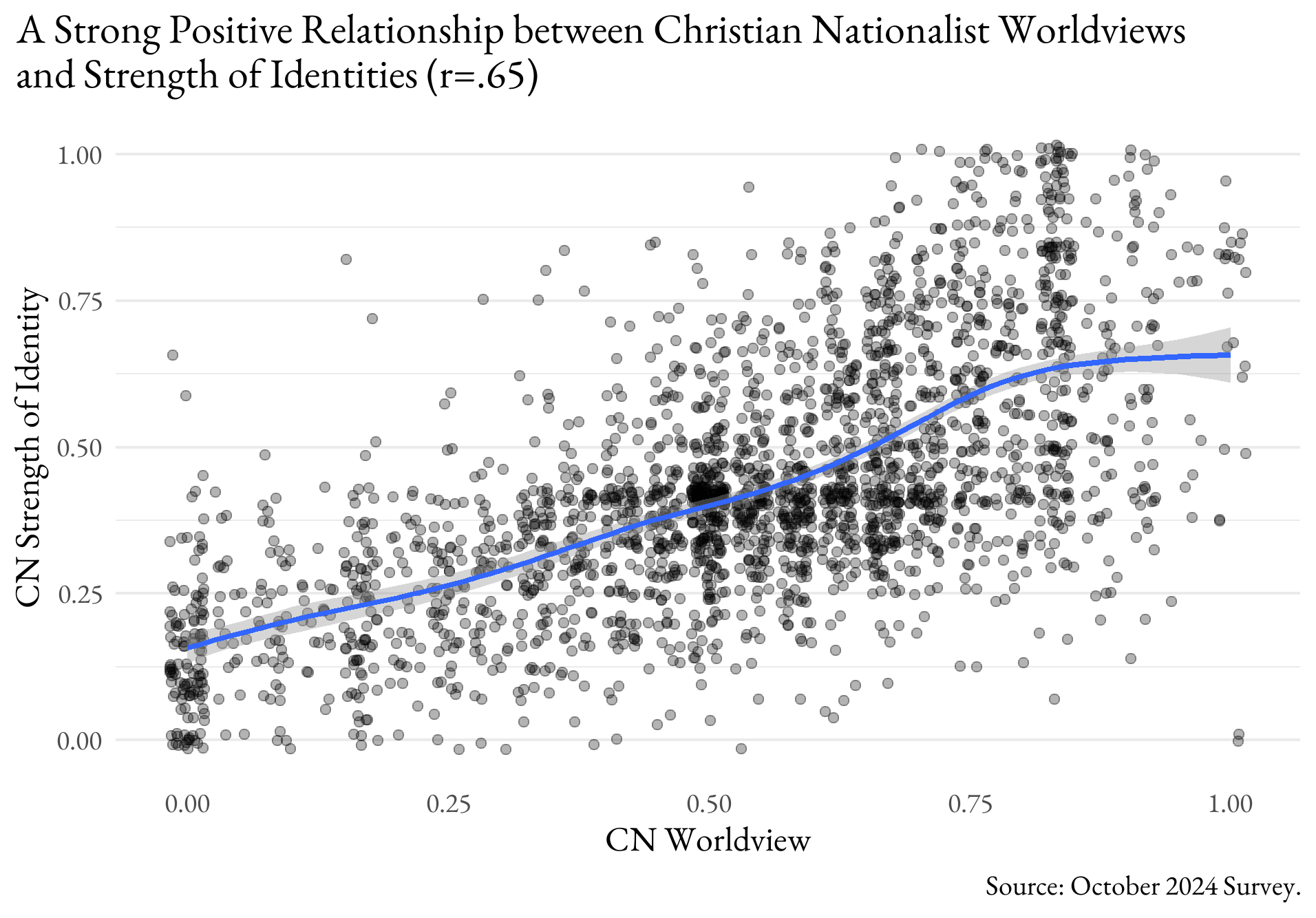
Second, we dug into the respondents who fall ‘off the diagonal’ – those who have stronger or weaker identities than we would expect. We identified those respondents whose Christian nationalist worldview (hereafter CNWV) scores were more than 2 standard deviations away from the line-of-best-fit. Individuals far below the line have a much stronger CNWV than what their Christian nationalist identity index (hereafter CNID) score would suggest, while individuals far above the line have a stronger CNID than their CNWV score would suggest.
The models drew our attention to political sophistication, and what we found was surprising. Typically, it’s reasonable to expect that individuals with exceptionally high identities (compared to their worldview) might be less sophisticated, relying on fast processing and social reasoning, instead of a thought-through ideology. But in this case, we found the opposite.
Individuals with identity levels that are far above expectations had higher education levels and more political interest compared to those near the predicted amount. And it’s not as though respondents with stronger-than-expected identities are blindly adopting the label – respondents with stronger identities than their worldviews would predict were more likely to have heard of CN before taking the survey. Moreover, respondents with weaker identities than their worldview would suggest did not differ from those near the line in any statistically-significant way. We tested this relationship in multiple ways and found consistent results.
This might be surprising to some — worldviews are typically more cognitively-demanding to hold than identities. But, harkening back to the Minimal Group Paradigm literature, individuals who are more knowledgeable and more interested are likely to be on the leading edge of new identity formation.
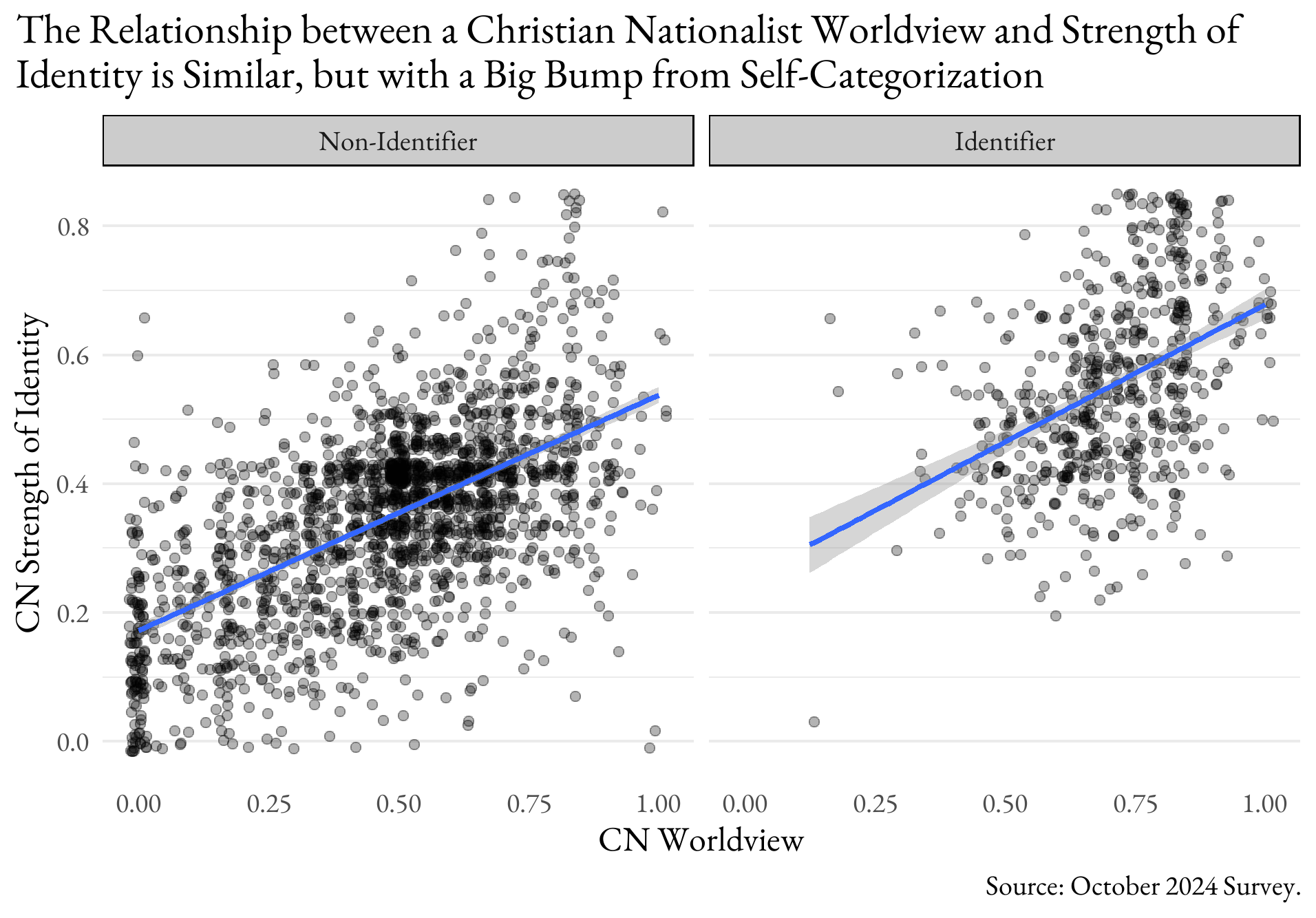
Another question raised by the reviewer was whether the strength of identity matters (the more nuanced items), above and beyond self-categorization. The scatterplots below show the relationship between the strength of a CN identity and the strength of agreement with a CN worldview separately for identifiers and non-identifiers. It is clear from this look at the data that there is a strong, positive relationship between the CNWV and CNID for both identifiers and non-identifiers. That is significant because it indicates that categorization is not just a clean step change in the worldview – strength of identity moves consistently with the worldview. But one difference between the two panels is the ~15 point bump in strength of identity from those who self-categorize as a Christian nationalist. The other point of note is that there are almost no self-categorizers who have a worldview score less than 0.5 on the scale.
A critique of the Minimal Group Paradigm in general (and one that’s applicable to Reynolds et al.) is that it lacks external validity because groups in the real world aren’t randomly assigned but instead emerge from real social cleavages. Of course, though, the most frequently-studied group identities (racial, gender, partisan) have labels and worldviews that developed long ago. Here, with Christian nationalism, we have a front-row seat to observe and document the development of a new identity ‘in the wild’, not just in a lab. And what we’re observing, on the basis of Reviewer 2’s suggestion, is that emerging identities don’t necessarily follow the rules of established ones. People with more education, interest, and information are on the leading edge of Christian nationalist identity adaptation, which indicates that identification as Christian nationalist is likely not at its ceiling.
Brooklyn Walker is an Assistant Professor of Political Science at the University of Tennessee-Knoxville. Learn more about her work on Twitter, Bluesky, or at her website.
Paul A. Djupe directs the Data for Political Research program at Denison University, is an affiliated scholar with PRRI, the book series editor of Religious Engagement in Democratic Politics (Temple), and co-creator of religioninpublic.blog. Further information about his work can be found at his website and on Bluesky.

