Jacob Neiheisel (SUNY-Buffalo) and Paul A. Djupe (Denison University)
The world is beset by demons; warfare in the spirit realm is unfolding in ways that resonate with the Book of Revelation presaging horribly violent engagement on earth. If the world is in decline and hurtling toward the final battle, what do you do?
Historically, one of the options was to wait and pray because Jesus will come as a thief in the night to take his followers to Heaven. The only thing one can do under such circumstances is to be right with God and to pray fervently that he comes soon. This “pre-millennial dispensationalist” view is on the decline, however, and much more assertive, active theologies have taken root. These “post-millennialist” viewpoints are part of a broad and growing tradition that suggests believers have agency to bring about the final battle and Christ’s triumphant return to earth. Though these seem like incompatible worldviews (because they are), many Christians believe elements of both and those who attend worship more often believe both at higher rates.
So, if you’re part of the latter camp and believe that we are living through the end times as prophesied in the Bible, do you wait and pray or start preparing for war? If the market has anything to say about this it is that people are prepping for dark times ahead when we experience full societal collapse. Jim Bakker (yes, the televangelist from the 1980s who was brought down by accusations that he raped his secretary and then paid her hush money – and here you thought that was a 2000s thing) is selling what NPR dubbed “Apocalypse Chow,” which is apparently not entirely appetizing (you too can obtain 31,000 servings of dehydrated meals for $4500 in what is called the “Peace of Mind Final Countdown Offer”). But he’s not the only one. Ads for doomsday supplies are all over the web, especially those populated by conservative Christians.
In new research out at Politics & Religion (open access!) with Jason Adkins, we wanted to test whether those with more apocalyptic beliefs are preparing to stand with the full armor of God stockpiling buckets of barely edible, freeze-dried food. That’s not all we asked about, of course. We used a battery of items designed by the Department of Homeland Security that has been used before on ANES surveys, including (8) activities like practicing disaster drills and taking a CPR class, as well as owning a list of (8) supplies like a radio, extra medicine, and batteries. The data come from surveying 3,100 respondents supplied by Lucid that we weighted to resemble the nation’s adult population.
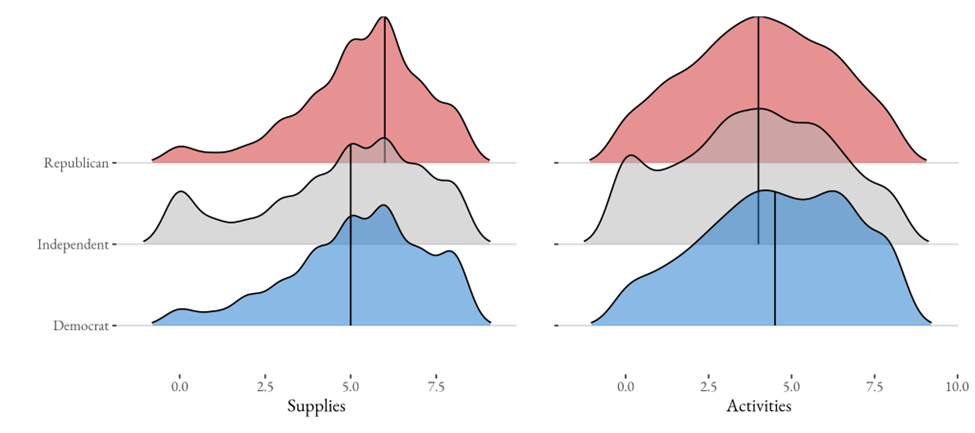
As the following figure shows, most Americans are pretty well prepared for a short disaster having about 5 of the supplies and engaging in about 5 of the activities. Republicans have a few more of the supplies and Democrats have engaged in a bit more of the activities, but they are effectively equivalent.
The Partisan Distribution of Preparedness
Instead, the variation in preparedness is tightly connected to apocalypticism. Our measure, discussed in detail in the paper and elsewhere, has four components: belief in human abilities to channel God’s will and power (prophecy), that we are in the end times now, that embodied evil walks the earth, and that Christians are being persecuted. In the figure below we show the connection of preparedness and apocalypticism by race in part because prepping is widely seen as a white people thing. This evidence suggests it is not. Instead, for each racial group, preparedness climbs after the midpoint of the apocalypticism scale so that the most apocalyptic have engaged in about 50 percent more preparedness behavior than those who number among the least apocalyptic.

Part of this relationship surely involves the belief that the world is entering a season of decline and that persecution is coming, but it also takes mobilization to connect these theological ideas to buying particular things and undertaking certain activities. And that’s what we find – church involvement and civic skills (the ability to organize) help propel people with apocalyptic views toward greater levels of preparedness.
But that’s not all. The coming “storm” is not value neutral and is perceived to target Christians explicitly. The language associated with apocalyptics these days appears to be getting increasingly “bloodthirsty,” according to Katherine Stewart. And we can find evidence of this in our data, as apocalypticism is very strongly linked to gun owners desiring to buy another gun in the near future. That the effect of apocalypticism on the probability of buying a gun is far more pronounced among those who already own a gun suggests that apocalyptic gun owners are engaging in stockpiling behavior of the type that one might engage in if they expect bloody conflict to be on the horizon.
Apocalyptic Gun Owners Appear to Be Stockpiling Guns

After this evidence, it’s funny that previous research has generally found that religious beliefs are poor predictors of individual preparedness activity. As we have found, the combination of supernatural involvement in this world, belief in both forces of active good and evil, as well as anticipation of their confrontation constitute apocalypticism – a worldview prone to extremes that can justify all manner of activity when the stakes are everything. Watch this space for more as we continue to roll out how apocalypticism is behind much of the extreme politics we have witnessed recently.
Jacob Neiheisel is an associate professor of political science at the University at Buffalo, SUNY. He very rarely tweets anything of note but can be found there all the same.
Professor Paul A. Djupe directs the Data for Political Research program at Denison University, is an affiliated scholar with PRRI, the series editor of Religious Engagement in Democratic Politics (Temple), and co-creator of religioninpublic.blog. Further information about his work can be found on his website and on Twitter.
 Religion in Public