By Brooklyn Walker and Kevin Mullinix
[Image credit: Rock Church Dallas]
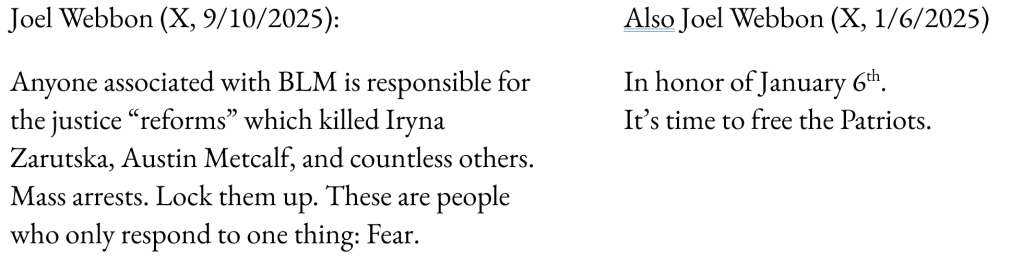
Joel Webbon is a notable Christian nationalist pastor. Closely tied to Doug Wilson and other advocates of Christian nationalism, he maintains an active social media presence, frequently addressing controversial issues. In 2025, he reflected on the Black Lives Matter protests of 2020 and the January 6th protests of 2021. The Black Lives Matter protests were largely nonviolent demonstrations that took place across thousands of American cities, calling for racial equity in the criminal justice system. The January 6th protests in Washington, D.C. involved an invasion of the U.S. Capitol building, resulting in seven deaths, over a hundred injured law enforcement officers, and over $30 million in damage. Yet, intriguingly, Webbon called for harsh punishment for BLM protestors and the exoneration for January 6 rioters – even calling the latter “Patriots.” Why?
For decades, social scientists have studied why some people are more punitive than others. Much of this research has focused on figuring out when and why people support harsh punishments for criminal offenders. Prior studies tell us a lot about who is most eager to get “tough on crime.” For example, unsurprisingly, people who are more concerned about crime and victimization tend to be more punitive[MK1] [MK2]. Other work makes clear that people with higher levels of racial resentment [MK3] [MK4] prefer harsher penalties for criminal offenders.
We wondered if Christian nationalism might be related to punitiveness.
We weren’t the first to consider this possibility. Joshua Davis demonstrated that Christian nationalism was correlated with increased support for the death penalty, stricter punishments for federal crimes, and for ‘cracking down on troublemakers’. We thought he was right (and were able to replicate his findings), but we also suspected that the relationship between Christian nationalism and punitiveness is not always so straightforward.
Christian nationalism is related to strong social boundaries. As Phil Gorski and Sam Perry frame it, Christian nationalism is about ‘liberty for us, order for them, maintained through violence’. Given this, we thought that the relationship between Christian nationalism and punitiveness was contingent on the crime itself – the type of crime and the descriptions of those involved.
In a new piece at Political Science Quarterly, we provide evidence that the effects of Christian nationalism on people’s willingness to get tough on crime look different from one situation to the next. To illustrate this, we designed a series of experiments and plugged them into surveys implemented in 2023 and 2025. The surveys were fielded to a national sample of 1,977 and 599 respondents (respectively) by Cint Theorem. People were asked what they thought was the appropriate punishment for various scenarios; the punitive options ranged from community service to varying lengths of incarceration to the death penalty. We scaled these punitiveness assessments to range from 0-1.
In one of these experiments, people were told about an assault and battery. Some respondents were told the victim was male, others were told the victim was female, and some were told the victim’s gender was nonbinary.
The left side of Figure 1 reveals that, for people at the lowest level of Christian nationalism, the gender of the victim had little effect on the harshness of their preferred punishment. Yet the right side of the figure looks quite different. Christian nationalists were much less punitive toward the offender when the victim’s gender was described as non-binary.
Victims who do not fit into dichotomous gender categories – and do not conform to Christian nationalist gender norms – do not appear to elicit similar levels of sympathy. Punitiveness is about restoration of justice, and it seems as though, for Christian nationalists, assault of a nonbinary person warrants weaker punishment than assault of people who fit Christian nationalist gender norms.
Figure 1: Christian Nationalism and Punitiveness based on Victim Gender
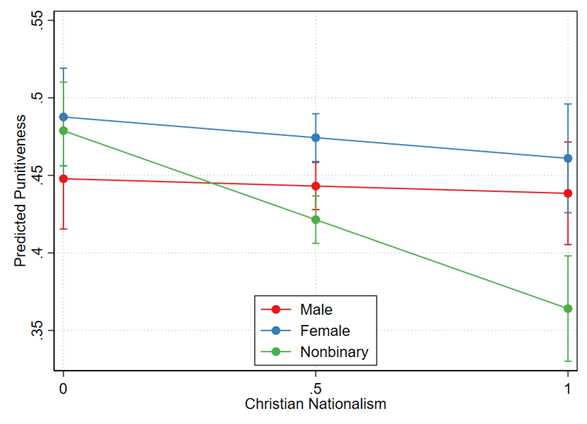
Source: 2023 Survey. Predicted punitiveness from OLS regression models. Vertical bars reflect 95% confidence intervals.
We also presented respondents with scenarios related to white collar crime – specifically, tax evasion. Here, we varied the financial situation of the offender. Some were informed that the tax evasion was committed by wealthy individual. Others were told that the offender was low income, and a final group was told about a person whose financial situation was left ambiguous. These alternative descriptions were consequential.
Figure 2 reveals that respondents low in Christian nationalism were more punitive of a wealthy person who illegally evaded taxes, and considerably less punitive of a low-income offender. But these differences were far less pronounced among Christian nationalists. While it reduced punitiveness toward the wealthy, Christian nationalism prompted harsher penalties for low-income tax offenders.
This makes sense – Christian nationalism is associated with economic worldviews that blame the poor (not larger structures) for their plight. If they find the work ethic and morality of the poor questionable, it’s not surprising that Christian nationalists are more punitive of them.
Figure 2: Christian Nationalism and Punitiveness for Tax Evasion by Offender Income
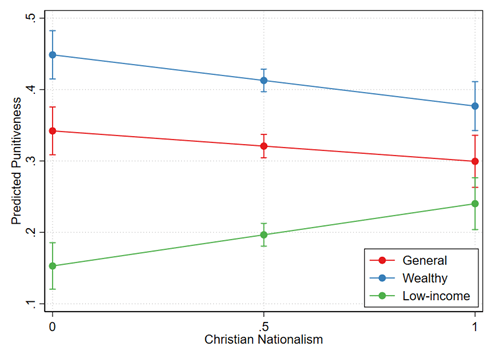
Source: 2023 Survey. Predicted punitiveness from OLS regression models. Vertical bars reflect 95% confidence intervals.
In another study, we designed an experiment to highlight the role of religious identities and descriptions. We thought this should be especially powerful. We told people that 501(c)3 organizations are offered tax-exempt status but must refrain from political campaigning. We next told some of them that a non-profit leader (with no obvious religious affiliation) had violated those rules. Other respondents were told that a Christian pastor or an Islamic imam had violated the rules.
Figure 3 shows that as Christian nationalism rises, punitiveness for non-profit and Christian leaders declines. But as Christian nationalism rises, punitiveness for Islamic imams rises. In other words, the religious affiliation of the perpetrator mattered – Christians were offered greater leniency, Muslims received legalism.
Figure 3: Christian Nationalism and Punitiveness for IRS Violations by Offender Religion
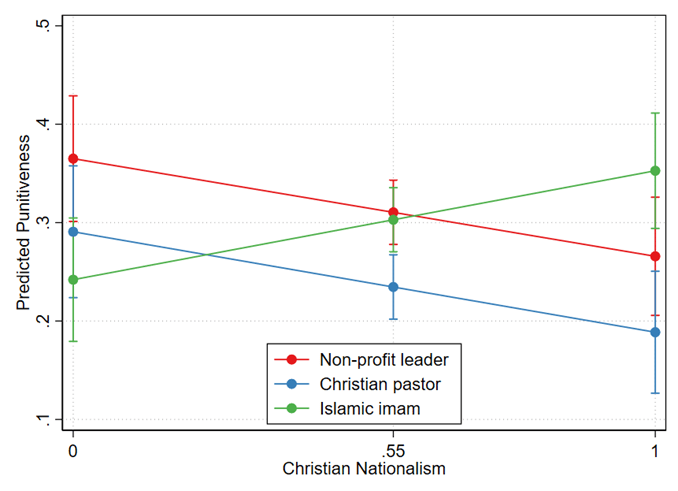
Source: 2025 Survey. Predicted punitiveness from OLS regression models. Vertical bars reflect 95% confidence intervals.
Beyond these experiments, our Political Science Quarterly paper presents additional evidence of the nuanced ways in which Christian nationalism impacts the extent to which people do and do not punish criminal offenders.
What is the effect of Christian nationalism on punitiveness? The answer is: it depends. It depends on the description of the victim and offender and the nature of the crime. Christian nationalism is inextricably linked to particular beliefs, norms, and identities. As such, it functions like a pair of glasses that color how people see criminal offenses. Given both the comparatively high levels of punitiveness in the American system and the growing influence of Christian nationalism, it is critical that we recognize these dynamics.
Brooklyn Walker is an Assistant Professor of Political Science at the University of Tennessee-Knoxville. Learn more about her work on Twitter, Bluesky, or at her website.
Kevin Mullinix is an Associate Professor of Political Science at the University of Kansas. His research is broadly focused on public opinion and political behavior in the United States.
[MK1]https://onlinelibrary.wiley.com/doi/abs/10.1111/j.1745-9125.2004.tb00523.x?casa_token=zdD01E-k5zsAAAAA%3ANWpyCZQUgWjrvYRDD9kDinyqG8of3lWJPsQ3HMMRtjmxZbAU82pLthzNOLXkbPVNIjUqh3ppd2_qJQ
[MK2]https://journals.sagepub.com/doi/abs/10.1177/1462474508098131?casa_token=bztx8nB4xycAAAAA:KAJeh-zFO1jKBJa-GEb6utjwO1_ABMhChyvXUP_w2rr1et6r0OU0diq3SKjsIJQbUyECj9ILHpM
[MK3]https://link.springer.com/article/10.1007/s10940-016-9319-4
[MK4]https://onlinelibrary.wiley.com/doi/abs/10.1111/1745-9125.12035?casa_token=SZIJZPIZSMoAAAAA:JZaFNyyOZUwO-mivzLNqQIzpeB0J5H9g-0x6QOilLv7pRyQHw3_FZCU6kO-hoffk67sobjpzFqnapQ

