
By Donald P. Haider-Markel, Abigail Vegter, and Brooklyn Walker
[Image note: AI generated image.]
Concerns about political violence in the United States have grown in recent years, yet we still know surprisingly little about how religion and gun culture interact to shape these attitudes. A growing body of research has examined the rise of political violence in the United States, but fewer studies have considered how religious nationalism and gun culture may jointly shape attitudes toward violence.
Our new article “An Army for God: Gun Ownership, Christian Nationalism, and Support for Political Violence” published in Social Science Quarterly addresses this gap by showing that Christian nationalism, gun ownership, and gun owner identity are each associated with greater support for political violence, and that these relationships are amplified when identities overlap.
Using original survey data from a nationally representative sample of American adults in 2021, we argue that Christian nationalism and gun culture operate as mutually reinforcing orientations. Christian nationalism contributes grievance, boundary maintenance, and a sense of embattlement; gun ownership contributes the perceived means; and gun identity contributes the normative readiness to respond forcefully to threat. Together, these factors appear to make political violence more acceptable as a political strategy.
Christian nationalism and political grievance
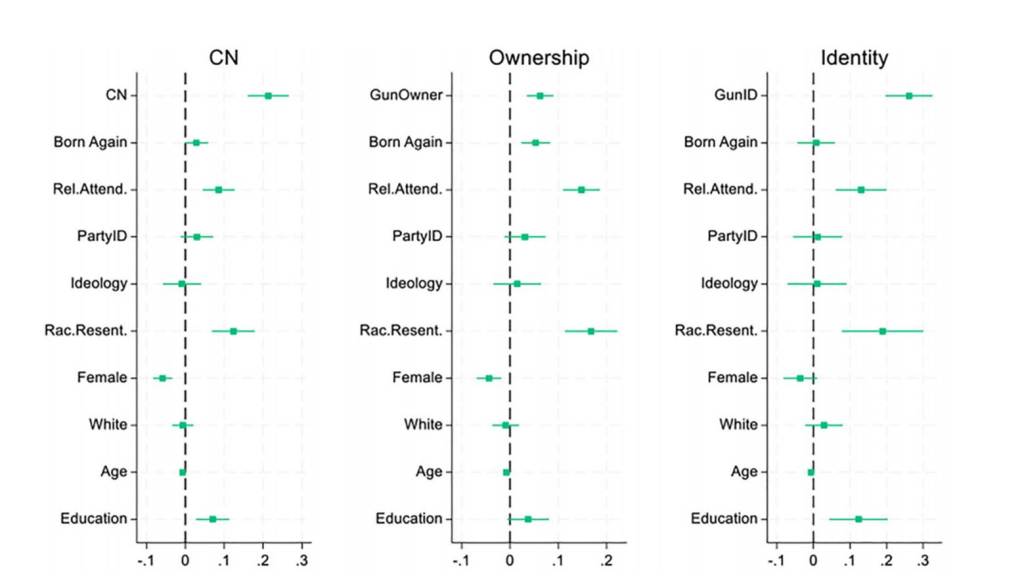
Figure 1 shows how Christian nationalism, gun ownership, and gun identity are related to political violence support. The green dots indicate the estimate for each variable, and the green line shows the confidence interval. Confidence intervals that don’t cross the dotted line at ‘0’ are statistically significant.
We situate Christian nationalism within a broader literature on political grievance and democratic instability. Christian nationalism, as we define it, is not simply religiosity or conservative theology. Rather, it is a framework that merges American and Christian identity, often implying that the nation has been divinely favored and is now under threat.
That sense of threat matters. We argue that Christian nationalism can encourage support for political violence because it frames political conflict as a struggle over moral order rather than ordinary disagreement. When democratic institutions are seen as ineffective, compromised, or hostile, violence becomes more imaginable as a corrective force. Our data bear this out – Christian nationalism is positively associated with political violence support more strongly than other variables in our model.
Gun ownership and political violence
We also link gun ownership to support for political violence. We do not claim that gun ownership is inherently violent. Instead, we emphasize the symbolic and cultural meanings attached to guns in contemporary American politics.
For many gun owners, firearms are associated with self-defense, vigilance, and preparedness. Those meanings can make violence easier to imagine, especially under conditions of threat. In this sense, by making available a tool of violence, gun owners are more likely to think of violence as a political tool. Again, we find that gun ownership matters, but to a lesser degree than other variables like racial resentment.
Figure 1: Christian nationalism, gun ownership, and gun owner identity increase political violence support
Gun identity as a stronger mechanism
One of the most important contributions of the article is its distinction between gun ownership and gun owner identity. Ownership alone matters, but identity matters more.
We find that individuals who strongly identify as gun owners are especially likely to support political violence. This result suggests that the political significance of guns lies not only in possession but also in the social meanings attached to ownership. When gun ownership becomes part of the self, it is more likely to shape political judgment in ways that normalize the use of force. People who identify as gun owners are more likely to believe that they have a responsibility to protect their communities, even if that protection entails violence. In our data, gun owner identity is a strong predictor of political violence support, with only racial resentment approaching its effect.
The interaction of identities
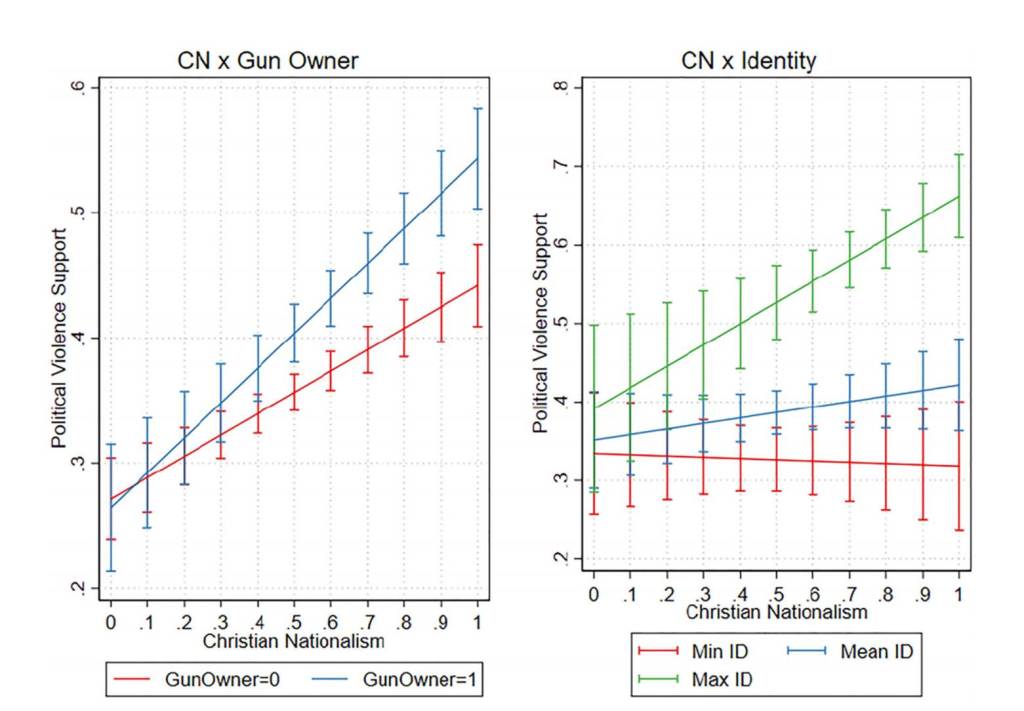
Our central finding is that Christian nationalism and gun culture are not merely correlated; they interact. This finding isn’t really about gun ownership. Figure 2 shows that Christian nationalism is associated with greater support for political violence, regardless of whether someone owns a gun or not. Instead, the action is largely occurring among gun owners for whom gun ownership is an important part of their identity. In other words, Christian nationalism isn’t associated with rises in political violence support for people low in gun owner identity. But Christian nationalism is linked to a dramatic rise in political violence support for respondents who have a strong gun owner identity, as illustrated in Figure 2.
This interaction is analytically important. It suggests that Christian nationalism supplies the grievance, threat and moral justification, while gun identity supplies a readiness to act in response to threat. In combination, these identities appear to create a more permissive environment for political violence than either one alone.
Our findings therefore extend beyond a simple account of religious conservatism or firearms politics. They point to a broader fusion of identity, threat perception, and political legitimacy that may help explain why some Americans view political violence as an acceptable means to defend their preferred social order.
Figure 2: Christian nationalism increases political violence support among gun owners and gun identifiers
Implications for religion and public life
For scholars of religion and public life, this article is significant because it highlights the political consequences of religious identity formation. Christian nationalism is not only a belief system about nation and faith; it is also a framework that can intensify political antagonism and weaken commitment to democratic restraint.
Our findings also suggest that religion does not operate in isolation. Its political effects are shaped by adjacent identities and cultural systems, including gun culture, masculinity, and ideas of self-defense. When these worlds overlap, they may reinforce each other in ways that heighten support for coercive or violent forms of politics.
That does not mean Christian nationalism or gun ownership inevitably lead to political violence. But it does mean that scholars and observers should pay close attention to the conditions under which these identities become mutually reinforcing. Our study offers an important reminder that democratic stability depends not only on institutions, but also on the narratives communities use to interpret threat, authority, and legitimate action.
Donald P. Haider-Markel is Professor of Political Science at the University of Kansas. Find him on Bluesky at @dhmarkel.bsky.social.
Abigail Vegter is an Assistant Professor of Political Science at William Jewell College in Liberty, MO. To see more of her work, visit abigailvegter.com or check out her twitter, @abigailvegter.
Brooklyn Walker is an Assistant Professor of Political Science at the University of Tennessee-Knoxville. Learn more about her work on Twitter, Bluesky, or at her website.

