
Paul A. Djupe and Brooklyn Walker
The conventional wisdom about religious congregations is that they are social places, where people can find opportunities for mutual support to ease the existential and real angst of the world. Attenders are often in the pews with friends and family and make new friends in small groups and activities that go on during the week. If that’s true, then it makes sense that observers would worry that the decline of religious affiliation is linked to the “epidemic of loneliness.” After all, without religious communities, the nones are surrounded by fewer people and might feel like a kite in the winds of life’s vagaries.
But what if it’s not true?
Let’s get a crucial definition straight. Loneliness is not about the number of people you are surrounded by, it’s about feeling disconnected from people. That feeling of disconnection can happen in a crowd or in the wilderness. That’s why the commonly-used questions used to tap loneliness do not reference the number of people around, but the feeling of disconnection; the questions we used included: How often do you feel that you lack companionship? How often do you feel left out? And How often do you feel isolated from others? The five response options ranged from never to very often. We averaged responses across the three questions and then condensed them to run from 0 (never lonely) to 1 (very often lonely).
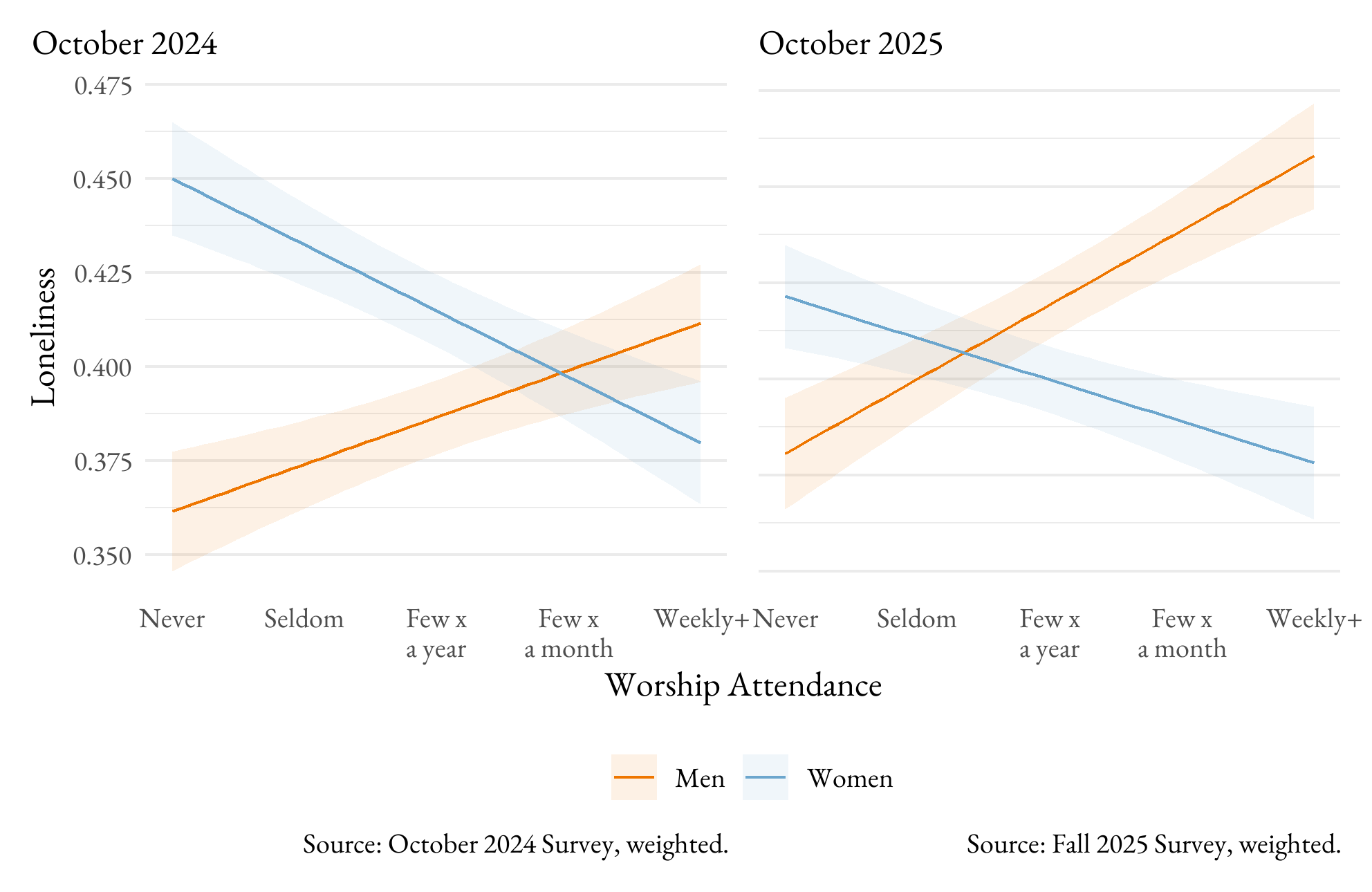
When it comes to social connection, it turns out that not all people yield the same gains from religious service attendance. In the United States, many congregations utilize gendered tools to meet the unique social needs of men and women, so we start with gender. Men and women are getting different things out of religion. Below are two looks at feelings of loneliness tied to frequency of worship attendance from the two datasets we have that included the same loneliness questions conducted in October 2024 and October 2025 (both are weighted to resemble the national adult population). As men’s attendance increases, so does their loneliness, while for women it does the exact opposite. The patterns are roughly the same across the two surveys, though the levels are not quite – men’s loneliness is capped lower in the election year and expands out in the off-election year. Is it related to the election?
Figure 1 – Men and Women are Getting Different Social Returns on their Attendance
This is not just about worship attendance. One common objection is that attendance isn’t where the social connection happens, it’s in the activities and small groups where people can connect over shared problems and projects. But the pattern looks essentially the same for men. It doesn’t look the same for women for whom loneliness increases as involvement increases. Why?
Figure 2 – The Involvement Pattern Yields The Same Attendance Conclusion for Men
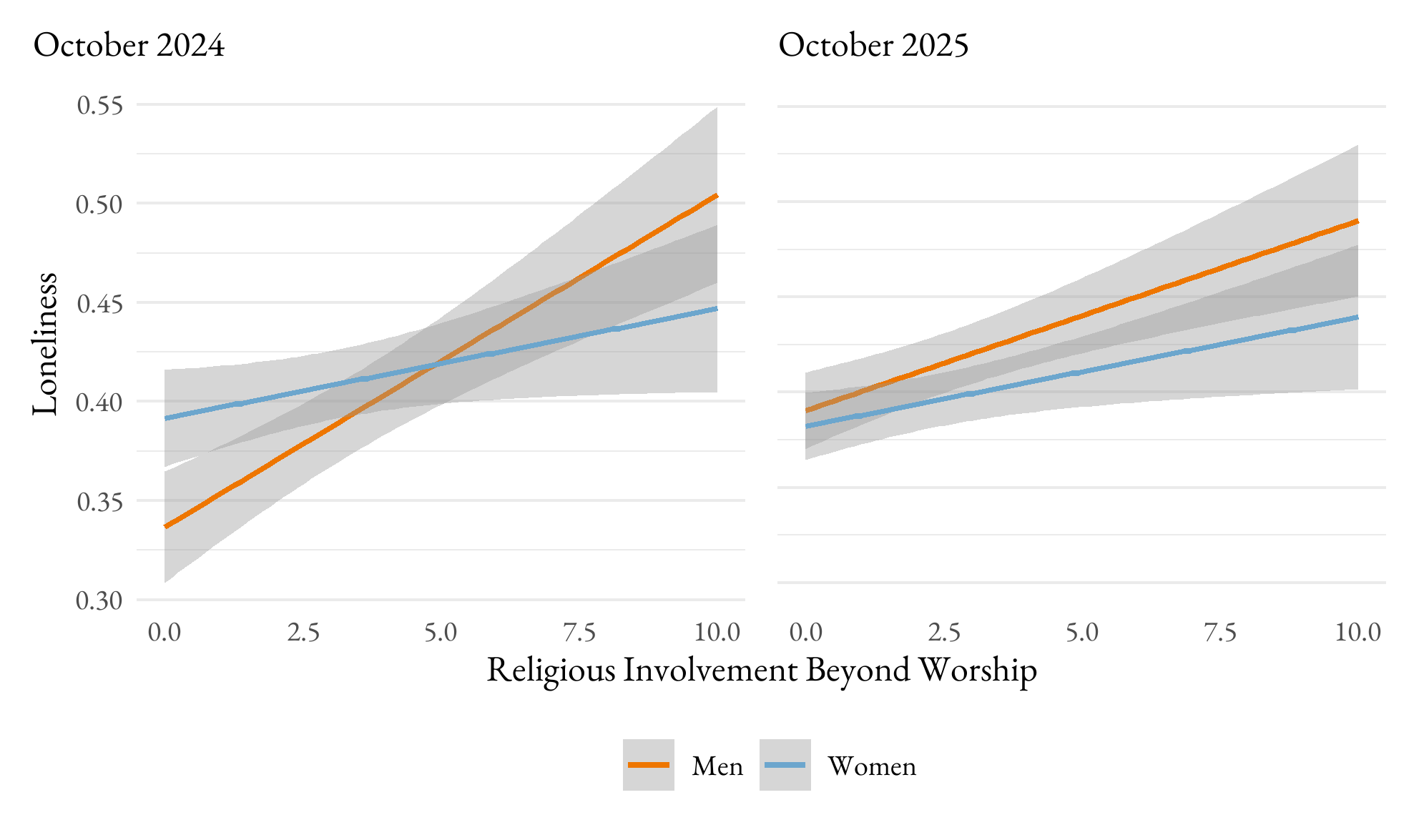
One reason why loneliness might be higher in those more involved is that they are getting involved to cure their loneliness. We can’t sort out the direction of the causal arrow given the data we have, and for one conclusion it doesn’t matter – the involved and attending population in the US is more lonely than the less or non-attending population, especially among men.
That matters because of the religion and politics of lonely people. Here’s a snapshot of an extreme religious worldview – apocalypticism – that is connected to loneliness. Apocalypticism, as described in an earlier post,
combines the belief that embodied evil exists on earth, that believers can channel God’s power, that the final battle between good and evil is happening or imminent, and that Christians are being persecuted. It may be no surprise that these beliefs constitute a particularly toxic worldview that leads to a wide variety of anti-democratic views and behaviors as we document in a forthcoming book The Politics of the End (NYU Press coming later this year).
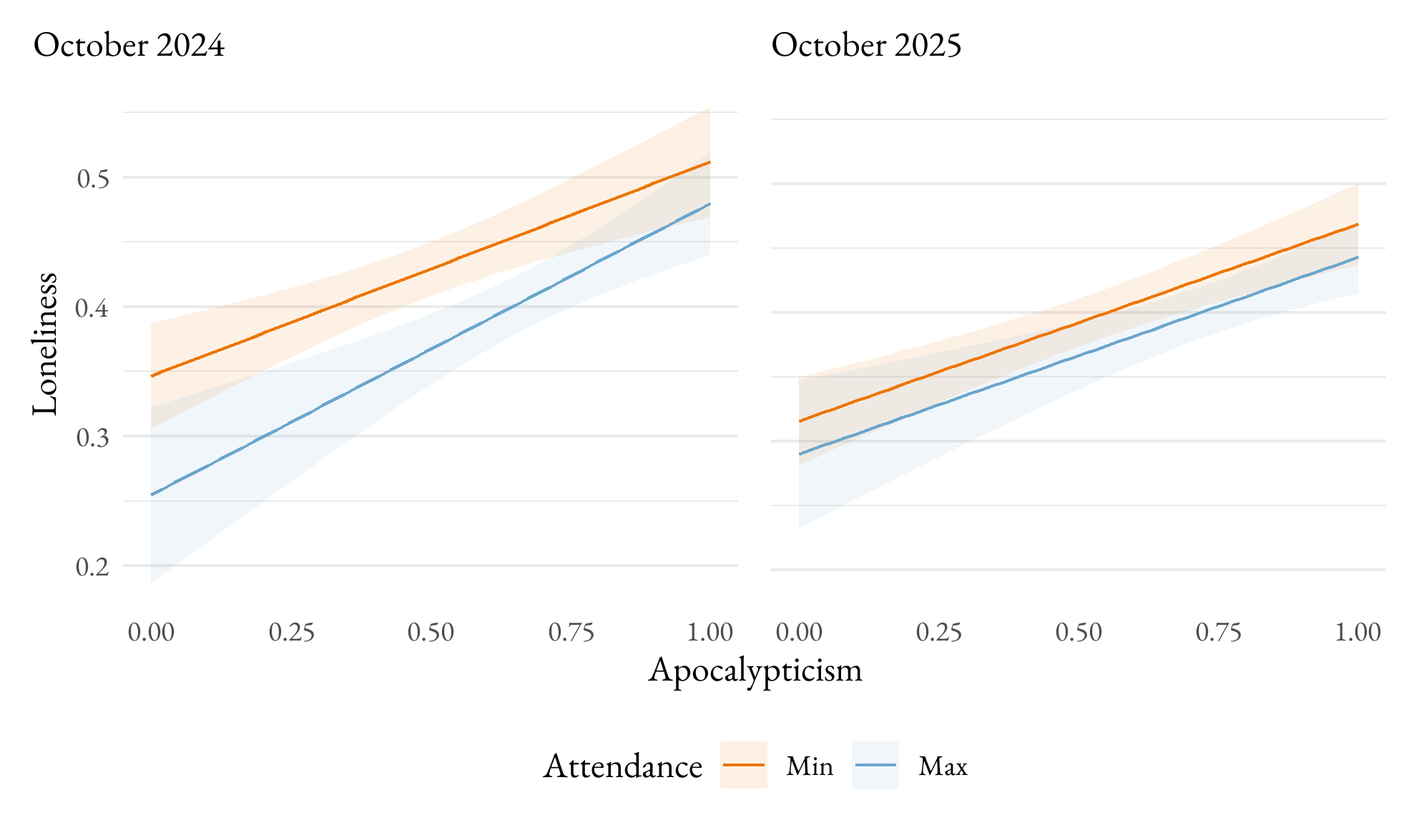
As apocalypticism climbs, so does loneliness for both frequent and never attenders. Perhaps there is a bit of a difference in the October 2024 sample, but there is not in October 2025. The worldview is profoundly alienating, leading people to believe that anyone with a different opinion is one of the evil minions trying to conquer and win for eternity. Again, the range is a bit greater in the election season when this language was in the air than in the following year.
Figure 3 – Apocalypticism is Linked to Greater Loneliness Regardless of Attendance
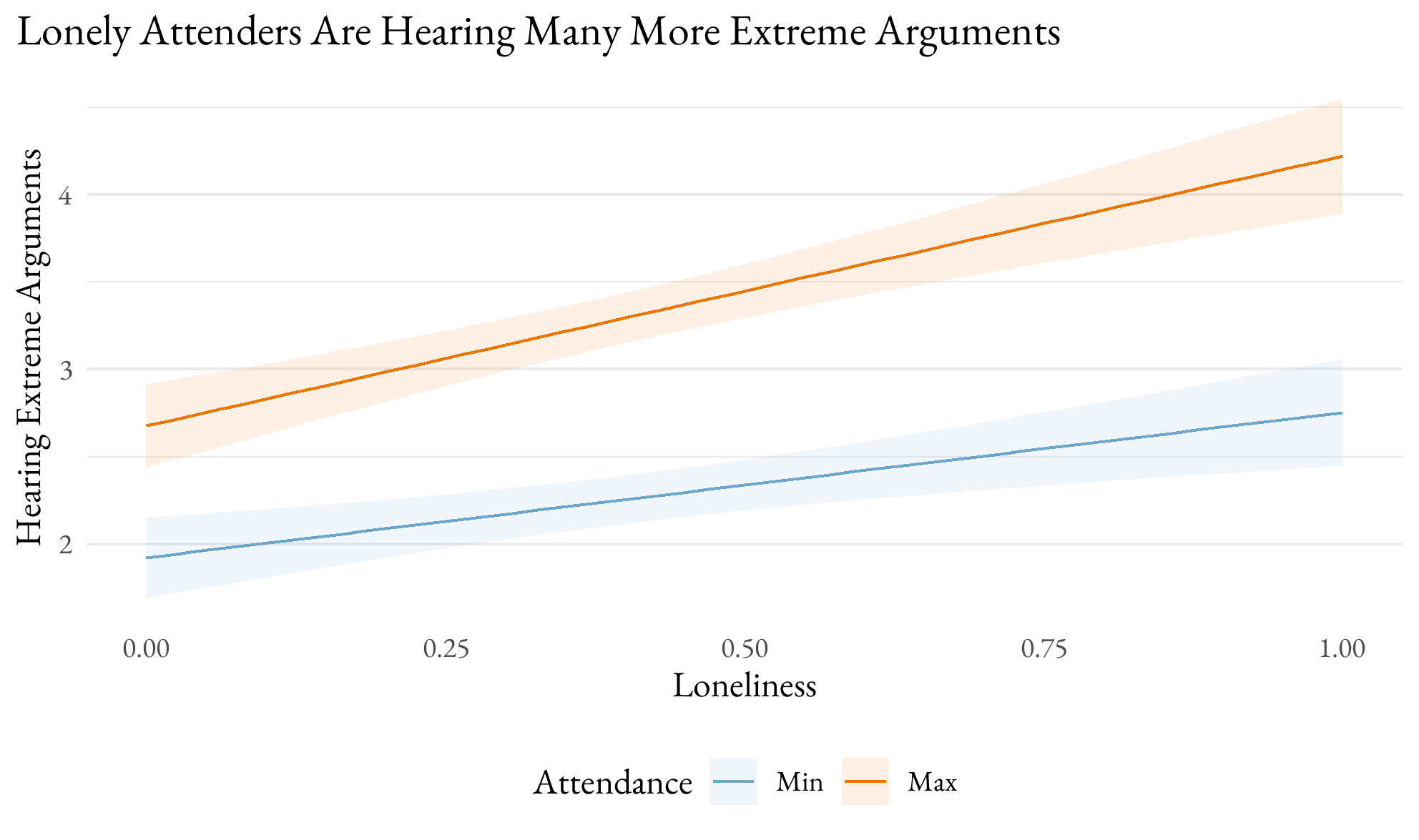
And then the politics. The lonely feel alienated and their sources of political information appear likewise. We suspect that the disconnected do not have the same social filters that might bound their information sources; instead, they may seek out or allow in sources making more extreme arguments. And by extreme, we asked whether survey respondents had heard anyone making claims like the following in the past few months (this was in October 2024): ‘The Deep State tried to kill Trump’, ‘We should repeal the 19th Amendment that gave women the right to vote’, and ‘Open immigration is an explicit effort to replace white Christians in the US.’ As shown below, lonely attenders hear twice as many extreme arguments as lonely attenders. And the non-lonely hear even fewer, though attendance still boosts the number.
This is a new formulation, a challenge to the conventional wisdom that religious involvement mitigates against loneliness through its support network and connection through a community of common believers. This evidence does not suggest the absence of that, but it does point to religion in America collecting modestly more lonely people. Why exactly they are there is an important story to sort out as the last two figures suggest. Are lonely people joining congregations and bringing extreme religion and politics with them? Or are the beliefs taught in congregations leading to greater disconnection from society? The level of disconnection linked to apocalypticism is profound too, as we (Paul, Jacob Neiheisel, and Andrew Lewis) show in the forthcoming book. Apocalyptics are willing to lie, cheat, and manipulate to get their way and many prefer razing societal institutions and starting fresh with something they can better agree with. There is no doubt that those orientations facilitate and are facilitated by a sense of social disconnection – loneliness.
Paul A. Djupe directs the Data for Political Research program at Denison University, is an affiliated scholar with PRRI, the book series editor of Religious Engagement in Democratic Politics (Temple), and co-creator of religioninpublic.blog. Further information about his work can be found at his website and on Bluesky.
Brooklyn Walker is an Assistant Professor of Political Science at the University of Tennessee-Knoxville. Learn more about her work on X, Bluesky, or at her website.

