
By Paul A. Djupe and Brooklyn Walker
Have you read Yesteryear by Caro Burke yet? What are you waiting for? Drawing on themes from real-world tradwives like Ballerina Farm, the book follows an evangelical woman who marries into wealth and has to generate a lifestyle within the strict confines of what is appropriate for women to support her family (including the ne’er-do-well husband). The main character constructs this lifestyle with enormous amounts of money for Instagram and amasses millions of followers/haters once a rightwing commentator amplifies her brand/image.
Such influencers have been dubbed “tradwives” – traditional wives – who supposedly make everything from scratch, keep their concerns to the household, reproduce often, homeschool their children, and obey their husbands in all matters. The reward? Status for embodying the Christian homemaker ideal (and maybe a social media revenue stream). Does anyone like this – not the book or the posts, but tradwives themselves?
We asked a national sample of Americans just this question in the Fall of 2025 in a sample weighted to resemble the national adult population. On a temperature scale from 0 (cold/negative) to 100 (warm/positive), Americans rated “Tradwives” a chilly 36 degrees – 39 from men and 33 from women. The median scores shown in the figure below suggest more skewed distributions. They also show a good amount of 50s – a 50 has generally been understood to stand for “I don’t know”. So, there are surely a good number of Americans who have no idea what a tradwife is. Compare those figures to warmth toward feminists (mean=48, men=44, women=52) and men’s rights advocates (mean=50, men=57, women=45) and you get the sense that tradwives actually not that popular.
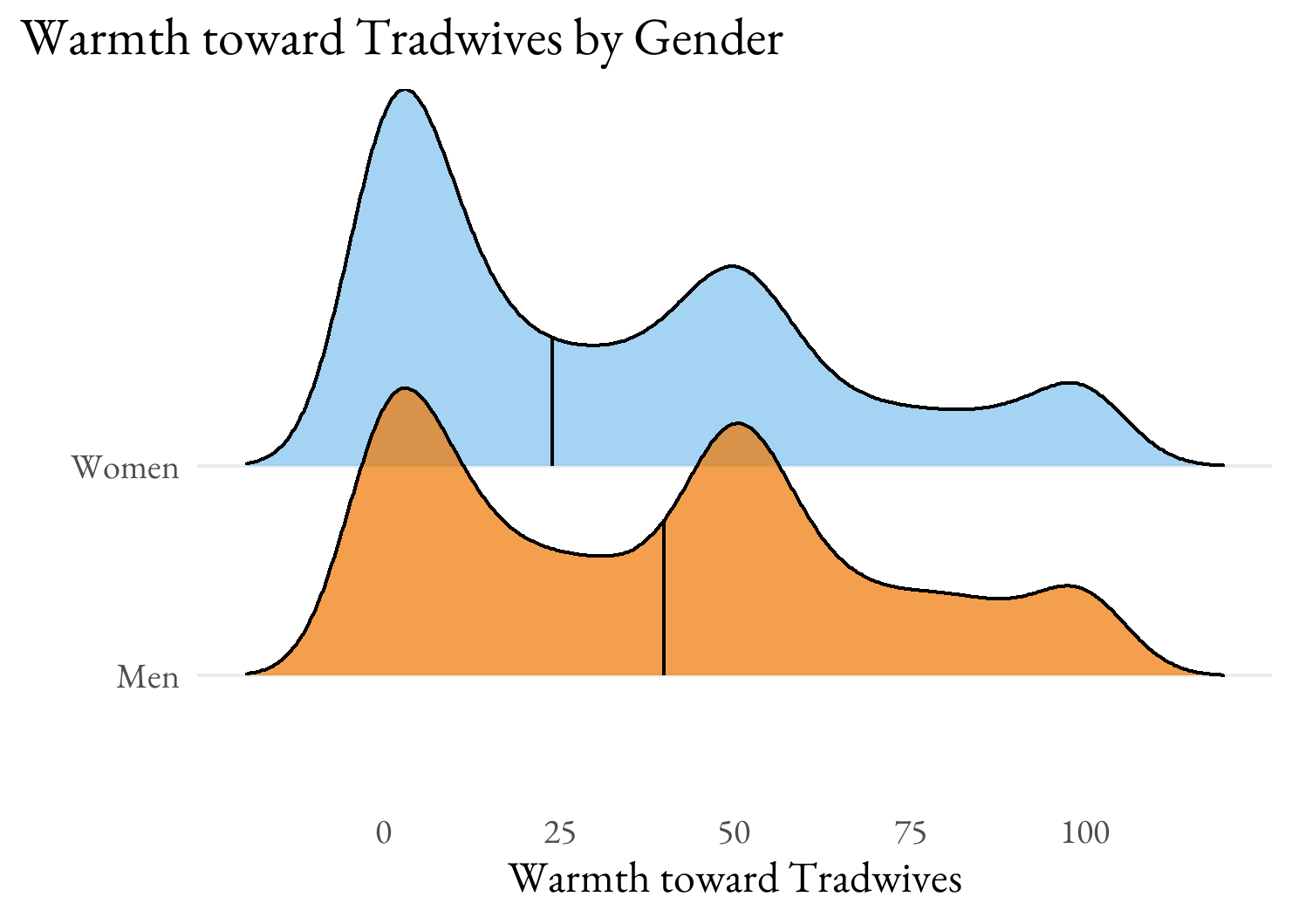
Maybe tradwives have had their cultural moment, but the essence beneath the trendy label endures in a religious worldview that provides the infrastructure to position women for these role. It’s called complementarianism and it was defined in reaction to the advance of feminism in American churches. Women were asking for equal treatment – in the pulpit, the home, and the workforce – so the reactionaries defined men’s and women’s roles so that they did not overlap. Those roles are argued to be complementary, so they fit together like puzzle pieces and produce a complete picture. But, of course, this puzzle is not horizontal, but vertical – women must submit to their husbands.
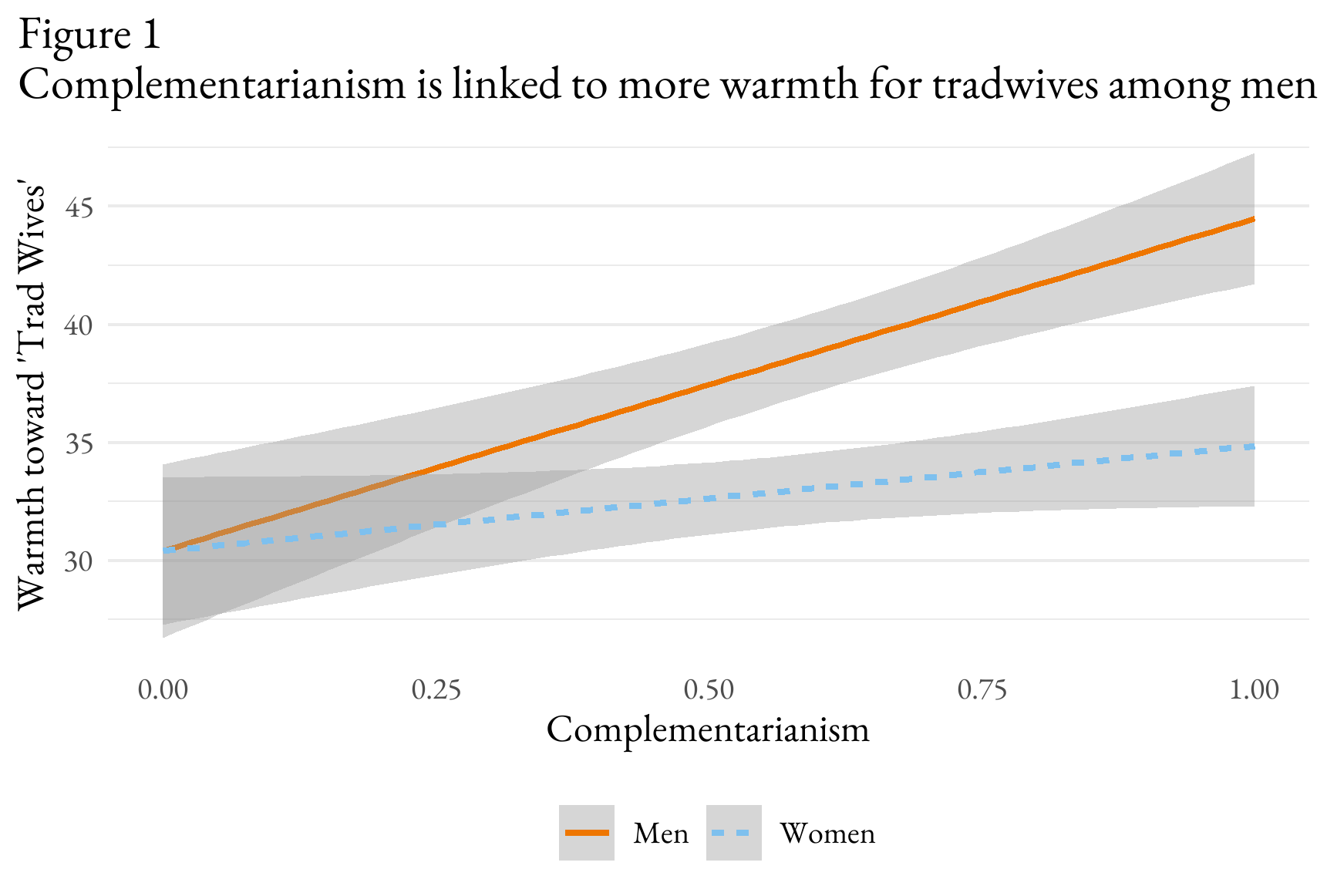
How is this worldview linked to feelings toward tradwives? We captured this worldview with 8 questions that you can see in a prior post. The figure below shows that the warmth felt toward tradwives increases along with complementarianism, but only for men. The score climbs a few points for women, but it’s not significant and doesn’t compare to the 14 point increase seen among men. But that’s interesting, too. Feelings are pretty chilly, even among the most ardent complementarian men.
What is it about tradwives that complementarian men appear to like? We didn’t ask follow-up questions, so we’re left making inferences from other relationships. One thing we checked was the link of feelings toward tradwives with two other forms of sexism. Benevolent sexism puts women on a pedestal as naturally moral and deserving of men’s protection and provision. While it appears caring, this worldview still limits women’s autonomy. Hostile sexism views women negatively – as schemers and temptresses who seek to control men despite their inferiority. We show the link between these versions of sexism (and complementarianism) to feelings toward tradwives below. Complementarianism has the strongest relationship with those feelings among men, but right alongside is hostile sexism. The weakest relationship (smallest vertical distance moving from least to most of the worldview) is benevolent sexism – it just doesn’t explain as much of those feelings about tradwives as the others.
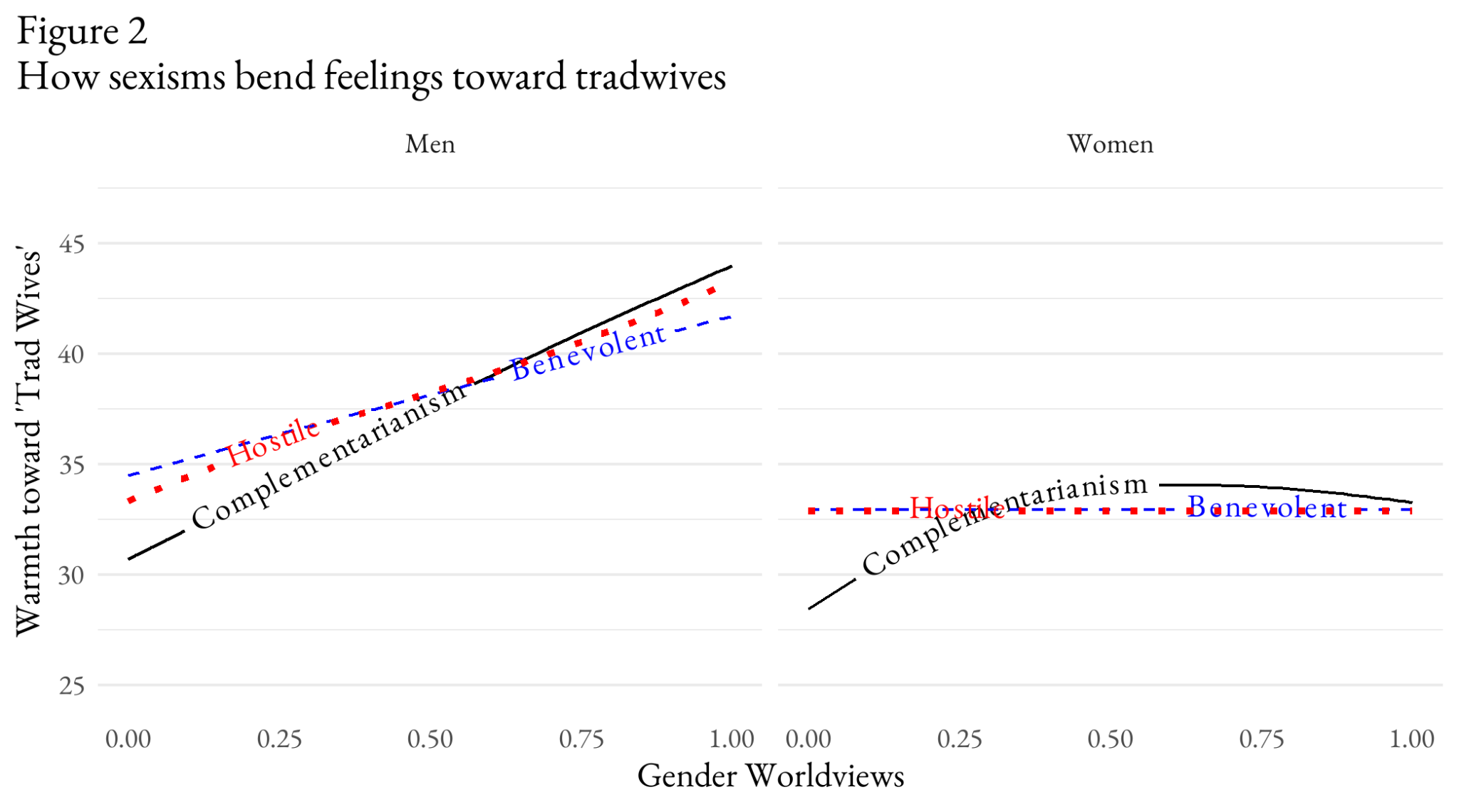
So, what does all this mean? One way to view the reason why men have warmer feelings toward tradwives is that they present as submissive and supportive of their men. That is, they counter the negative stereotypes of women held by those with a hostile sexism perspective. They may not care that tradwives make fresh sourdough, store lots of things in balljars, make gauzy afternoon-light photos of children running through hay fields, or come out with their own hydration products and denim aprons for sale. What they like is the submission.
But also look at those patterns among women! The sexisms (yes, women can be sexist too) are not linked to any variation in feelings toward tradwives at all. Only among those women who reject all elements of complementarianism do we even see a dip in warmth toward tradwives.
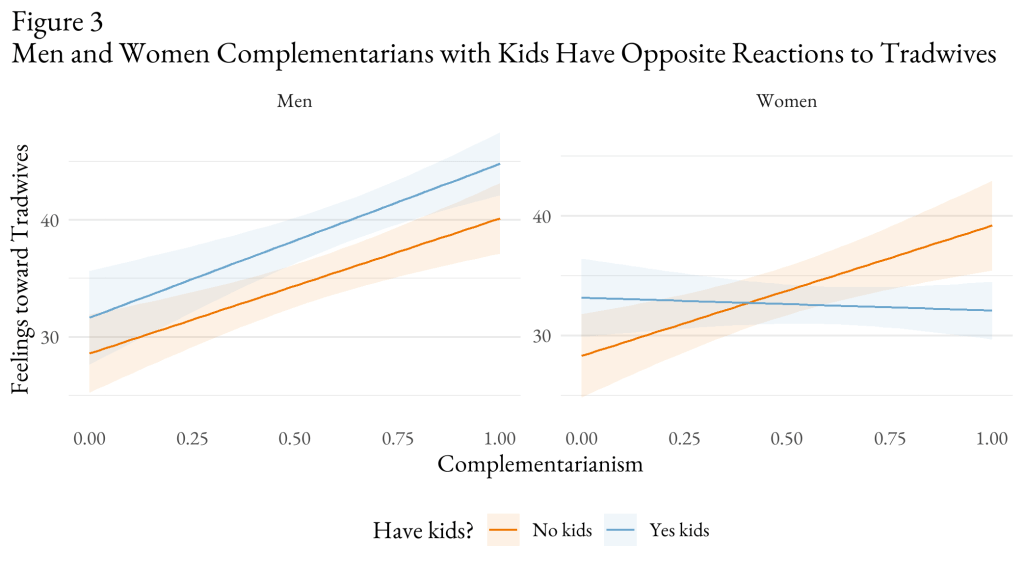
OK, one more look at the data and we’ll wrap this up. We couldn’t resist seeing how the presence of kids shifts feelings toward tradwives. Kids may be a blessing, but they sure are hard. In the figure below, we look at how the presence of kids shifts how men and women link complementarianism to feelings about tradwives. Without kids, complementarianism has identical effects on feelings toward tradwives – warmth increases by about 11 degrees for both men and women. But when they have kids, complementarian women are not having it. They show an ever-so-slight decrease in warmth. Men with kids, however, show a bump in warmth toward tradwives that increases as their complementarianism grows so that their warmth is a 45, on average – about 13 points higher than complementarian women with kids. Apparently, for men, it is attractive to contemplate a partner who is 100% dedicated to taking care of the kids.
We were surprised that there aren’t stronger, more polarized feelings toward tradwives. There is certainly that corner of social media where admirers and haters come together to engage with the content, but that is apparently a small corner. What is perhaps more surprising is that complementarians are not greater admirers of tradwifery because at least some have branded the worldview with that image. The reality is that while some choose that role, most cannot, and it is possible to have complementarian views without a life of complete domesticity. But that doesn’t mean that complementarian men and women are going to be on the same page about it.
Paul A. Djupe directs the Data for Political Research program at Denison University, is an affiliated scholar with PRRI, the book series editor of Religious Engagement in Democratic Politics (Temple), and co-creator of religioninpublic.blog. Further information about his work can be found at his website and on Bluesky.
Brooklyn Walker is Assistant Professor of Political Science at the University of Tennessee-Knoxville. Learn more about her work on Twitter, Bluesky, or at her website.


It seems to me that if the highest degree of approval for tradwives, even from men, peaks at 45%, that says that, on balance, most men don’t want a wife who adheres to strict “complementarian” roles. And if only, at maximum, 35% of women find tradwives appealing, that seems pretty polarized. That means that 65% of women do not. That’s rejection not ambivalence.
But isn’t part of the problem here that tradwives aren’t real. They are a creation of the internet and anyone who isn’t a total idiot knows that all of that gauzy IG nonsense is created by wealthy (predominently but not exclusively white) women using loads of staff who are doing it as a job (which isn’t very tradwife, if you ask me). They are fake. When you ask people what they think of tradwives, there are people who know what they are, who don’t like them, and people who don’t know what they are, so they don’t really care. And then, maybe, there is a small subset of people who basically agree with the premise, and don’t care about the baggage.
In my 60 years of experience, 30+ of them as a wife and mother, the men of my acquaintance, colleagues, friends, and relatives, want a partner not a subject. But maybe that’s because I don’t hang out with men who seek to oppress me?
LikeLiked by 1 person