
By Paul A. Djupe and Brooklyn Walker
It has been 250 years since the Declaration of Independence was signed and some portions of the US are more excited than others. Judy Woodruff of PBS News went to Rededicate 250, a celebratory Christian event held on the National Mall and interviewed a selection of attendees. Rededicate 250 featured the usual cast of characters pushing a Christian nationalist line. Mainstay of Trump’s evangelical advisory council, Robert Jeffress, is captured as saying, “If being a Christian nationalist means loving Jesus Christ and loving America, count me in!” No researcher we know conflates Christian nationalism with Christian patriotism – all the scholarly measures leave substantial space for someone to be patriotic and Christian, without being Christian nationalist – but ok. Somehow Eric Metaxas came to the conclusion that “Trusting the Lord is how America came into being” and the founders knew it, “even Benjamin Franklin.”
But there is something more interesting than those elite speakers and their hackneyed discussion of American history – it’s who Woodruff interviewed at the event. She talked to some white women, but she also talked to people of color, both men and women . And, no surprise, they all drew on many of the usual talking points about the necessity of America being a Christian nation, lest the country cease to exist or lose God’s blessing. That’s surprising from at least one perspective: research and writing about Christian nationalism often prepends the descriptor “White” as if Christian nationalism is just a White project.
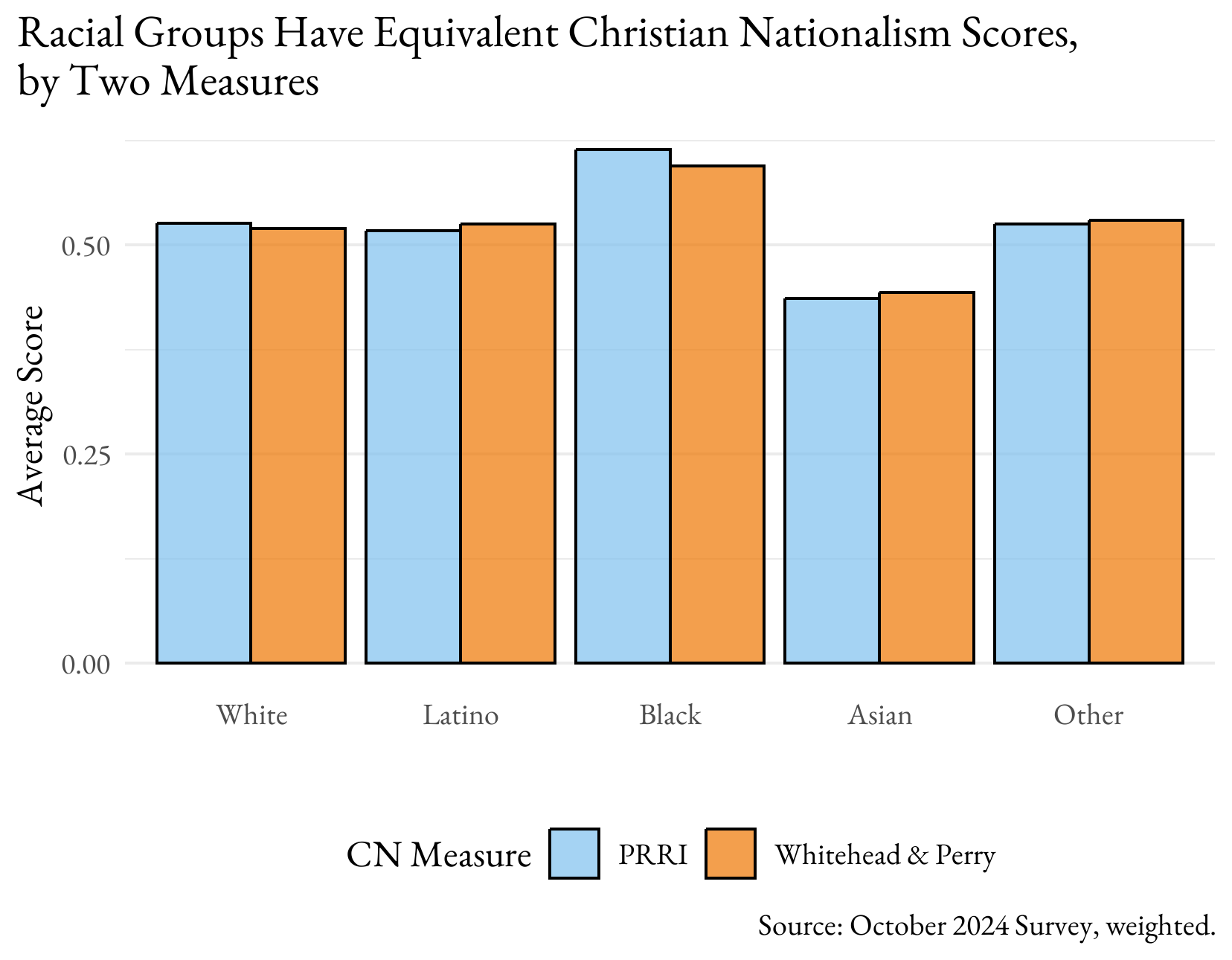
But is it? Is Christian nationalism limited to Whites? The answer from a growing line of research is no. Christian nationalists look like America, though an older one. A helpful place to start is to see how different racial groups score on common measures of the worldview. Shown below, we looked at October 2024 data we collected that included multiple measures of Christian nationalism, including the items to capture PRRI’s index and then a modestly tweaked version of Andrew Whitehead and Sam Perry’s measure from the Baylor Religion Survey data. Both measurement efforts capture some of the key elements heard in Woodruff’s interviews. It clearly doesn’t matter which measure we pick. Both indexes capture the same truth – there is substantial Christian nationalism across racial groups. There is a higher concentration among Blacks and a lower average among Asians, which can be attributed to the proportions of Christians in those two groups.
But that’s not the end of the conversation because people can associate things in different ways. Maybe the “Christian nation” envisioned by Black Americans is different from the one envisioned by Whites, etc. That turns out to be true, at least sometimes. The trick with figuring this out is that you can’t just pick particular racialized issues and then conclude that Christian nationalism means different things to different racial groups. Researchers need to examine a wide range of attitudes all together to gauge the extent to which the effects of Christian nationalism vary for racial groups.
And so far there is just one article that has done that – by us and some colleagues. In that paper published in Perspectives on Politics, we articulate a theory of Christian nationalism (CN) as ingroup protection, which has the benefit of telling us when links to CN should differ across racial groups and when it should not. The relationship should differ when issues are racialized, hitting on the interest of the ingroup, and otherwise should be no different. We use a very wide range of issue attitudes and find evidence that supports our theory. Racialized issues, including policing, voting rights, the minimum wage, and a few others, saw relationships with CN that differed across racial groups. Other issues, such as the culture wars issues of abortion, gay rights, and more, saw nearly identical CN effects across groups.
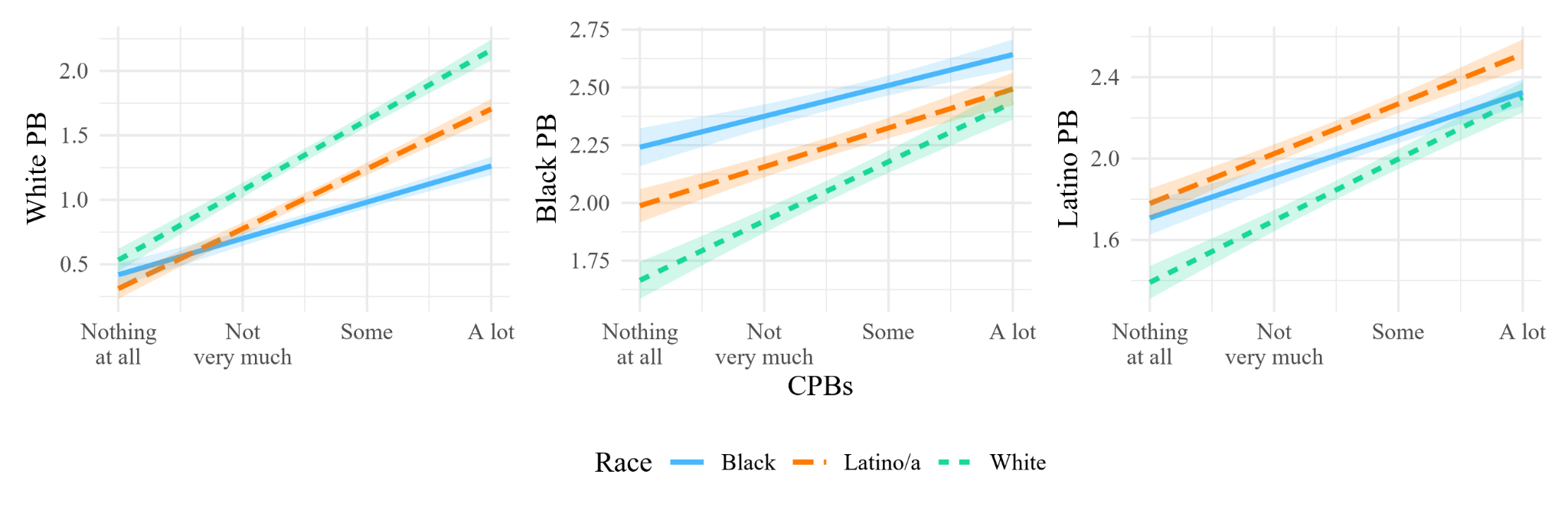
And one of the common refrains driving people to Christian nationalism is a sense that their faith is under attack and the power of the state should be used to defend Christians. It turns out that those Christian persecution beliefs (CPBs) are also pretty similar across racial groups and those CPBs are positively linked to perceptions of greater levels of persecution against racial groups. There is racial “Fellowship in the Fiery Furnace.”
Racial Groups Link Christian Persecution Beliefs to Racial Persecution Beliefs
Why does it matter that Christian nationalism is a multiracial coalition, built on a commonly-shared sense of grievance? Other work has found that Christian nationalism is related to a host of antidemocratic impulses – a willingness to undermine elections, to restrict the civil liberties of people you don’t like, and even to support political violence. The silver lining of the surge of Christian nationalist rhetoric and influence in the halls of power is a corresponding desire among some Christians to break the linkages between Christian nationalism, faith, and patriotism. Understanding the broad swath of people to whom Christian nationalism appeals is an important first step.
Paul A. Djupe directs the Data for Political Research program at Denison University, is an affiliated scholar with PRRI, the book series editor of Religious Engagement in Democratic Politics (Temple), and co-creator of religioninpublic.blog. Further information about his work can be found at his website and on Bluesky.
Brooklyn Walker is an Assistant Professor of Political Science at the University of Tennessee-Knoxville. Learn more about her work on X, Bluesky, or at her website.


[…] Here are political scientists Paul Djupe and Brooklyn Walker at Religion Public blog: […]
LikeLike