
By Brooklyn Walker and Paul A. Djupe
[Image credit: Empathy is the new Christian battleground : r/Christianity]
Empathy is sin. Or so goes the thesis of several highly popular books by conservative Christian thought leaders like Joe Rigney and Allie Beth Stuckey. In their telling, empathy is a vice because it requires that people set aside truth and accept as legitimate the feelings of another person. Is the attack on empathy isolated to a handful of Christian elites and their hardcore followers? Or is the rejection of empathy widespread?
We have some data from a survey of American adults fielded by Verasight tailor-made to address this question. We posed several statements about empathy, asking respondents whether they agreed or disagreed with them.
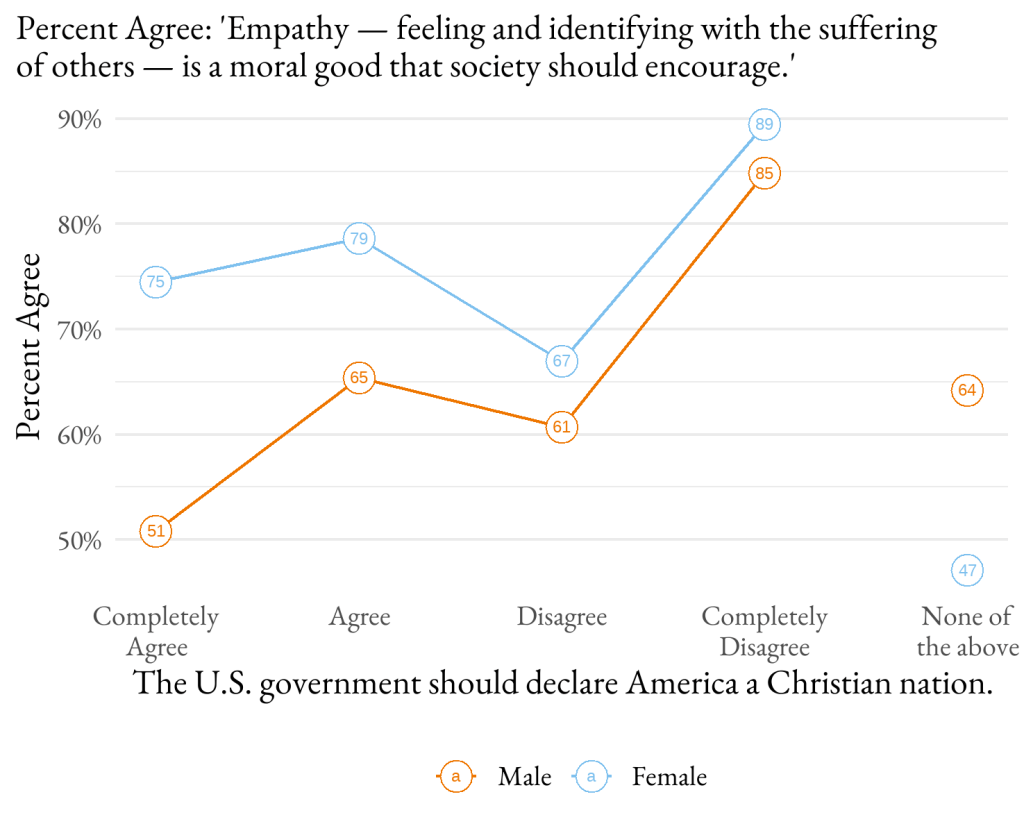
The first statement, “Empathy — feeling and identifying with the suffering of others — is a moral good that society should encourage,” presents empathy as a social norm. As such, it’s uncontroversial. 75.5% of respondents agree that empathy is morally good, at least when it comes to people interacting with each other in society. Only 5.9% disagree, while 18.6% are neutral.
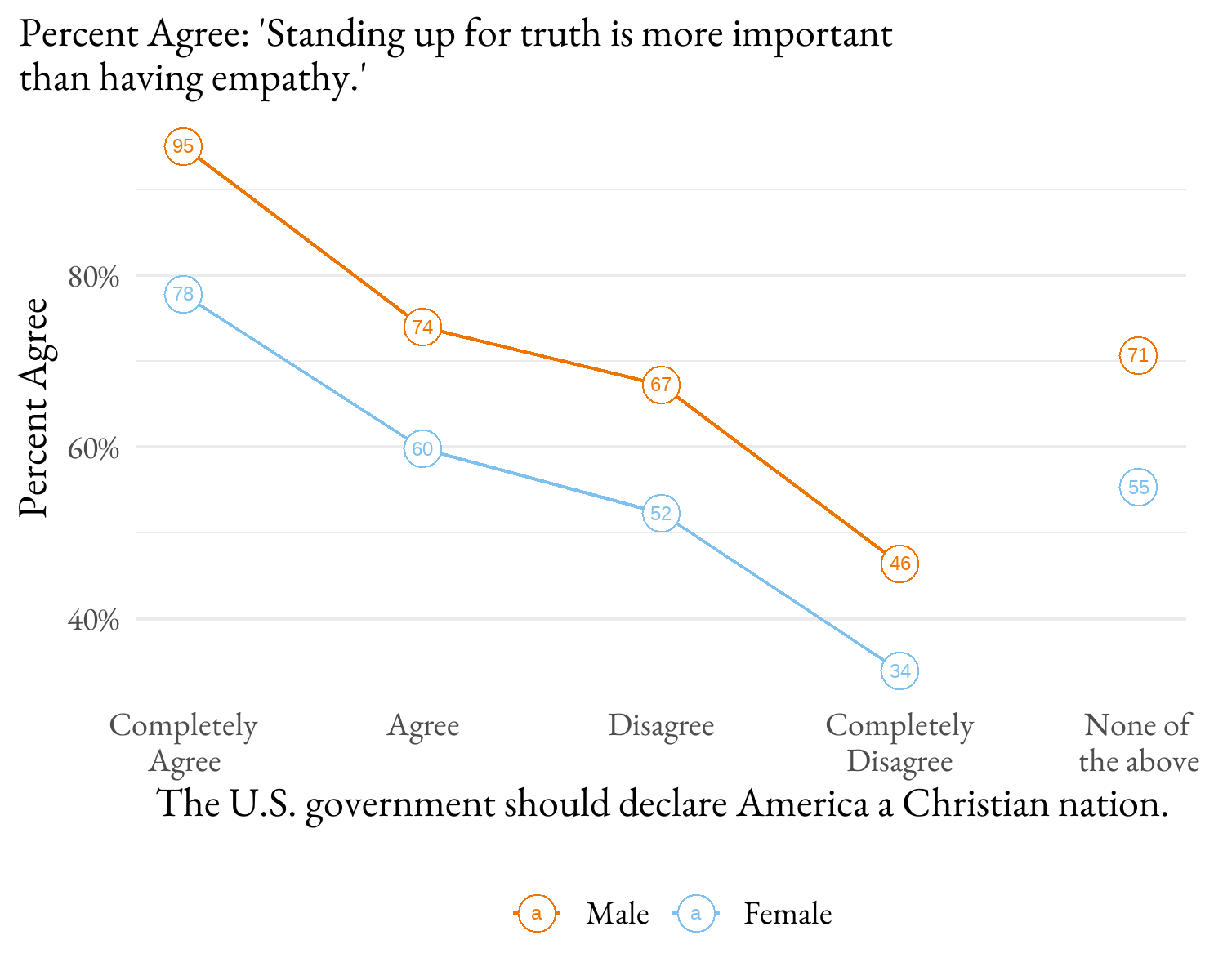
Our next item contrasts truth and empathy. This is a common theme amongst the ‘empathy is sin’ crowd. In a Turning Point interview (aptly titled “The Danger of Putting Empathy Above Truth”), Allie Beth Stuckey encourages listeners to step away from the “empathy mob’s” demands and instead ask, “What is factually and biblically true?” So we asked respondents if they agreed that “Standing up for truth is more important than having empathy.” Only 15.1% of respondents disagreed with this statement, and 55.1% agreed.
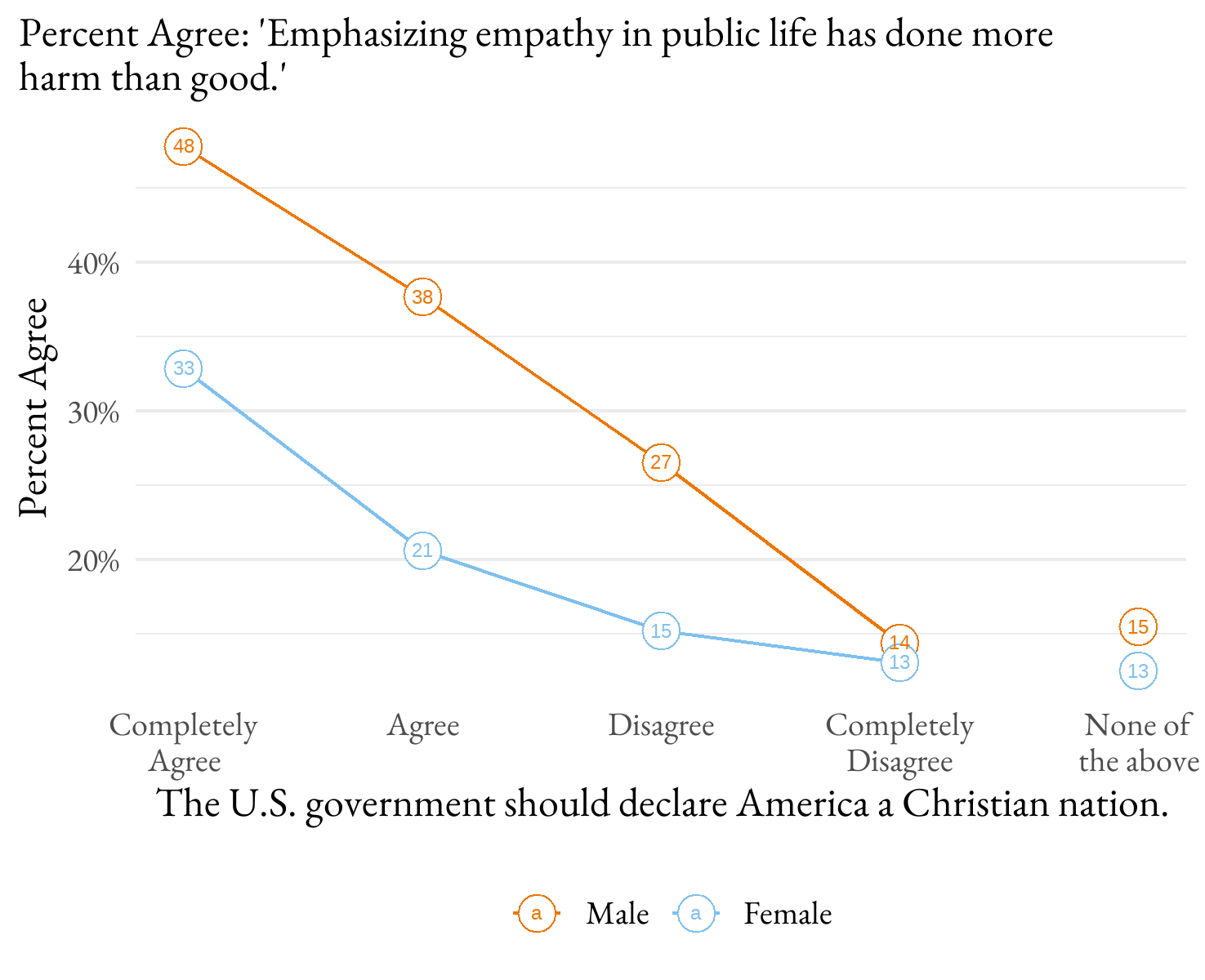
It is no accident that the “toxicity of empathy” is becoming a matter of debate at this particular political moment. Conservative Christian leaders argue that the Left has weaponized empathy against Christians. Want to get Christians to support killing babies by abortion? The Left tells Christians to have empathy for pregnant moms. Want to get Christians to support same-sex marriage? The Left tells Christians to have empathy for gay people. Want to get Christians to support transgender kids’ access to gender affirming care? The Left tells Christians to have empathy for trans kids. In an interview with Al Mohler, Joe Rigney connects these dots, concluding that, “empathy became the steering wheel by which opportunistic people took advantage of Christian soft heartedness” and “I do want people to be more mindful of the ways that institutions and families and communities can be hijacked by powerful emotions in the hands of advocates who are trying to steer them.” To capture this sense that empathy has been weaponized, we asked respondents if “Emphasizing empathy in public life has done more harm than good.” 19.2% of respondents agreed with this statement, 30.6% were neutral, and 41.2% disagreed.
While attracting attention from mainstream media outlets like PBS News and the New York Times, anti-empathy crusaders have largely targeted their messages towards their Christian audiences. We would therefore expect that support with our empathy statements would vary alongside a respondent’s commitment to right-wing worldviews like Christian nationalism or apocalypticism. In the data that follow, we’ll also disaggregate by sex. In Al Mohler’s interview, Rigney places the blame for empathy and empathy’s ill effects directly on women:
Why is [empathy] so destructive in the modern world? It’s feminism. Because what feminism has done is it’s taken the more empathetic sex, women are the more empathetic sex by God’s design, I think it’s a glorious design feature that God made women to intuit emotions, share emotions, feel emotions respond to suffering, people with care and compassion. […] But that same gift, if you try to put it in other contexts, particularly contexts in which you have to draw clear lines and show fortitude and courage in the face of threats, it is not an asset. It is a liability. […] So it’s no surprise that in a culture which has become dominated by feminism, it’s deep in the American system at this point, that in that same timeframe you would have an outbreak of empathy that would become the steering wheel by which every institution is hijacked.
Given the politicized nature of the attacks on empathy, we first suspect that Christian nationalism, a worldview that largely supports Republican politics, should be associated with anti-empathy sentiment. That indeed seems to be the case. While the majority of respondents support social empathy, support clearly increases as Christian nationalism declines.
Figure 1 – Empathy is a Moral Good and Christian Nationalism
Next, to the extent that truth and empathy are in competition with each other, Christian nationalists clearly pick sides. 95% of men and 78% of women say that truth is the higher good. Again, this is strongly related to Christian nationalism (see Figure 2). Respondents firmly opposed to Christian nationalism are much less enamored with the idea of focusing on truth over empathy (46% of men, 34% of women).
Figure 2 – Truth, Empathy, and Christian Nationalism
In Figure 3, we see that 48% of men and 33% of women ardent Christian nationalists believe that empathy in public life has done more harm than good, and these percentages decline precipitously along with Christian nationalism support. While not majorities, the message that empathy has no place in public life has a foothold among Christian nationalists. Overall, what we are observing is that hardening oneself against empathy goes hand-in-hand with social hierarchies (in this case, centering Christians).
Figure 3 – Empathy in Public Life and Christian Nationalism
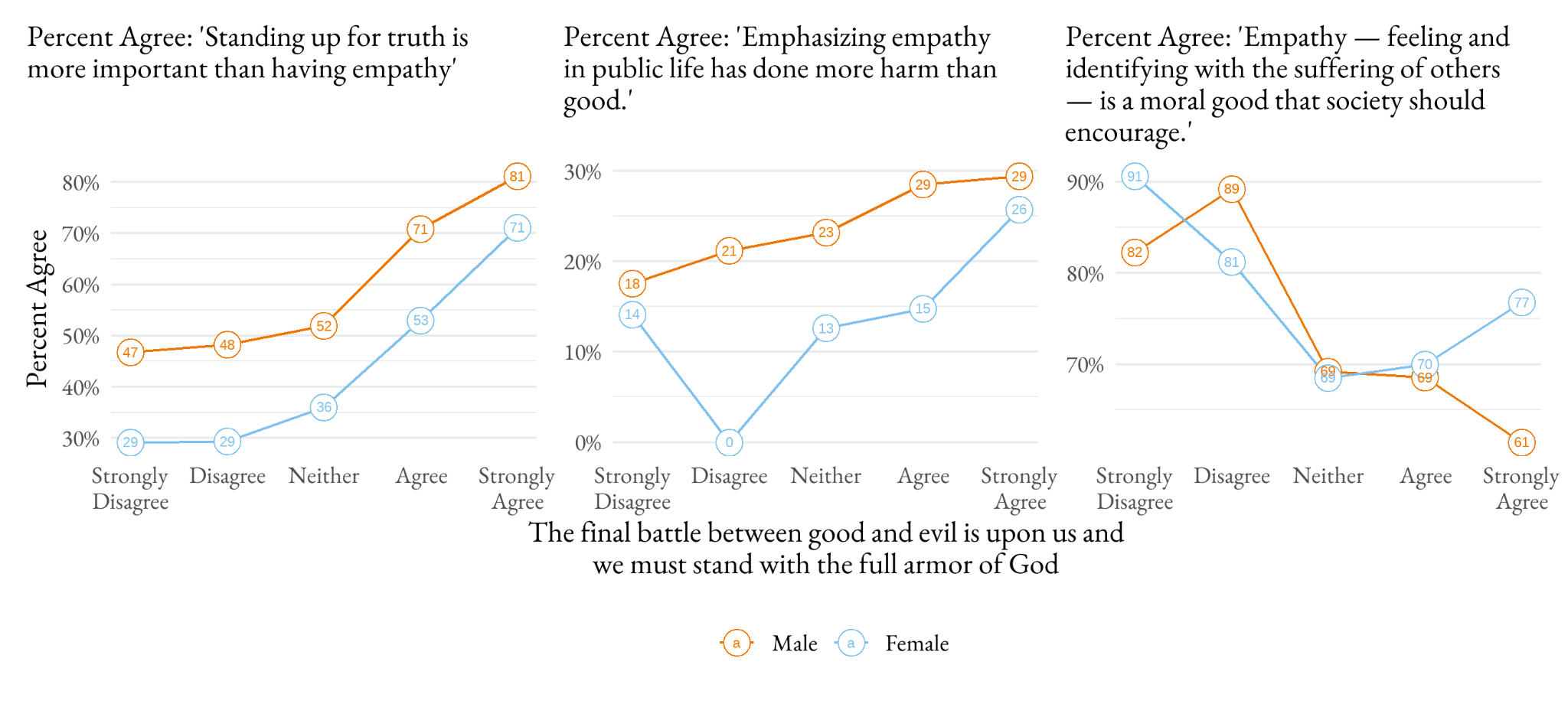
Some critics dismiss Christian nationalism as a perversion of the faith by putting politics first. While that may be, we have another measure that captures a long tradition of conservative Christian theology – apocalypticism which we measure by asking about agreement with “The final battle between good and evil is upon us and we must stand with the full armor of God” (referring to Ephesians 6). While just a single measure, it is strongly related to a much more complete measure used in other research and to the Christian nationalism measures used here. Also, this apocalypticism measure captures the sense of threat that other research has found nullifies pro-social religious beliefs. Most importantly, the relationships between apocalypticism and the empathy measures do not look much different. They maintain the gender gap, they prioritize “truth” over empathy, and show less support for the innate moral worth of empathy.
Figure 4 – How Empathy is Linked to a Measure of Apocalypticism
It might be hard to understand, at first, why there is so much uproar on the right about empathy and other, related synonyms like tolerance. Some of it is theological, which makes sense if you believe that the world is full of temptation to stray from the narrow path to salvation. And that temptation may come in all sorts of packages that do not convey the evil intent within. But the other crucial fact to consider is that white evangelicalism is shrinking in proportions of the electorate and, in order to win, Republicans need to turn out increasingly high numbers of them. From that perspective, any trapdoor that allows their voters to escape must be blocked. Therefore, the empathy, kindness, tolerance that women are more likely to hold are potential toeholds for modestly more liberal views that may just lead to higher rates of Democratic voting. And that can’t be tolerated.
Brooklyn Walker is an Assistant Professor of Political Science at the University of Tennessee-Knoxville. Learn more about her work on X, Bluesky, or at her website.
Paul A. Djupe directs the Data for Political Research program at Denison University, is an affiliated scholar with PRRI, the book series editor of Religious Engagement in Democratic Politics (Temple), and co-creator of religioninpublic.blog. Further information about his work can be found at his website and on Bluesky.


I don’t understand the problem. One can very well project oneself into another person’s experience, understand the reason why that person acted the way they did, and still be conscious of the fact that the action was wrong. The capacity to empathise does not negate having a moral compass or subscribing to truth in the biblical sense.
LikeLike