
By Brooklyn Walker and Paul A. Djupe
[Image credit: moms.gov]
America’s demography has changed drastically over the past 50 years. Fertility rates have fallen, so much so that the U.S. can no longer maintain its current population through natural growth. At the same time, the U.S. has become more racially diverse so that the U.S. is predicted to become a White-minority country by 2045. And the U.S. is becoming more religiously-diverse, with a significant rise in the ‘nones’ (people who don’t identify with any religion).
These changes have prompted concerns among some who link those trends. They see in the declining fertility rate a sign of national weakness. A lower fertility rate means fewer workers (and soldiers) to take care of older generations, produce goods, and service ballooning public debt. It also means low fertility rate countries will have to import workers to fill jobs. But perhaps the biggest threat conservatives see is from women – “two variables explain 85 percent…of all the variation in fertility in the last seventy years across all countries…women’s educational attainment and access to reproductive health services.” Put that together and it’s clear that this issue is at the core of MAGA politics.
We aren’t the first to inquire about why some Americans might have a renewed interest in procreation. Pronatalism (support for more births) has already been linked to Christian nationalism. But we thought there might be a missing variable in these analyses – a sacralized gender worldview called complementarianism. In a new article out at the Journal for the Scientific Study of Religion, we argue that complementarianism is strongly related to both pronatalism, not just for the population as a whole, but specifically for Whites and Christians.
Complementarianism is a religious gender worldview that sees men and women as having distinct, God-designed roles. Men are supposed to lead – churches, wives, and children. Women are designed to be childbearers and nurturers. And while performance of these roles is important for one’s own sanctification, it is also the case that complementarians link gender roles to the well-being of the culture and the nation. For instance, far-right pastor Joel Webbon put the argument quite directly: “If we had a Christian nation and women could vote, then within 50 years we will no longer have a Christian nation.” We wondered if complementarianism mattered for pronatalism and, if it did, whether it mattered differently than secular gender worldviews. We fielded a survey to approximately 3,300 respondents in the fall of 2025 to find out.
First, we asked respondents whether they agreed with the main tenets of complementarianism as laid out in what is perhaps the founding document of this loose movement. These tenets are:
· God created men to be masculine and women to be feminine.
· God created different roles for men and women.
· God institutions male headship for biblical marriages.
· God designed men for leadership roles in the church.
· Biblical women joyfully submit to their husband’s leadership.
· When men and women don’t occupy their biblical roles, the culture disintegrates.
We certainly aren’t the first to think about gender worldviews. Other scholars have developed scales to capture two other ways people may think about gender and gender roles. Hostile sexism is openly disparaging to women, framing them as people who are out to benefit themselves at the expense of men. Benevolent sexism paints women in a positive light, as more moral or kind, but does so in a way that reaffirms limiting gender roles. Neither of these measures makes any reference to religion. We wanted to know how complementarianism, as a sacralized gender worldview, compared.
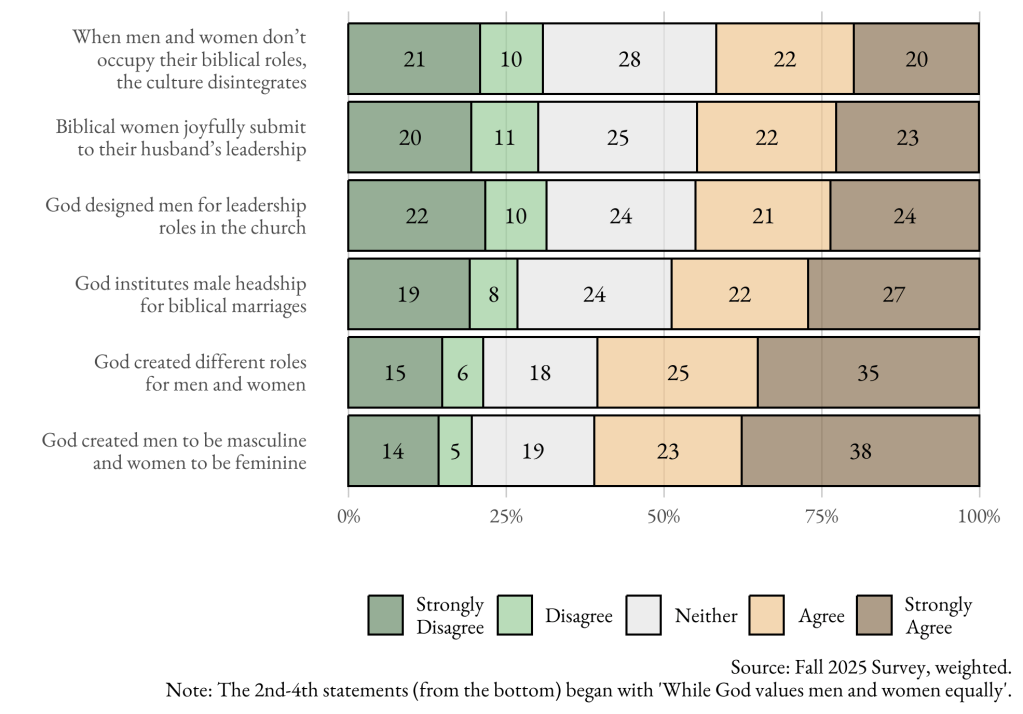
As demonstrated in Figure 1 below, complementarianism is hardly a fringe idea. Significant percentages of Americans agree with each of its tenets. The least subscribed view ties traditional gender roles to the success of the nation, which, at 42 percent agreeing, is the plurality view in the US. From there, agreement grows so that 61 percent agree with the fact of traditional gender roles – that God created different roles for men and women.
Figure 1: Distribution of Complementarian Beliefs in the US in 2025
We also asked our respondents whether they agreed that “Our declining fertility rate should alarm us as a nation” and “The decline of the US birth rate threatens the vitality of the country.” These two statements logically and statistically fit together well, so we combined them into a single item of “national pronatalism.”
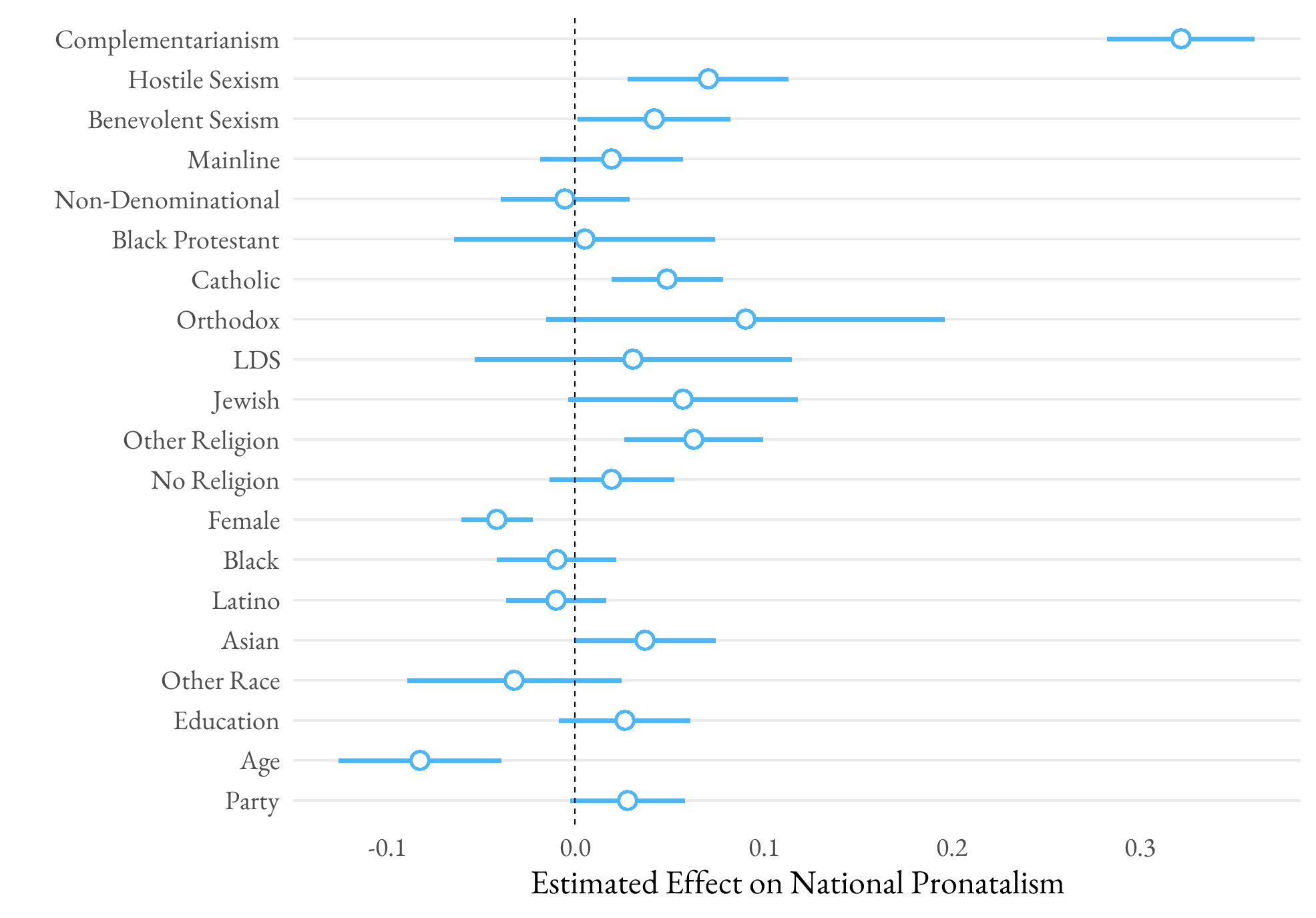
Figure 2 shows how complementarianism correlates with this national pronatalism measure. Compared to all the other variables, complementarianism is the strongest predictor, having a much larger effect than other forms of sexism, religious tradition, and partisanship. Its effect is significantly larger than hostile sexism, benevolent sexism, partisan identification, or religious tradition.
Figure 2: Complementarians desire greater national natalism
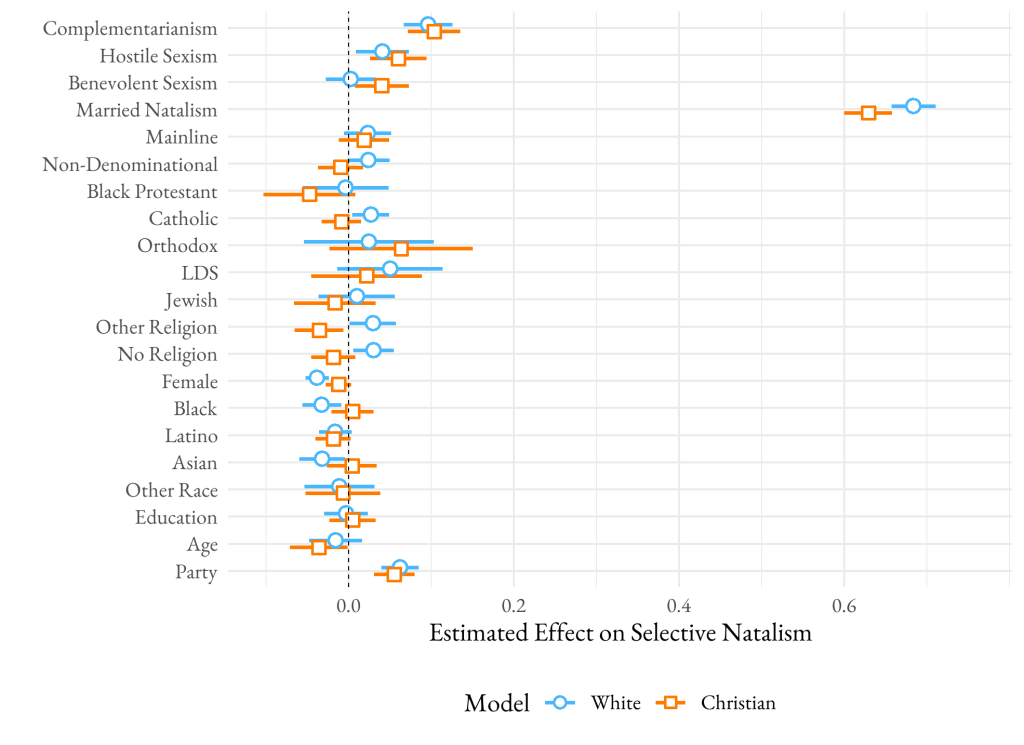
But the birthrate challenge has been linked to threats rooted in race and religion – not just a lack of babies in general, but a lack of particular kinds of offspring. So next we asked our respondents if they believed in more selective pronatalism – does it matter what kinds of families have more children? Respondents were asked if ‘White couples in our country should have more babies, not fewer’ and if ‘Christian couples in our country should have more babies, not fewer.’ It could be the case that respondents might answer these items in the affirmative not because they prefer White or Christian babies, but because they just want to see more babies in general. We controlled for whether respondents agreed with the statement ‘Married couples in our country should have more babies, not fewer,’ so our estimates here are preferences for White and Christian children above and beyond a preference for children in general.
In Figure 3, we see that complementarianism again matters. The biggest effect is simply desiring more children to be born (to married parents). But the results show that complementarians also want more Christian and White babies to be born. Complementarians don’t just want to see US birth rates grow. They also care about who has those children. And again, complementarianism has a stronger effect than either of the other two secular gender worldviews (hostile and benevolent sexism).
Figure 3: Complementarianism is linked to greater Support for Christian and White Natalism
Our JSSR paper doesn’t stop at pronatalism – it also explores support for state policies to control fertility (e.g., birth control) and finds similar relationships. We think these results are pretty strong evidence that complementarianism is a concept scholars should be thinking more about. We have seen an uptick in discussion of gender and gendered issues of late, and we think this sacralized gender worldview might play a substantial role in affecting how people see a host of issues. We’ll dig into some of those other issues in time – stay tuned!
Brooklyn Walker is an Assistant Professor of Political Science at the University of Tennessee-Knoxville. Learn more about her work on X, Bluesky, or at her website.
Paul A. Djupe directs the Data for Political Research program at Denison University, is an affiliated scholar with PRRI, the book series editor of Religious Engagement in Democratic Politics (Temple), and co-creator of religioninpublic.blog. Further information about his work can be found at his website and on Bluesky.

