
By Brooklyn Walker and Paul A. Djupe
[Image credit: Carl Joseph Ministries]
The term ‘Christian nationalism’ gained traction in academic research about a decade ago and since then has gained steam in the media and among the public. It has been used to describe a worldview that fuses America with Christianity, often with deleterious effects on democratic norms. But the term is contested. People who would score high on Christian nationalism scales disagree about whether they should adopt the label. The Family Research Council, which advocates for the types of religion-in-public-space policies characteristic of Christian nationalism, hosted an entire conference dedicated to making the argument that Christians should not claim the identity ‘Christian nationalist’. Marjorie Taylor Greene, though, proudly proclaimed herself to be a Christian nationalist, even producing sweatshirts so her followers could similarly advertise their Christian nationalist identity. These conflicting signals have prompted confusion in the public. Most Christians believe both that ‘Christian nationalism is a term invented by the left to smear conservative Christians’ and ‘Christian nationalism is the only idea that will save this fallen nation.’ It was clear that we needed systematic research to assess whether people identify with “Christian nationalism” and how tightly that decision is linked to the worldview that is conventionally measured.
This current era of Christian nationalism research started with measuring Christian nationalism with a set of items on the Baylor Religion Survey. They capture respondents’ worldviews, or beliefs and preferences about the political system, with statements like, ‘The federal government should declare the United States a Christian nation,’ ‘The federal government should advocate Christian values for the benefit of Christians,’ and ‘The federal government should allow Christian prayer in public schools.’
But then along comes some other research that argues that Christian nationalism isn’t just about a worldview. Instead, a better way to understand Christian nationalism is as an identity – Christian nationalism gives people a sense of self (‘American Christian’) and determines who is part of the in-group (other American Christians) and who belongs to the outgroup.
Worldviews and identities are different things. Worldviews are more cognitive – they are about what people think. Identities are more affective – they are about where people belong. Existing research convincingly shows that Christian nationalist ideas exist across the country. But what about Christian nationalist identities? We explored this question in a paper now published at Public Opinion Quarterly (with coauthors Anand Sokhey and Don Haider-Markel).
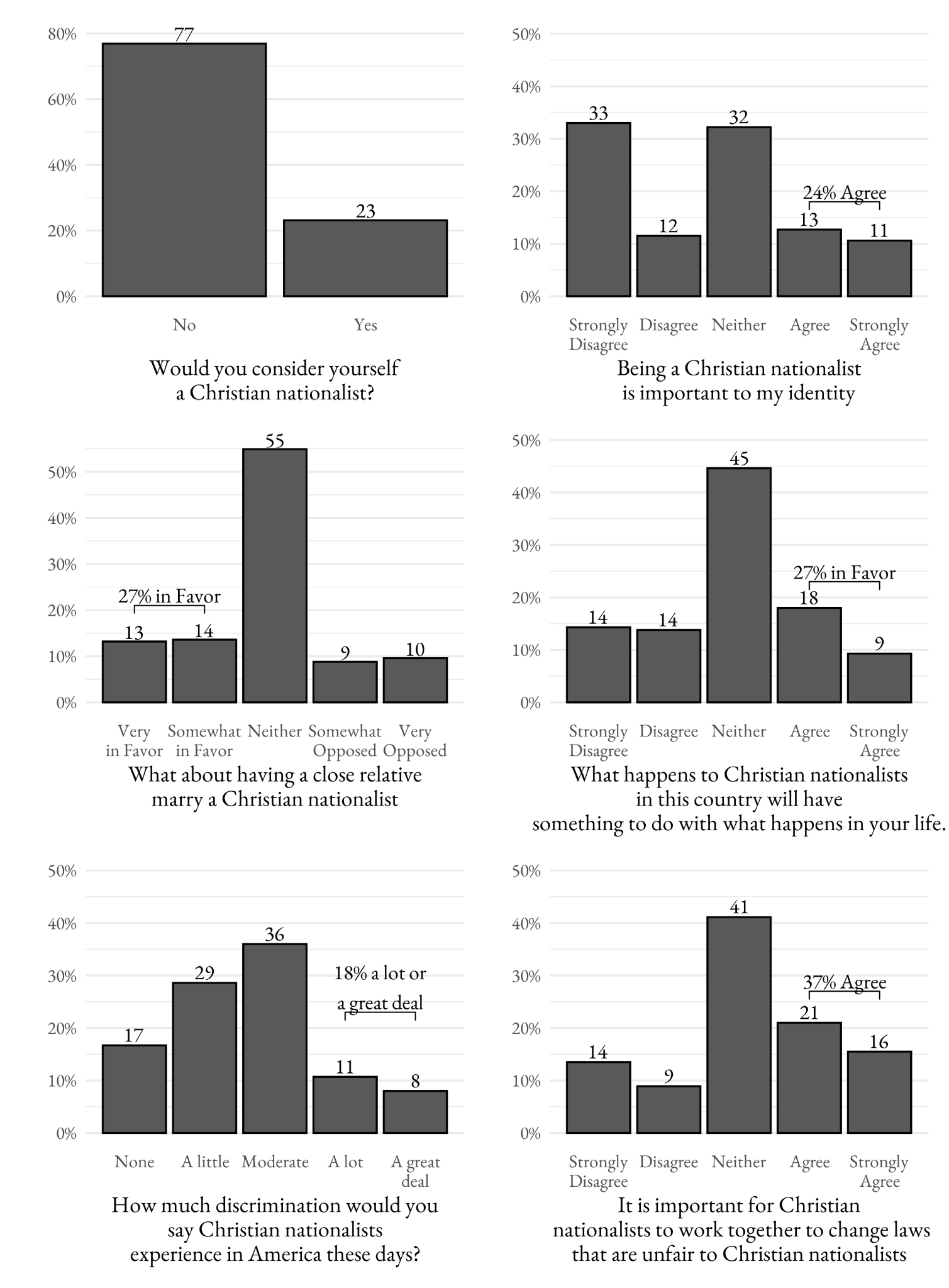
In a survey fielded in October 2024, we asked respondents to express their agreement with the Christian nationalism worldview measures listed above. Then we pulled a series of items often used to capture racial identity, editing them to reference Christian nationalism instead. These tap into group memberships – self-classification into a group, how important the group is, the group’s social standing:
- Would you consider yourself a Christian nationalist? (Yes, No)
- Being a Christian nationalist is important to my identity. (Strongly disagree, Somewhat disagree, Neither agree nor disagree, Somewhat agree, Strongly agree)
- What about having a close relative marry a Christian nationalist.? (, Very opposed, Somewhat opposed, Neither in favor nor opposed, Somewhat in favor, Very in favor)
- What happens to Christian nationalists in this country will have something to do with what happens in your life. (Strongly disagree, Somewhat disagree, Neither agree nor disagree, Somewhat agree, Strongly agree)
- How much discrimination would you say Christian nationalists experience in America these days? (None at all, A little, A moderate amount, A lot, A great deal)
- It is important for Christian nationalists to work together to change laws that are unfair to Christian nationalists. (Strongly disagree, Somewhat disagree, Neither agree nor disagree, Somewhat agree, Strongly agree)
We combined the Christian nationalism identity items into a single measure, scaled to range from 0 to 1. The distribution of responses to each of our items is illustrated in Figure 1. We first asked whether anyone actually identifies as a Christian nationalist. When we asked whether people consider themselves a Christian nationalist, 23.1% of our sample said ‘yes’. Similar percentages agreed with our other identity items – Christian nationalists are preferred as family members, Christian nationalism is important to identity, Christian nationalists share a common fate, Christian nationalists face discrimination. The item with the strongest agreement captured group consciousness – Christian nationalists should work together to address unfair conditions.
Figure 1: Significant Numbers of Americans Identify as Christian Nationalists
When we assemble these items into a single Christian nationalism identity index, we learn that approximately 28% of Americans lean towards identifying as Christian nationalists (see Figure 2).
Figure 2: The Distribution of the Christian Nationalism Identity Scale
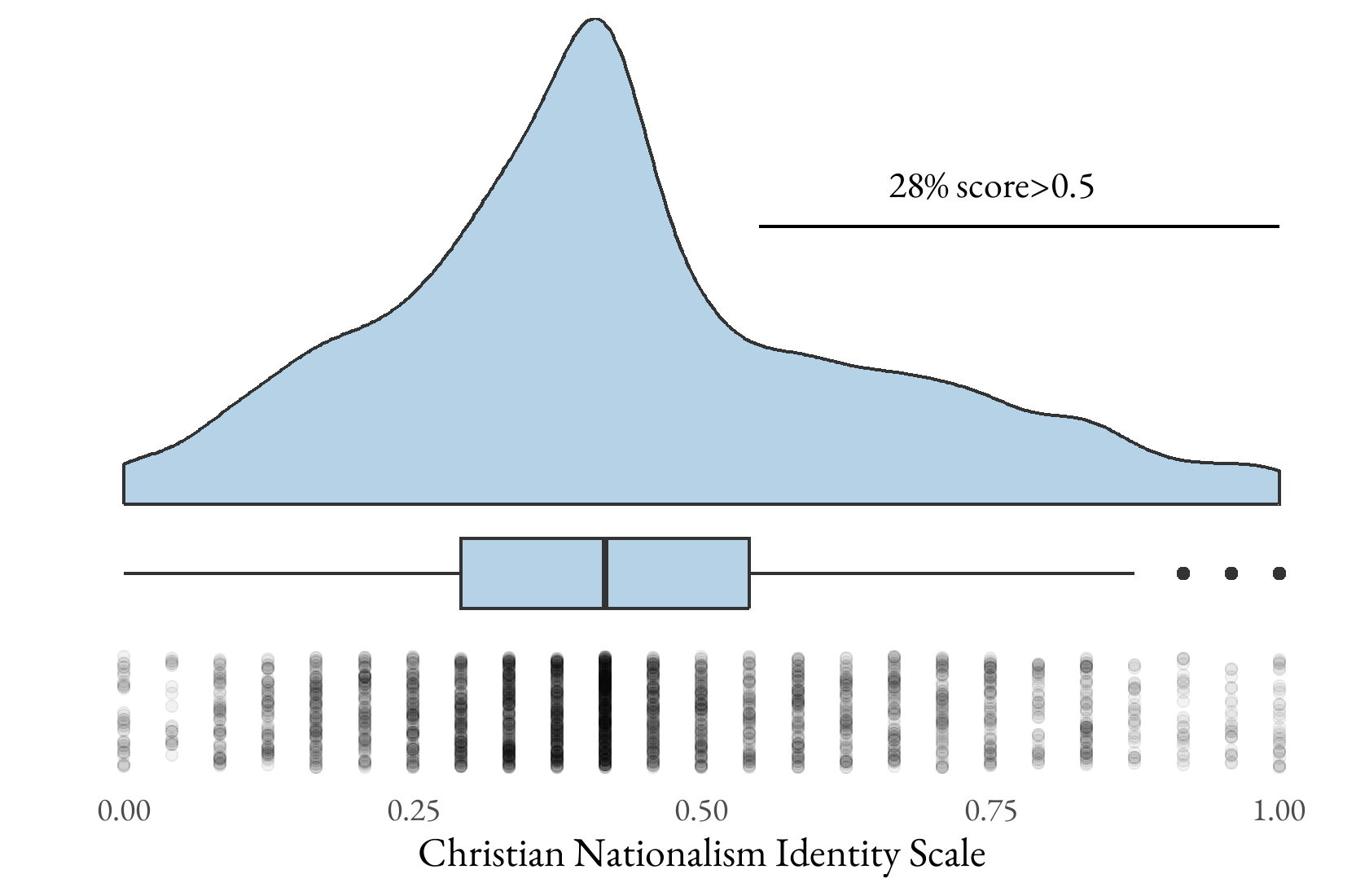
We asked our respondents the worldview items from the Baylor Religion Survey (which also range from 0 to 1), and the correlation between worldview and identity is robust. People who do not identify as Christian nationalist have a mean worldview score of 0.47 (so slightly disagree with the items, on average), while people who identify as Christian nationalist have a worldview score of 0.71. The correlation between the worldview and identity indices is 0.65. Christian nationalist worldviews and identities clearly go together.
In the paper, we also show that the same types of people who adopt Christian nationalist worldviews also adopt Christian nationalist identities, and that our identity and worldview measures predict similar outcomes, like warmth of feelings towards Black Americans and Christians; political and social trust; and support for a candidate who identifies as a Christian nationalist. This is strong evidence that the identity index is capturing something real that’s tightly related to the worldview.
Most identity work has focused on identities with long histories – race, ethnicity, religion (in broad strokes, like ‘Christian’). When we study these identities, we are asking about groups that have existed as groups, often for hundreds of years. But with Christian nationalism, we get a unique opportunity to watch a new identity develop. The ideas of Christian nationalism have been around for a long time in American history. In this study, we document that a new label is now being applied to the worldview, and that people are changing how they think about themselves as a result.
Brooklyn Walker is an Assistant Professor of Political Science at the University of Tennessee-Knoxville. Learn more about her work on Twitter, Bluesky, or at her website.
Paul A. Djupe directs the Data for Political Research program at Denison University, is an affiliated scholar with PRRI, the book series editor of Religious Engagement in Democratic Politics (Temple), and co-creator of religioninpublic.blog. Further information about his work can be found at his website and on Bluesky.
 Religion in Public
[like] R. Brown reacted to your message: ________________________________
LikeLike