
By Paul A. Djupe and Brooklyn Walker
From infancy, we are taught what is acceptable and normal for humans to be doing. Some of the most strongly encoded expectations cover how to be a good man or woman, and we are bombarded with those sometimes conflicting signals from every direction. Some argue that gendered traits like masculinity are socially constructed, others say that they are innately tied to biology. But as social scientists, we are more interested in whether Americans are on the same page about masculine traits and try to figure out why American’s views of masculine norms might differ.
Following prior efforts by Joanna Piacenza at Morning Consult and Sarah Mackenzie at Denison, we asked a sample of nearly 3,000 adult Americans through Cint Theorem (weighted to resemble the adult population) in the fall of 2025, “How masculine would you consider these activities? Choose a position on the scale where 0=not masculine at all and 100=very masculine.” While some are general interest, we picked others (like travel to Europe) because we ran across a right-wing influencer type suggesting that it wasn’t masculine to do (yes, in one example it was receiving Social Security they were railing about).
The full distribution of those views across the 7 activities we asked about can be seen below for men and women. When the two distributions overlap, the color is brown; when one gender has a higher concentration of views at any particular point then their color stands out by itself. For instance, women have a slightly higher concentration of rating ‘being a Democrat’ at 50 (blue color), while men have a higher concentration of rating of ‘being a Democrat’ as masculine. But most people pick 50 for most activities, suggesting that they do not see the activity as leaning masculine (or not masculine).
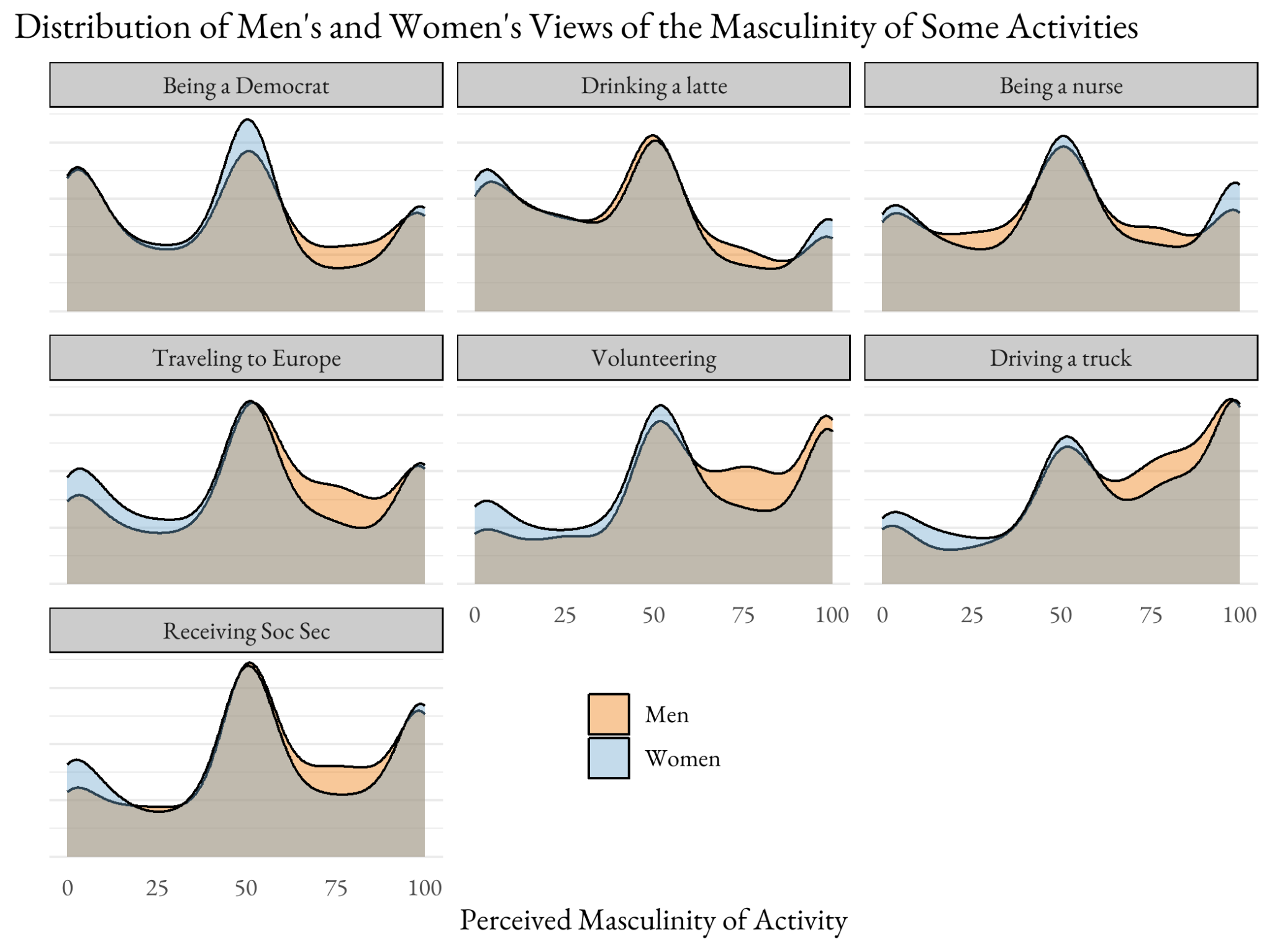
There are several activities that strike us as good things for anyone, male or female. Volunteering is a public good that often brings high personal rewards. Travel to Europe can be the trip of a lifetime. Receiving Social Security is a helpful, if limited, support that greatly reduces poverty among the elderly. With that framing, it makes sense that men and women would code their masculinity differently – men see those activities as leaning masculine, while women see them as leaning not masculine, which likely accords with their own gendered trait assessment.
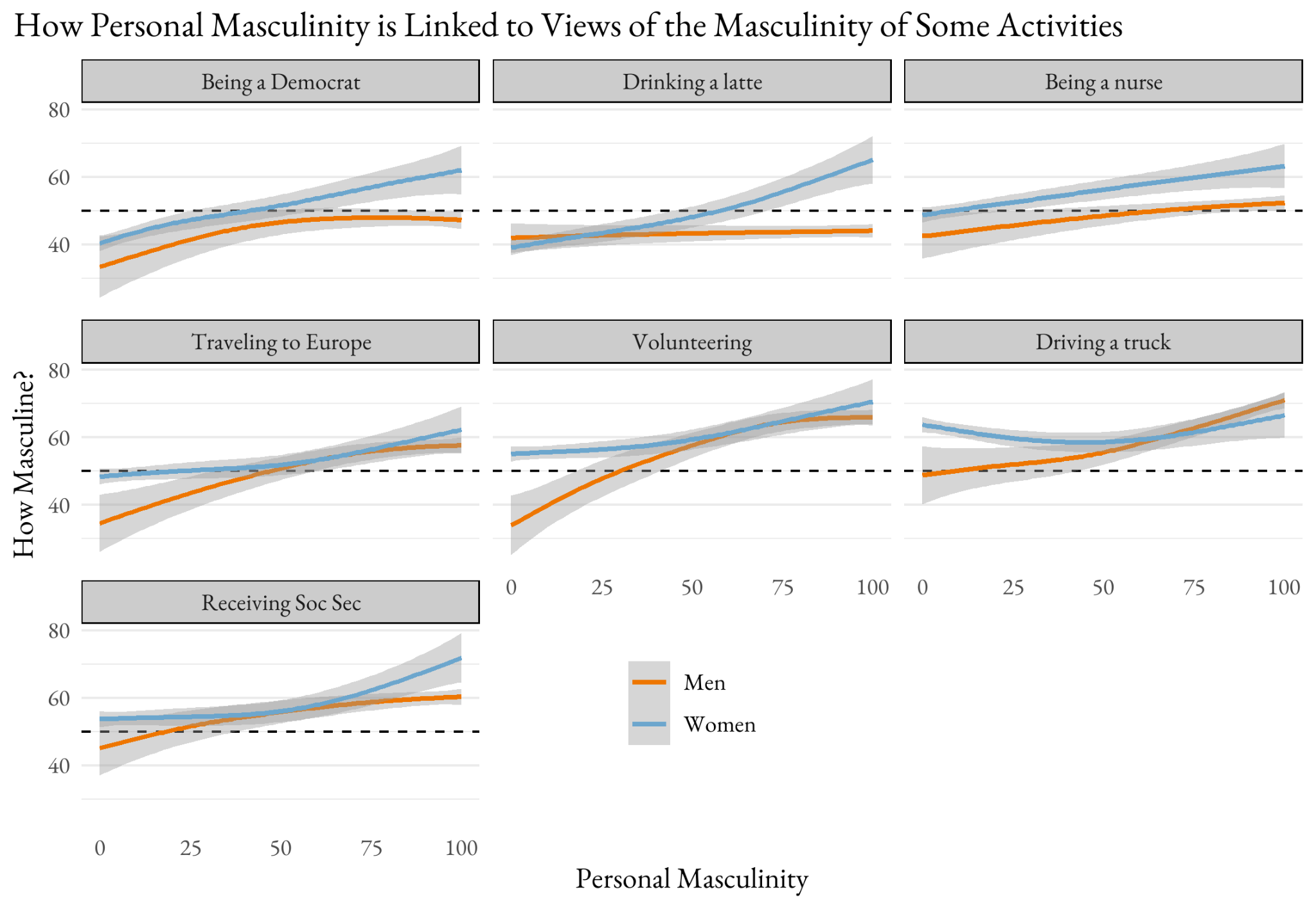
We can check that out explicitly because we regularly ask how masculine and feminine survey respondents feel. In the figure below, we show how personal masculinity (x axis) is linked to the perceived masculinity of each activity (y axis) for men and women (colors). By and large, more personal masculinity is linked to perceived masculinity of the activity for both men and women. There are exceptions – men just don’t see drinking lattes as masculine, no matter their personal masculinity. Similarly, women see truck driving as masculine almost regardless of their own masculinity. Still, in most cases, people are mapping their personal masculinity onto these activities.
While personal gendered traits can be important (such as identifying as masculine), just what those labels are attached to is unclear. What do masculine people do? What are they interested in? What should they wear? What should they say? The answers to these questions can shift through time and space, with answers depending on different worldviews. One such worldview is complementarianism. Born of a reaction against the push for gender equality in conservative Christian churches, complementarianism suggests that while men and women are equal before God, they have tightly parsed roles to play in society. For men, those roles include provision, leadership, and discipline, while for women they entail keeping a home, raising a family, and being led.
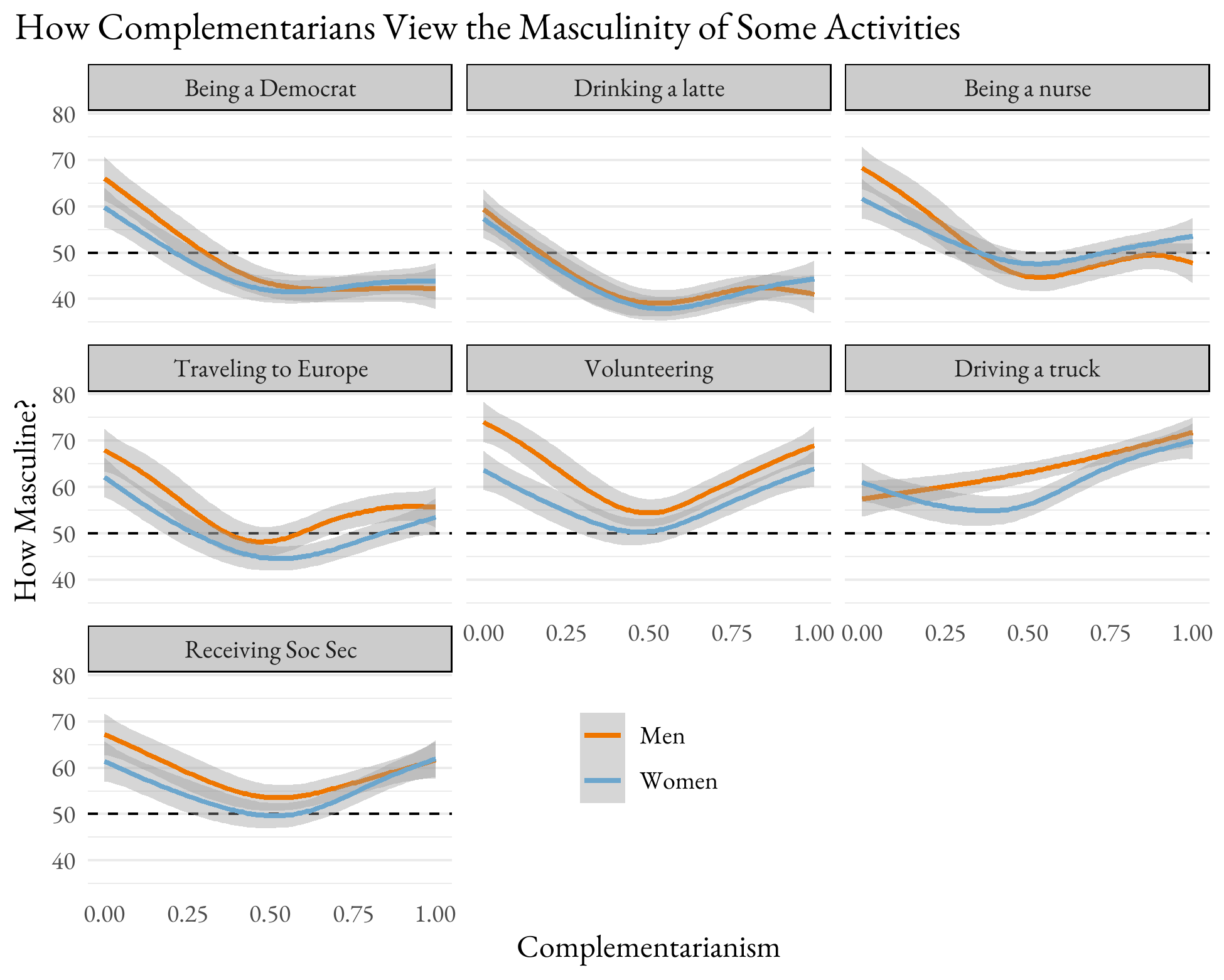
We expect complementarian men and women to substantially agree on what’s masculine. And we expect that complementarians will have considerably different viewpoints compared to non-complementarians. The figure below shows just this – complementarians are quite different in their assignment of masculinity in the top row of panels in the graph (+1) – they see being a Democrat, being a nurse, traveling to Europe, and drinking a latte as less masculine. The final three show a bit of a different pattern. Both high and low complementarians see volunteering as more masculine and it’s those in the middle who differ; the same goes for Social Security. Trucks are masculine and complementarians reaffirm that sense. We also don’t see significant differences between men and women. Instead, once they adopt a gender worldview (in this case, complementarianism), the gender worldview defines masculinity. Both men and women adopt that understanding.
It is abundantly clear that there is no societal accord on what men (and women) should be doing in order to be considered masculine. Is that why when women drive trucks, they tend to have many bumper stickers advertising that fact? Instead, people award a gendered trait to activities they would like to do. For instance, traveling to Europe can be assigned masculine if you are masculine, which may make it feel more comfortable to do. But we did find some evidence of a set of ideas active in American society (i.e., complementarianism) that does appear to set masculine standards. That concentration helps explain why those who live in Trump states are more concerned with testosterone levels, why Republican politicians call their opponents “low T”, and also why men who do not have the requisite feelings of masculinity appear to compensate (blogpost) by advocating for more extreme, violent politics.
Paul A. Djupe directs the Data for Political Research program at Denison University, is an affiliated scholar with PRRI, the book series editor of Religious Engagement in Democratic Politics (Temple), and co-creator of religioninpublic.blog. Further information about his work can be found at his website and on Bluesky.
Brooklyn Walker is an Assistant Professor of Political Science at University of Tennessee-Knoxville. Learn more about her work on Twitter, Bluesky, or at her website.

