
By Paul A. Djupe, Brooklyn Walker, Anand E. Sokhey, Miles D. Williams, and Jacob R. Neiheisel
Christian nationalism has taken the academic social science world by storm. This body of research has consistently found that Christian nationalism puts pressure on democratic institutions and norms in the US. There are hundreds of articles and books that typically investigate the correlations of the worldview with public policy support, views toward other groups, and orientations toward democratic government. None of it suggests that Christian nationalism is an ally of a diverse democracy.
With so much at stake, it is curious that there are so few attempts to examine the measurement of the concept. In the three articles with such an intention, all of them use the Baylor Religion Survey (BRS) measure (from 2007) that Andrew Whitehead and Sam Perry use. They come to varying conclusions by using different methods and assumptions. If other papers address this at all, they tend to cite Nick Davis’ thoughtful and persuasive article in Politics and Religion, which finds that the BRS combination of 6 measures is not capturing a unified concept. At the same time, PRRI has created their own index of 5 measures, some of which resemble Whitehead and Perry’s. Reviewers consistently push us on measurement, one memorably referring to our BRS-based Christian nationalism measure as ‘garbage’. In the midst of this maelstrom, what are social scientists of religion and politics to do?
We decided to wade into this research because 1) we had access to a much wider range of datasets including the BRS measures stretching across years and 2) we decided to ask an expanded range of questions beyond the BRS that we thought captured Christian nationalism. Are there reasons to opt for the PRRI measure compared to the BRS measure? Or does it even matter which combination of items we use?
In a new article just published in Politics & Religion (open access), we sought to bring new and actionable evidence to address those questions. Our analysis had three components.
First, we checked the factor structure of 10 datasets ranging from 2007 to 2024. Several are surveys fielded by Baylor, but most of them were conducted by some subset of this blog post’s authors. They all included BRS measures, though beginning in 2023, our surveys altered the wording of several items to make them exclusively Christian[see end note 1]. Our factor analysis of those 10 datasets indicated that the BRS scale is consistently capturing a unified concept with two exceptions. The statement “The federal govt should enforce strict separation of church and state” did not load with the other variables. And the 2007 BRS data has a different factor structure that aligns with Nick Davis’s conclusions. Every other dataset had essentially the same factor structure (see Table 1 on p7 of the article) that suggested the BRS is a sound measure (whether with our updated language or not).
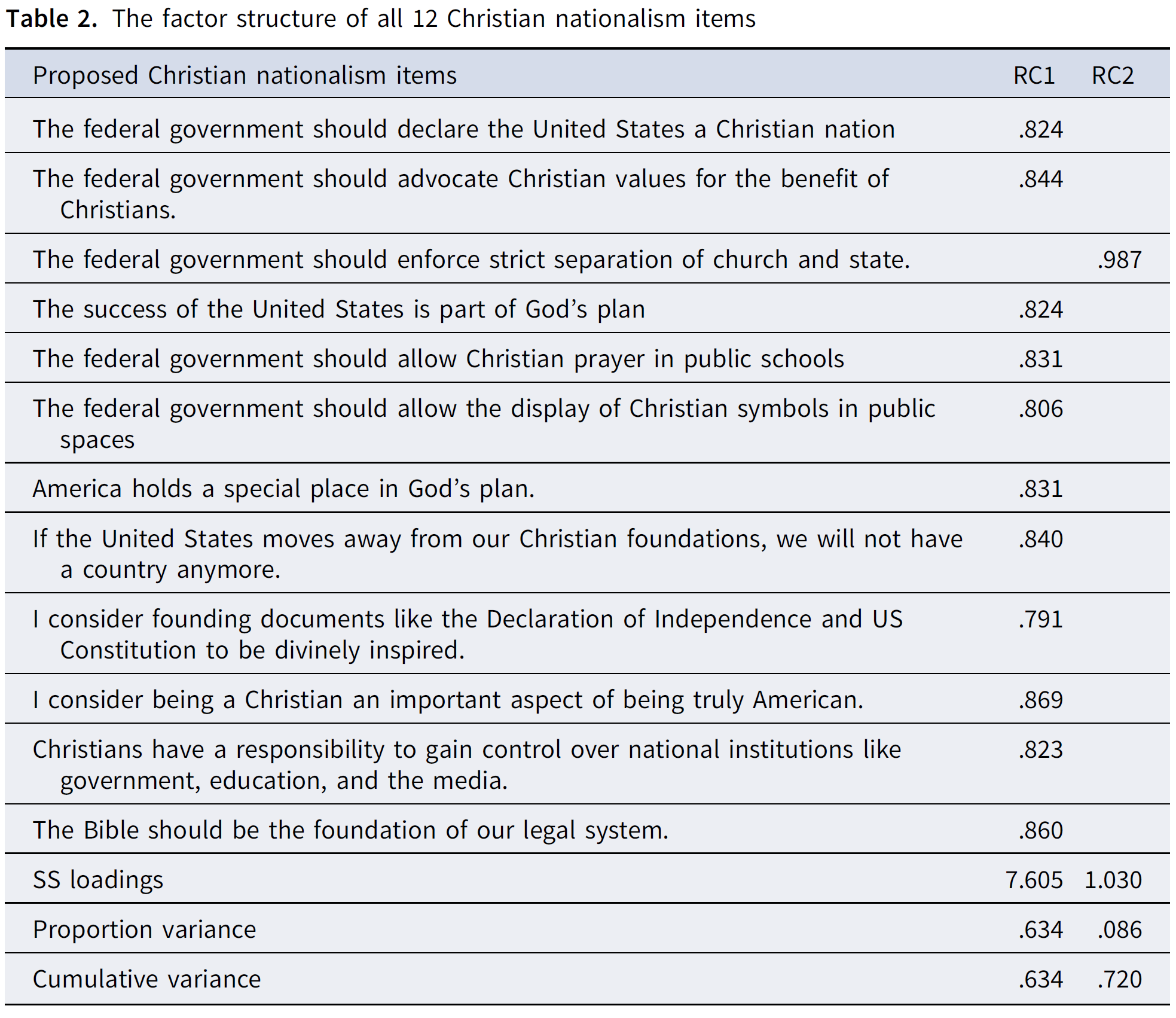
Second, we added six more questions to the mix drawing on PRRI’s items (or close facsimiles). Table 2 below shows the items included as well as their factor structure. ALL of the items load on the same factor with the exception, yet again, of the separation of church and state measure.
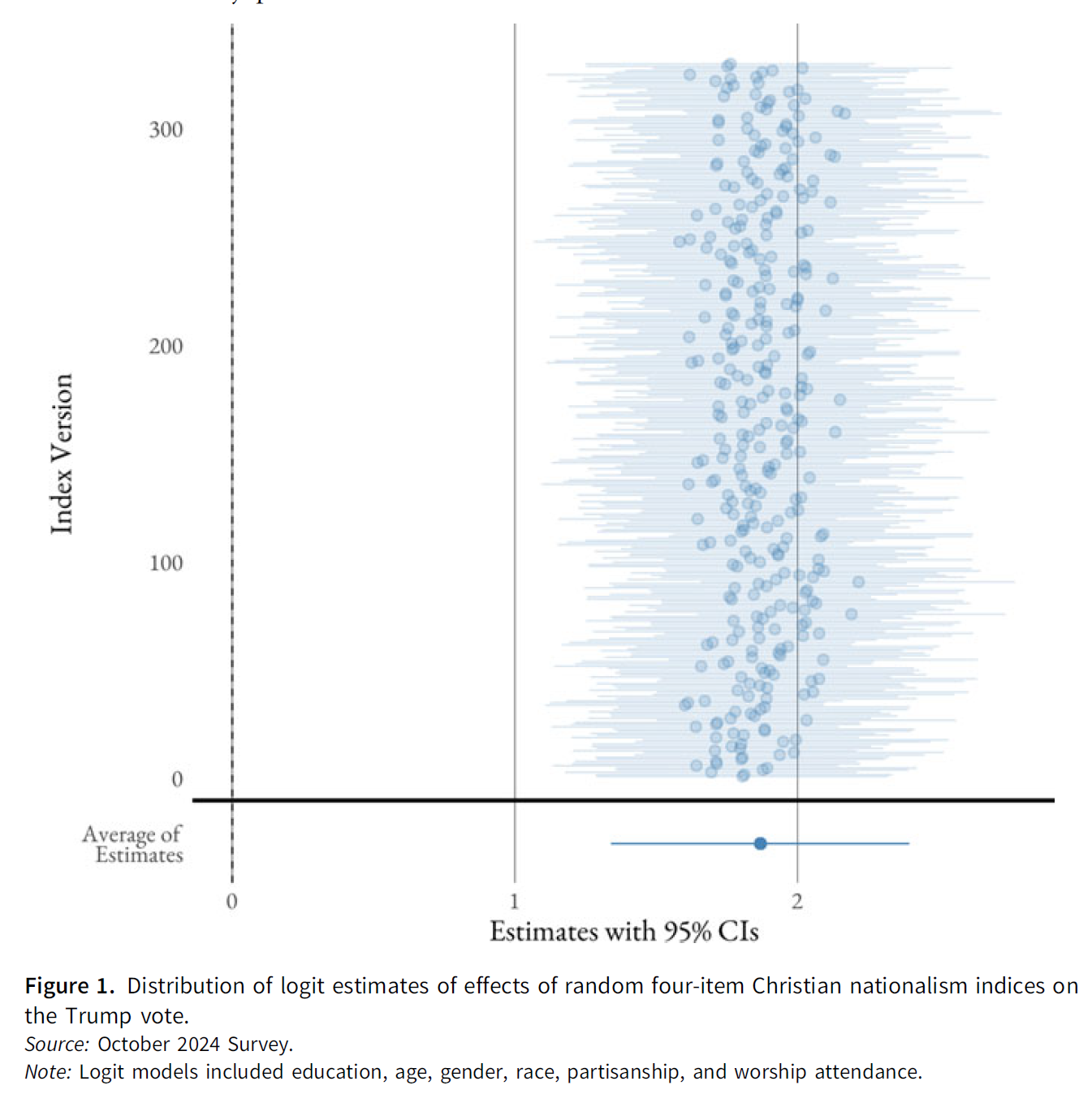
That evidence suggests we could use any or all of those measures to capture a common concept, but we sought additional, practical evidence to verify our perception. So, third, we tested the relationship of all combinations of 4 items from the list of 11 (leaving out the separation question) with two dependent variables: support for Trump and an immigration attitude. Figure 1 below shows estimates of 330 different Christian nationalism indices on the Trump vote. While there is some variation in the size of the estimated relationship, none of them are distinguishable from each other. Put another way, it does not seem to matter which combination of four items researchers might pick. It does not have to be four items – more items from this list will tighten up the estimates, while picking fewer will give a noisier estimate (we included similar analyses using combinations of three items in the paper’s appendix). The immigration results (not shown) provide the same lesson.
As we ask in the conclusion, “How is it that we can ‘grab bag’ a functional scale?” We go on to argue: “it’s not as if researchers have put no thought into composing the measures used for their scales, even if it is true that the authors of the BRS 2007 items were not necessarily thinking of Christian nationalism
as it eventually emerged a la Whitehead and Perry (2020). From our perspective, the 11 items we examined capture concepts that fit into a reasonably well-structured definition. Christian nationalism is a worldview about how society and government are and should be composed for Christians to exercise dominion…[Therefore,] picking any measures that capture beliefs about the special, exclusive Christian character of the US, as well as aspirations that Christians should be in charge without constraint, should work equally well as a measure of Christian nationalism.”
Paul A. Djupe directs the Data for Political Research program at Denison University, is an affiliated scholar with PRRI, the book series editor of Religious Engagement in Democratic Politics (Temple), and co-creator of religioninpublic.blog. Further information about his work can be found at his website and on Bluesky.
Brooklyn Walker is an Assistant Professor of Political Science at University of Tennessee-Knoxville. Learn more about her work on Twitter, Bluesky, or at her website.
Anand Edward Sokhey is a professor of political science at the University of Colorado, where he directs the American Politics Research Lab and is a faculty fellow at the Institute of Behavioral Science. He studies political behavior and democratic functioning in the United States and is an associate editor at the Journal of Politics.
Miles Williams is a political scientist in the Data for Political Research program at Denison University. He writes a newsletter called Foreign Figures. You can learn more about his work on his website, LinkedIn, and Substack.
Jacob R. Neiheisel is an associate professor of political science at the University at Buffalo, SUNY and is coauthor of the forthcoming The Politics of the End: Apocalypticism in America (NYU Press).

