
By Brooklyn Walker and Paul A. Djupe
[Image credit: Photo taken by Kevin Mullinix, Sunday, November 17, 2024. Vintage Church, Lawrence, KS.]
While the term ‘Christian nationalism’ may be relatively new, its presence among the American public is not. Not only have major organizations like the Family Research Council and WallBuilders been actively promoting Christian nationalist ideas for decades, but recently Americans have been actively taking on and identifying with the label ‘Christian nationalist’. And that’s concerning because Christian nationalism is associated with stronger outgroup antipathy, especially towards racial, ethnic, sexual orientation, and gender identity minorities.
This past summer (2025), at their annual meeting, the Presbyterian Church (USA) released a set of FAQs and a liturgy confronting Christian nationalism. The PCUSA is not the first religious organization to attempt to educate and redirect American Christians–the Baptist Joint Committee has created an entire curriculum for parishioners on Christian nationalism. These resources tend to be organized around support of pluralism with a focus on principles of love of others and separation of church and state. We wondered if American Christians have adopted any of the principles advocated by anti-Christian nationalist elites, and whether those principles can inoculate American Christians from the intolerant effects of Christian nationalism.
In our research, just published in Politics & Religion, we inquired about that tension and found a profoundly important imbalance between the two.
In the study, to capture Christian nationalism and anti-Christian nationalism, we started by asking a common set of Christian nationalism questions, then a few others designed to determine support for ideas that run counter to Christian nationalism and provide support for religious pluralism (see Table 1).
Table 1 – Christian Nationalism and Anti-Christian Nationalism Item Wording | |
Christian nationalism | The federal government should declare the United States a Christian nation. The federal government should advocate Christian values for the benefit of Christians. The success of the United States is part of God’s plan. The federal government should allow Christian prayer in public schools. The federal government should allow the display of Christian symbols in public spaces. |
Anti-Christian nationalism | The government should ensure religious freedom for all because Christians can be minorities in some communities. Nations should not favor one religion over another – the conditions that benefit one religion will benefit others. We need to advocate the Christian values of loving your neighbor as yourself and what we do to the least of these we do to God. |
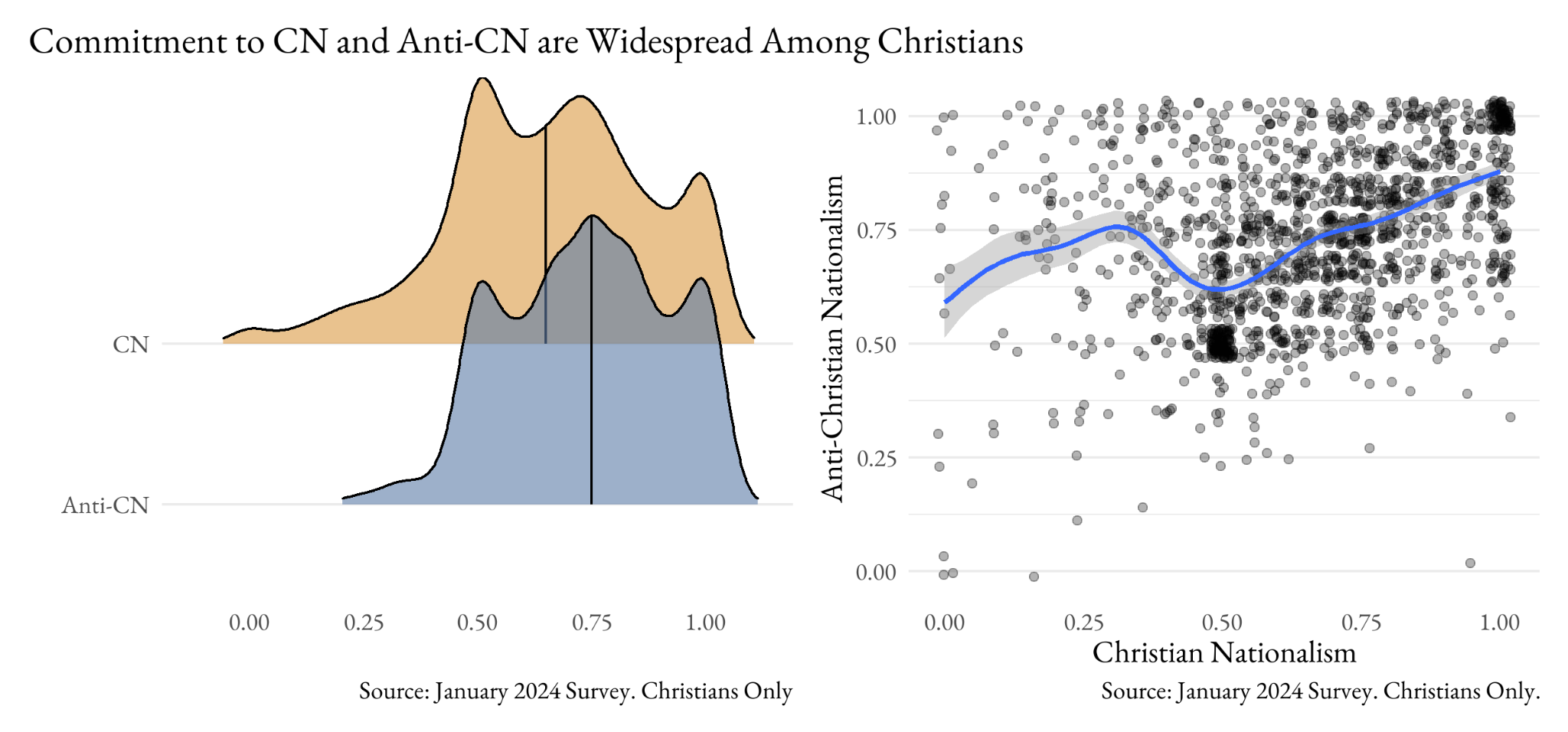
Though support for religious pluralism seems antithetical to Christian nationalism, many American Christians appear to disagree. That is, Christian nationalists are also adherents to anti-Christian nationalism. The correlation between the two is .36, affirming the positive relationship between the two. This can make sense – Christianity is multivocal. Christian texts and theology were developed by many authors in diverse contexts over millennia. So Christianity contains both elements that could be used to construct outgroup boundaries as well as elements that could diminish those boundaries. Perhaps it’s not that surprising from another perspective given the extent to which Christians in the US believe they are persecuted. Persecuted groups are exactly the ones we would expect to be supporters of religious pluralism, which ensures protection for religious minorities. And, as it turns out, threat plays a fundamentally important role in this story.
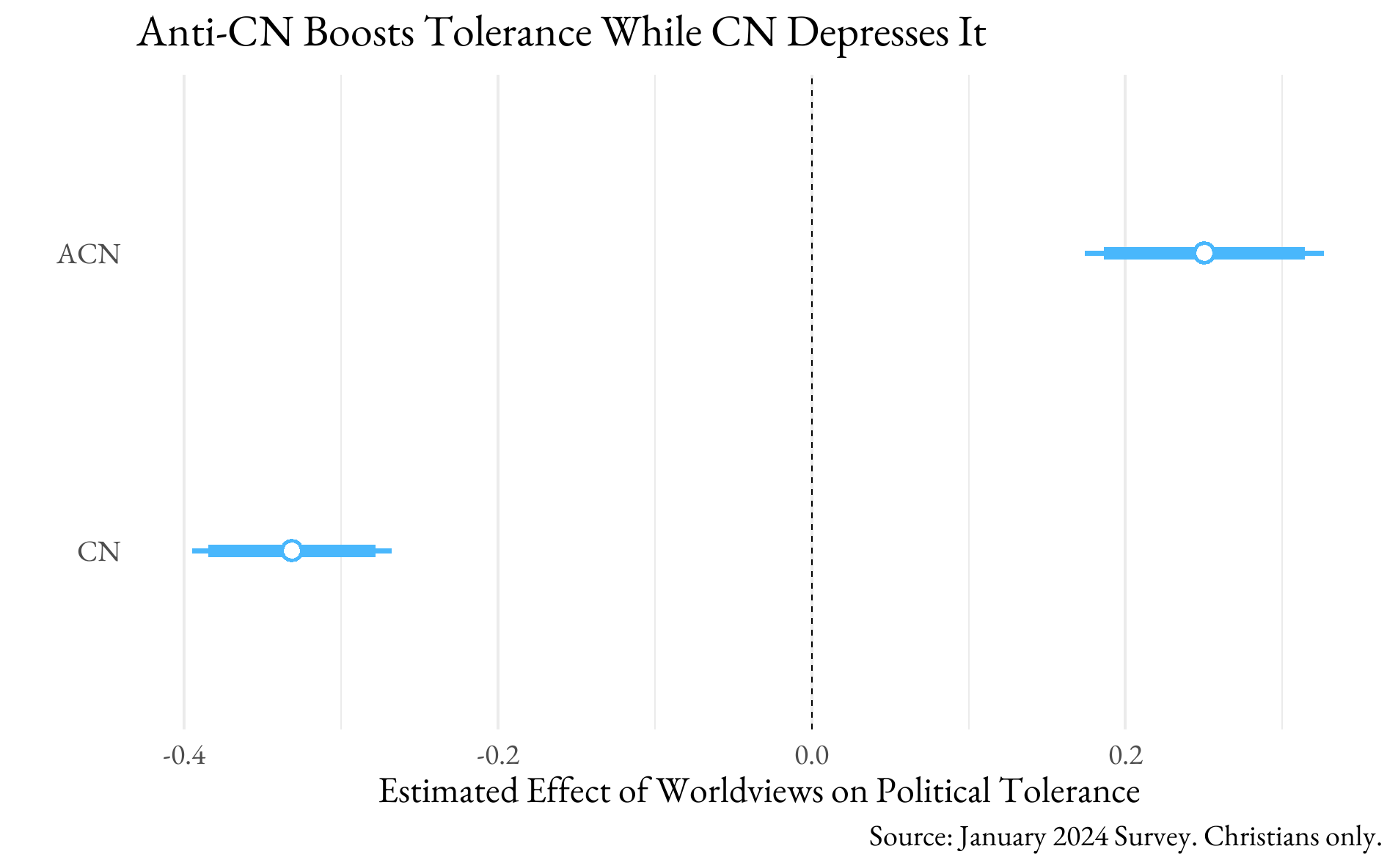
We used political tolerance as our barometer to assess the effectiveness of anti-Christian nationalist beliefs – extending equal rights to groups we don’t like (tolerance) lies at the core of stable democracies. In our first look, Christian nationalism and anti-Christian nationalism have the effects on tolerance that we’d expect. Christian nationalism is associated with decreased tolerance for a respondent’s least-liked group, and anti-Christian nationalism is associated with increased tolerance. So the intuition of the advocates of anti-Christian nationalism is right – in a vacuum, if people adopted anti-Christian nationalist ideas, we’d likely see more tolerance.
This seems like good news. But there are two caveats. First, as we just demonstrated, there is no vacuum and, instead, American Christians hold both Christian nationalist and anti-Christian nationalist ideas in their heads at the same time. And, second, the more they affirm anti-Christian nationalism, the more they affirm Christian nationalism. We need to assess the evidence in a way that allows people to hold these worldviews at the same time.

Image of Christian multivocality from X,
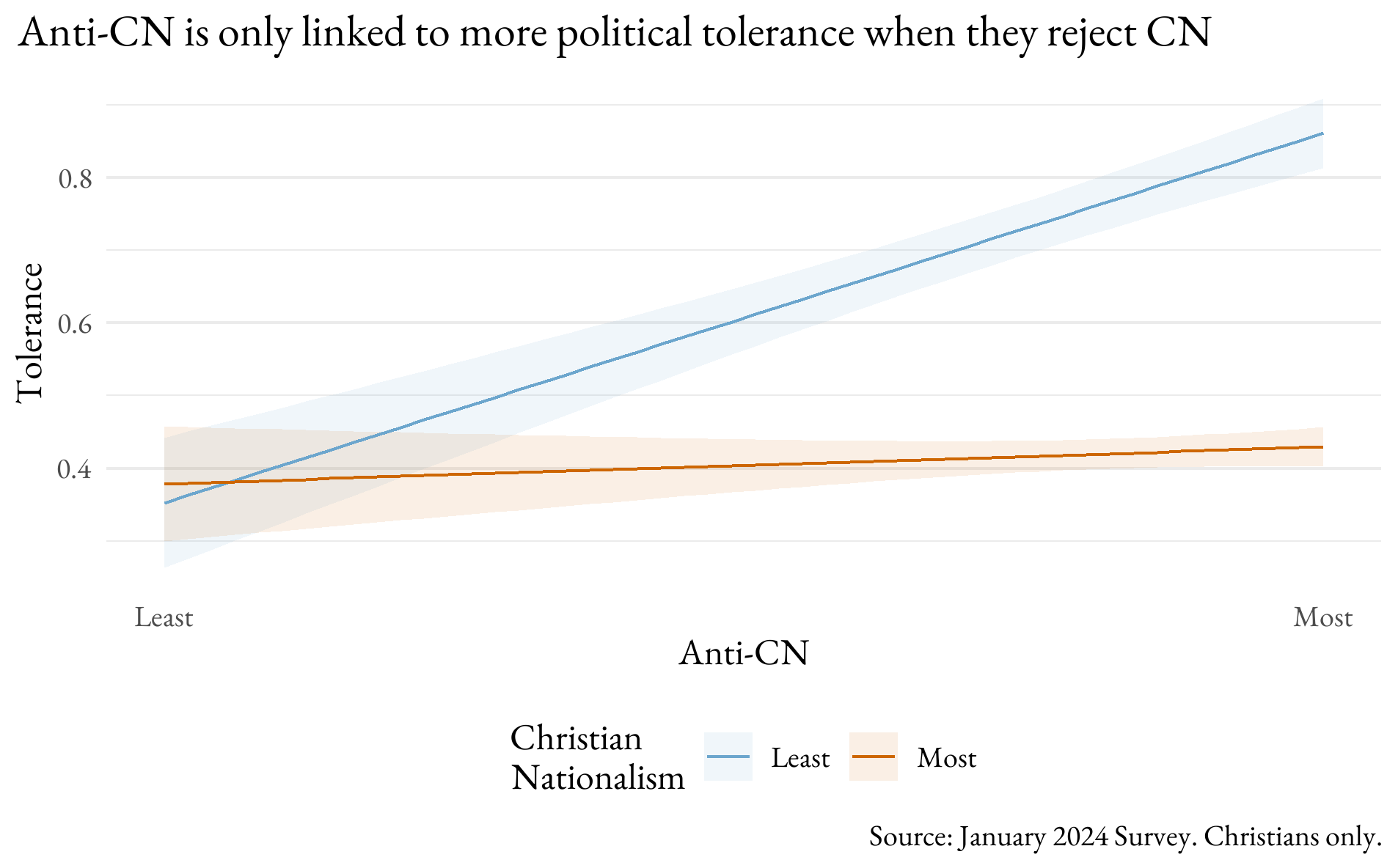
But when people hold both of these ideas at the same time, it’s Christian nationalism that wins out. Only people who don’t ascribe to Christian nationalism (red line in the graph below) see the pro-tolerance effects of anti-Christian nationalism. We’d argue that this is due to the threat environment. Many American Christians perceive that they are the target of anti-Christian persecution. In conditions of threat, ideologies and actions that deal with that threat are prioritized. Protecting yourself by asserting special protections and enhanced power for Christians (aka Christian nationalism) becomes paramount, relegating the power-abdicating anti-Christian nationalism ideas to the back pew.
Opponents of Christian nationalism are working with some plowed ground, and they are increasingly spreading the seeds of separation of church and state, religious tolerance, and the Golden Rule. But when elites conjure stormclouds that portend threats for Christians, the anti-Christian nationalism seeds are washed away, giving the seeds of Christian nationalism plenty of room to crowd out tolerance. Opponents of Christian nationalism, therefore, need to take on Christian persecution beliefs head-on.
Brooklyn Walker is Assistant Professor of Political Science at the University of Tennessee-Knoxville. Learn more about her work on Twitter, Bluesky, or at her website.
Paul A. Djupe directs the Data for Political Research program at Denison University, is an affiliated scholar with PRRI, the book series editor of Religious Engagement in Democratic Politics (Temple), and co-creator of religioninpublic.blog. Further information about his work can be found at his website and on Bluesky.
 Religion in Public
[like] R. Brown reacted to your message: ________________________________
LikeLike